

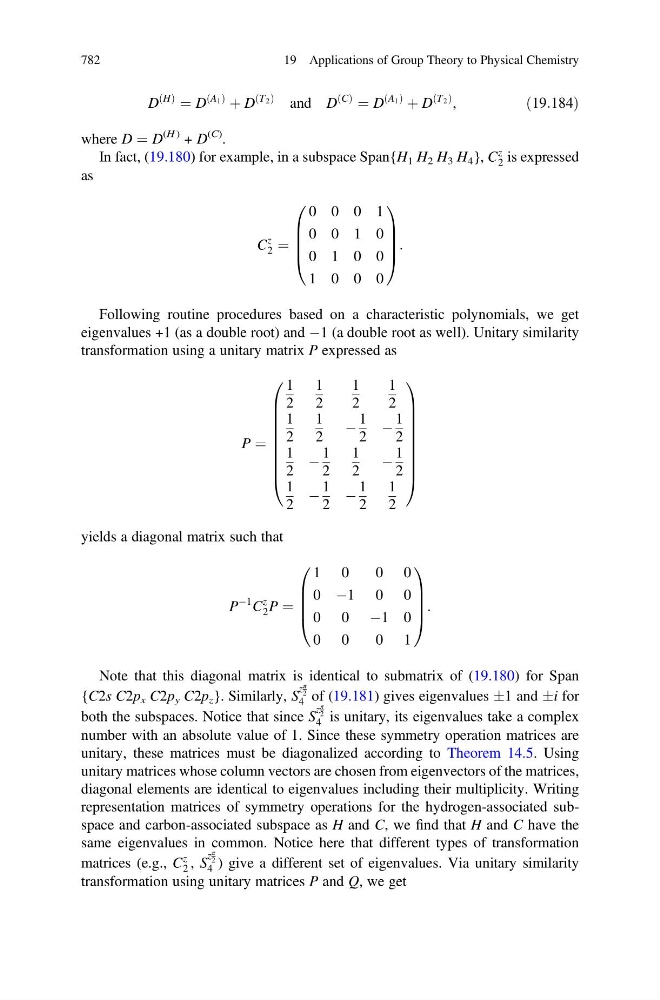
D
H
ð Þ
¼ D
A 1
ð Þ
þ D
T 2
ð Þ
and D
C
ð Þ
¼ D
A 1
ð Þ
þ D
T 2
ð Þ ,
ð19:184Þ
where D ¼ D
(H ) + D
(C) .
In fact, (19.180) for example, in a subspace Span{H 1 H 2 H 3 H 4 }, C
z
2 is expressed
as
C
z
2 ¼
0 0 0 1
0 0 1 0
0 1 0 0
1 0 0 0
0
B
B
B
@
1
C
C
C
A
:
Following routine procedures based on a characteristic polynomials, we get
eigenvalues +1 (as a double root) and À1 (a double root as well). Unitary similarity
transformation using a unitary matrix P expressed as
P ¼
1
2
1
2
1
2
1
2
1
2
1
2
À
1
2
À
1
2
1
2
À
1
2
1
2
À
1
2
1
2
À
1
2
À
1
2
1
2
0
B
B
B
B
B
B
B
B
@
1
C
C
C
C
C
C
C
C
A
yields a diagonal matrix such that
P
À1 C
z
2 P ¼
1 0
0 0
0 À1 0 0
0 0 À1 0
0 0
0 1
0
B
B
B
@
1
C
C
C
A
:
Note that this diagonal matrix is identical to submatrix of (19.180) for Span
{C2s C2p x C2p y C2p z }. Similarly, S
z
π
2
4 of (19.181) gives eigenvalues Æ1 and Æi for
both the subspaces. Notice that since S
z
π
2
4 is unitary, its eigenvalues take a complex
number with an absolute value of 1. Since these symmetry operation matrices are
unitary, these matrices must be diagonalized according to Theorem 14.5. Using
unitary matrices whose column vectors are chosen from eigenvectors of the matrices,
diagonal elements are identical to eigenvalues including their multiplicity. Writing
representation matrices of symmetry operations for the hydrogen-associated subspace and carbon-associated subspace as H and C, we find that H and C have the
same eigenvalues in common. Notice here that different types of transformation
matrices (e.g., C
z
2 , S
z
π
2
4 ) give a different set of eigenvalues. Via unitary similarity
transformation using unitary matrices P and Q, we get
782
19 Applications of Group Theory to Physical Chemistry