

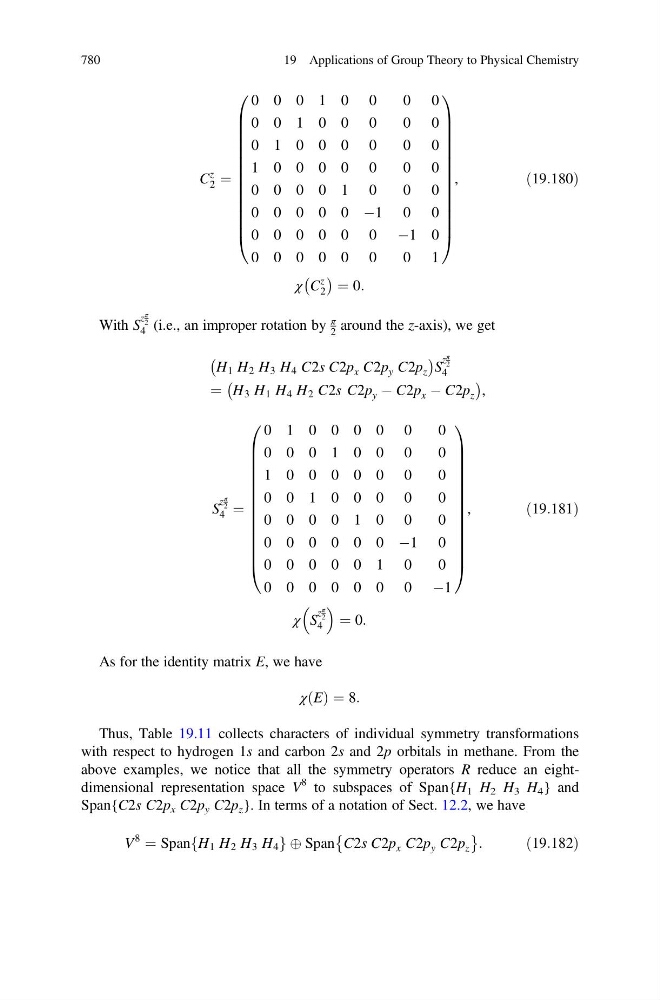
C
z
2 ¼
0 0 0 1 0 0
0 0
0 0 1 0 0 0
0 0
0 1 0 0 0 0
0 0
1 0 0 0 0 0
0 0
0 0 0 0 1 0
0 0
0 0 0 0 0 À1 0 0
0 0 0 0 0 0 À1 0
0 0 0 0 0 0
0 1
0
B
B
B
B
B
B
B
B
B
B
B
B
B
@
1
C
C
C
C
C
C
C
C
C
C
C
C
C
A
,
ð19:180Þ
χ C
z
2
À Á ¼ 0:
With S
z
π
2
4 (i.e., an improper rotation by
π
2 around the z-axis), we get
H 1 H 2 H 3 H 4 C2s C2p x C2p y C2p z
À
Á
S
z
π
2
4
¼ H 3 H 1 H 4 H 2 C2s C2p y À C2p x À C2p z
À
Á
,
S
z
π
2
4 ¼
0 1 0 0 0 0 0
0
0 0 0 1 0 0 0
0
1 0 0 0 0 0 0
0
0 0 1 0 0 0 0
0
0 0 0 0 1 0 0
0
0 0 0 0 0 0 À1 0
0 0 0 0 0 1 0
0
0 0 0 0 0 0 0 À1
0
B
B
B
B
B
B
B
B
B
B
B
B
B
@
1
C
C
C
C
C
C
C
C
C
C
C
C
C
A
,
ð19:181Þ
χ S
z
π
2
4
¼ 0:
As for the identity matrix E, we have
χ E
ð Þ ¼ 8:
Thus, Table 19.11 collects characters of individual symmetry transformations
with respect to hydrogen 1s and carbon 2s and 2p orbitals in methane. From the
above examples, we notice that all the symmetry operators R reduce an eightdimensional representation space V
8 to subspaces of Span{H 1 H 2 H 3 H 4 } and
Span{C2s C2p x C2p y C2p z }. In terms of a notation of Sect. 12.2, we have
V
8
¼ Span H 1 H 2 H 3 H 4
f
g È Span C2s C2p x C2p y C2p z
È
É :
ð19:182Þ
780
19 Applications of Group Theory to Physical Chemistry
z
2 ¼
0 0 0 1 0 0
0 0
0 0 1 0 0 0
0 0
0 1 0 0 0 0
0 0
1 0 0 0 0 0
0 0
0 0 0 0 1 0
0 0
0 0 0 0 0 À1 0 0
0 0 0 0 0 0 À1 0
0 0 0 0 0 0
0 1
0
B
B
B
B
B
B
B
B
B
B
B
B
B
@
1
C
C
C
C
C
C
C
C
C
C
C
C
C
A
,
ð19:180Þ
χ C
z
2
À Á ¼ 0:
With S
z
π
2
4 (i.e., an improper rotation by
π
2 around the z-axis), we get
H 1 H 2 H 3 H 4 C2s C2p x C2p y C2p z
À
Á
S
z
π
2
4
¼ H 3 H 1 H 4 H 2 C2s C2p y À C2p x À C2p z
À
Á
,
S
z
π
2
4 ¼
0 1 0 0 0 0 0
0
0 0 0 1 0 0 0
0
1 0 0 0 0 0 0
0
0 0 1 0 0 0 0
0
0 0 0 0 1 0 0
0
0 0 0 0 0 0 À1 0
0 0 0 0 0 1 0
0
0 0 0 0 0 0 0 À1
0
B
B
B
B
B
B
B
B
B
B
B
B
B
@
1
C
C
C
C
C
C
C
C
C
C
C
C
C
A
,
ð19:181Þ
χ S
z
π
2
4
¼ 0:
As for the identity matrix E, we have
χ E
ð Þ ¼ 8:
Thus, Table 19.11 collects characters of individual symmetry transformations
with respect to hydrogen 1s and carbon 2s and 2p orbitals in methane. From the
above examples, we notice that all the symmetry operators R reduce an eightdimensional representation space V
8 to subspaces of Span{H 1 H 2 H 3 H 4 } and
Span{C2s C2p x C2p y C2p z }. In terms of a notation of Sect. 12.2, we have
V
8
¼ Span H 1 H 2 H 3 H 4
f
g È Span C2s C2p x C2p y C2p z
È
É :
ð19:182Þ
780
19 Applications of Group Theory to Physical Chemistry