

Ψ 2 ¼
j ξ 2 i
j ξ 2
j j j
¼
ϕ 1 À ϕ 2
ffiffiffiffiffiffiffiffiffiffiffiffiffiffiffiffiffi
2 1 À S
ð
Þ
p
:
ð19:105Þ
Note that both normalized MOs and energy eigenvalues depend upon whether we
ignore an overlap integral, as being the case with the simplest Hückel approximation.
Nonetheless, MO functional forms (in this case either ϕ 1 + ϕ 2 or ϕ 1 À ϕ 2 ) remain the
same regardless of the approximation levels about the overlap integral. Regarding
quantitative evaluation of α, β, and S, we will briefly mention it later.
Once we have decided symmetry of MO (or an irreducible representation which
the orbital belongs to) and its energy eigenvalue, we will be in a position to examine
various physicochemical properties of the molecule. One of them is an optical
transition within a molecule, particularly electric dipole transition. In most cases,
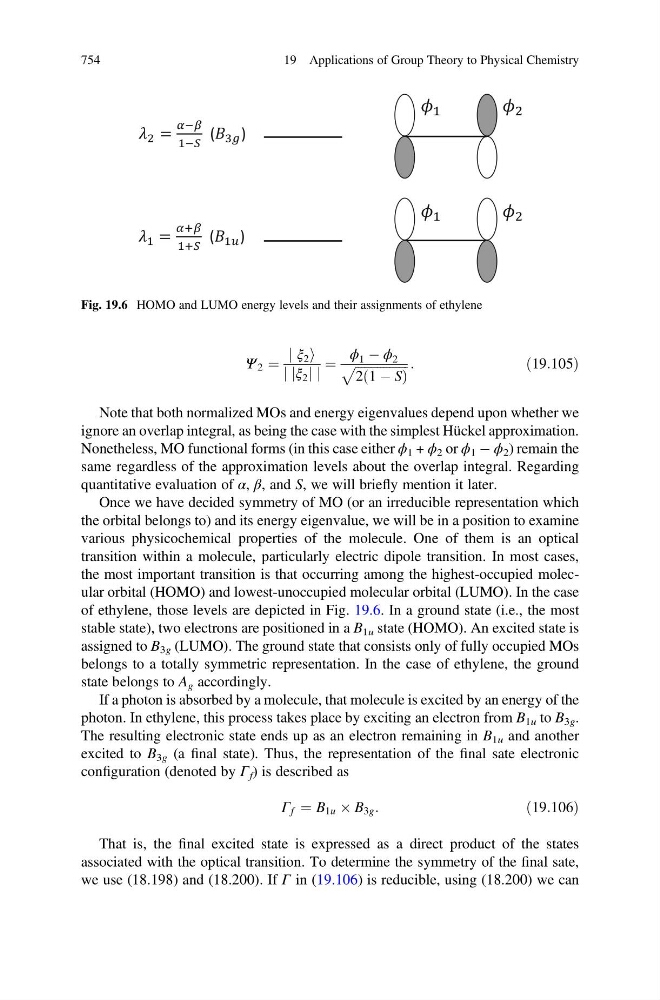
the most important transition is that occurring among the highest-occupied molecular orbital (HOMO) and lowest-unoccupied molecular orbital (LUMO). In the case
of ethylene, those levels are depicted in Fig. 19.6. In a ground state (i.e., the most
stable state), two electrons are positioned in a B 1u state (HOMO). An excited state is
assigned to B 3g (LUMO). The ground state that consists only of fully occupied MOs
belongs to a totally symmetric representation. In the case of ethylene, the ground
state belongs to A g accordingly.
If a photon is absorbed by a molecule, that molecule is excited by an energy of the
photon. In ethylene, this process takes place by exciting an electron from B 1u to B 3g .
The resulting electronic state ends up as an electron remaining in B 1u and another
excited to B 3g (a final state). Thus, the representation of the final sate electronic
configuration (denoted by Γ f ) is described as
Γ f ¼ B 1u  B 3g :
ð19:106Þ
That is, the final excited state is expressed as a direct product of the states
associated with the optical transition. To determine the symmetry of the final sate,
we use (18.198) and (18.200). If Γ in (19.106) is reducible, using (18.200) we can
=
(
)
=
(
)
Fig. 19.6 HOMO and LUMO energy levels and their assignments of ethylene
754
19 Applications of Group Theory to Physical Chemistry