

¼
X
k
X
l
Ψ
Æ
kl
1
2
X
μ
X
ν
D
α
ð Þ
kμ g
ð ÞD
α
ð Þ
lν g
ð ÞÆD
α
ð Þ
lμ g
ð ÞD
α
ð Þ
kν g
ð Þ
h
i
D
α
ð Þ
μi g
0
ð ÞD
α
ð Þ
νj g
0
ð Þ
n
o
¼
X
k
X
l
Ψ
Æ
kl
(
1
2
X
μ
X
ν
D
αÂα
ð
Þ g
ð Þ
i
kl,μν Æ
h
h
D
αÂα
ð
Þ g
ð Þ
i
lk,μν
n
o
D
α
ð Þ
μi g
0
ð ÞD
α
ð Þ
νj g
0
ð Þ,
ð18:209Þ
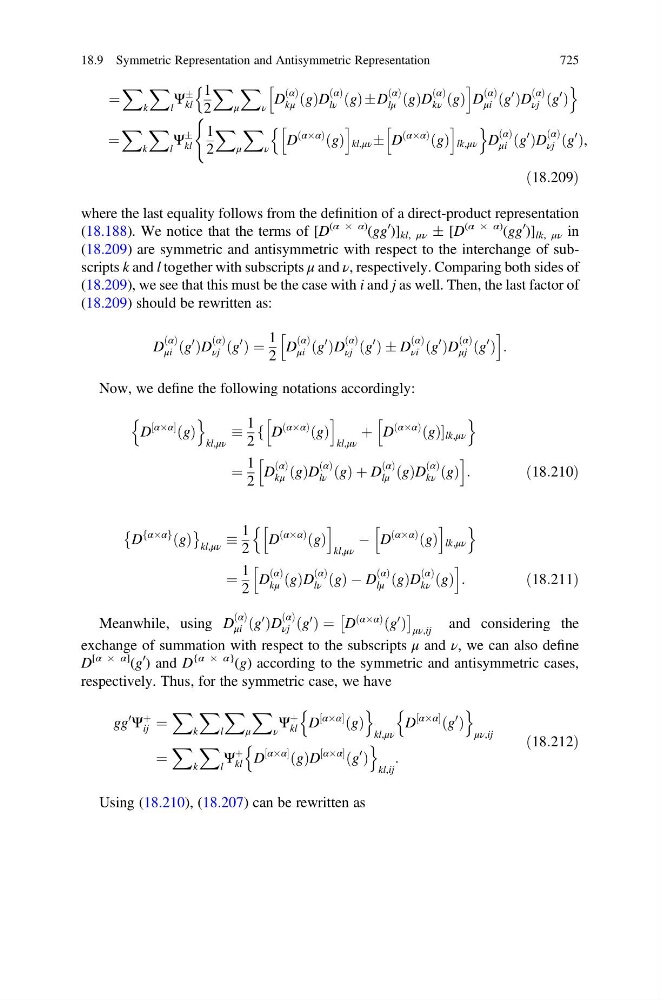
where the last equality follows from the definition of a direct-product representation
(18.188). We notice that the terms of [D
(α Â α)
(gg
0 )] kl, μν Æ [D
(α Â α) (gg
0
)] lk, μν in
(18.209) are symmetric and antisymmetric with respect to the interchange of subscripts k and l together with subscripts μ and ν, respectively. Comparing both sides of
(18.209), we see that this must be the case with i and j as well. Then, the last factor of
(18.209) should be rewritten as:
D
α
ð Þ
μi g
0
ð ÞD
α
ð Þ
νj g
0
ð Þ ¼
1
2
D
α
ð Þ
μi g
0
ð ÞD
α
ð Þ
νj g
0
ð Þ Æ D
α
ð Þ
νi g
0
ð ÞD
α
ð Þ
μj g
0
ð Þ
h
i
:
Now, we define the following notations accordingly:
D
αÂα
½
g
ð Þ
n
o
kl,μν
1
2
f D
αÂα
ð
Þ g
ð Þ
h
i
kl,μν
þ D
αÂα
ð
Þ g
ð Þ lk,μν
h
o
¼
1
2
D
α
ð Þ
kμ g
ð ÞD
α
ð Þ
lν g
ð Þ þ D
α
ð Þ
lμ g
ð ÞD
α
ð Þ
kν g
ð Þ
h
i
:
ð18:210Þ
D
αÂα
f
g g
ð Þ
È
É
kl,μν
1
2
n
D
αÂα
ð
Þ g
ð Þ
h
i
kl,μν
À D
αÂα
ð
Þ g
ð Þ
i
lk,μν
h
o
¼
1
2
D
α
ð Þ
kμ g
ð ÞD
α
ð Þ
lν g
ð Þ À D
α
ð Þ
lμ g
ð ÞD
α
ð Þ
kν g
ð Þ
h
i
:
ð18:211Þ
Meanwhile, using D
α
ð Þ
μi g
0
ð ÞD
α
ð Þ
νj g
0
ð Þ ¼ D
αÂα
ð
Þ g
0
ð Þ
Â
Ã
μν,ij
and considering the
exchange of summation with respect to the subscripts μ and ν, we can also define
D
[α Â α] (g
0
) and D
{α Â α} (g) according to the symmetric and antisymmetric cases,
respectively. Thus, for the symmetric case, we have
gg
0
Ψ
þ
ij ¼
X
k
X
l
X
μ
X
ν
Ψ
þ
kl D
αÂα
½
g
ð Þ
n
o
kl,μν
D
αÂα
½
g
0
ð Þ
n
o
μν,ij
¼
X
k
X
l
Ψ
þ
kl D
αÂα
½
g
ð ÞD
αÂα
½
g
0
ð Þ
n
o
kl,ij
:
ð18:212Þ
Using (18.210), (18.207) can be rewritten as
18.9 Symmetric Representation and Antisymmetric Representation
725
X
k
X
l
Ψ
Æ
kl
1
2
X
μ
X
ν
D
α
ð Þ
kμ g
ð ÞD
α
ð Þ
lν g
ð ÞÆD
α
ð Þ
lμ g
ð ÞD
α
ð Þ
kν g
ð Þ
h
i
D
α
ð Þ
μi g
0
ð ÞD
α
ð Þ
νj g
0
ð Þ
n
o
¼
X
k
X
l
Ψ
Æ
kl
(
1
2
X
μ
X
ν
D
αÂα
ð
Þ g
ð Þ
i
kl,μν Æ
h
h
D
αÂα
ð
Þ g
ð Þ
i
lk,μν
n
o
D
α
ð Þ
μi g
0
ð ÞD
α
ð Þ
νj g
0
ð Þ,
ð18:209Þ
where the last equality follows from the definition of a direct-product representation
(18.188). We notice that the terms of [D
(α Â α)
(gg
0 )] kl, μν Æ [D
(α Â α) (gg
0
)] lk, μν in
(18.209) are symmetric and antisymmetric with respect to the interchange of subscripts k and l together with subscripts μ and ν, respectively. Comparing both sides of
(18.209), we see that this must be the case with i and j as well. Then, the last factor of
(18.209) should be rewritten as:
D
α
ð Þ
μi g
0
ð ÞD
α
ð Þ
νj g
0
ð Þ ¼
1
2
D
α
ð Þ
μi g
0
ð ÞD
α
ð Þ
νj g
0
ð Þ Æ D
α
ð Þ
νi g
0
ð ÞD
α
ð Þ
μj g
0
ð Þ
h
i
:
Now, we define the following notations accordingly:
D
αÂα
½
g
ð Þ
n
o
kl,μν
1
2
f D
αÂα
ð
Þ g
ð Þ
h
i
kl,μν
þ D
αÂα
ð
Þ g
ð Þ lk,μν
h
o
¼
1
2
D
α
ð Þ
kμ g
ð ÞD
α
ð Þ
lν g
ð Þ þ D
α
ð Þ
lμ g
ð ÞD
α
ð Þ
kν g
ð Þ
h
i
:
ð18:210Þ
D
αÂα
f
g g
ð Þ
È
É
kl,μν
1
2
n
D
αÂα
ð
Þ g
ð Þ
h
i
kl,μν
À D
αÂα
ð
Þ g
ð Þ
i
lk,μν
h
o
¼
1
2
D
α
ð Þ
kμ g
ð ÞD
α
ð Þ
lν g
ð Þ À D
α
ð Þ
lμ g
ð ÞD
α
ð Þ
kν g
ð Þ
h
i
:
ð18:211Þ
Meanwhile, using D
α
ð Þ
μi g
0
ð ÞD
α
ð Þ
νj g
0
ð Þ ¼ D
αÂα
ð
Þ g
0
ð Þ
Â
Ã
μν,ij
and considering the
exchange of summation with respect to the subscripts μ and ν, we can also define
D
[α Â α] (g
0
) and D
{α Â α} (g) according to the symmetric and antisymmetric cases,
respectively. Thus, for the symmetric case, we have
gg
0
Ψ
þ
ij ¼
X
k
X
l
X
μ
X
ν
Ψ
þ
kl D
αÂα
½
g
ð Þ
n
o
kl,μν
D
αÂα
½
g
0
ð Þ
n
o
μν,ij
¼
X
k
X
l
Ψ
þ
kl D
αÂα
½
g
ð ÞD
αÂα
½
g
0
ð Þ
n
o
kl,ij
:
ð18:212Þ
Using (18.210), (18.207) can be rewritten as
18.9 Symmetric Representation and Antisymmetric Representation
725