

P
β
ð Þ P
α
ð Þ
¼
d β
n
d α
n
X
g
X
k,i,j
D
β
ð Þ g
ð Þ
i
Ã
kk
h
h
D
α
ð Þ g
ð Þ ji
X
g 0 D
α
ð Þ g
0
ð Þ
h
i Ã
ji
g
0
¼
d β
n
d α
n
X
k,i,j
n
d β
δ αβ δ kj δ ki
X
g 0 D
α
ð Þ g
0
ð Þ
h
i Ã
ji
g
0
¼
d α
n
X
k
X
g 0 D
α
ð Þ g
0
ð Þ
h
i Ã
kk
g
0
¼ δ αβ
d α
n
X
g 0 χ
α
ð Þ g
0
ð Þ
h
i Ã
g
0
¼ δ αβ P
α
ð Þ
:
ð18:180Þ
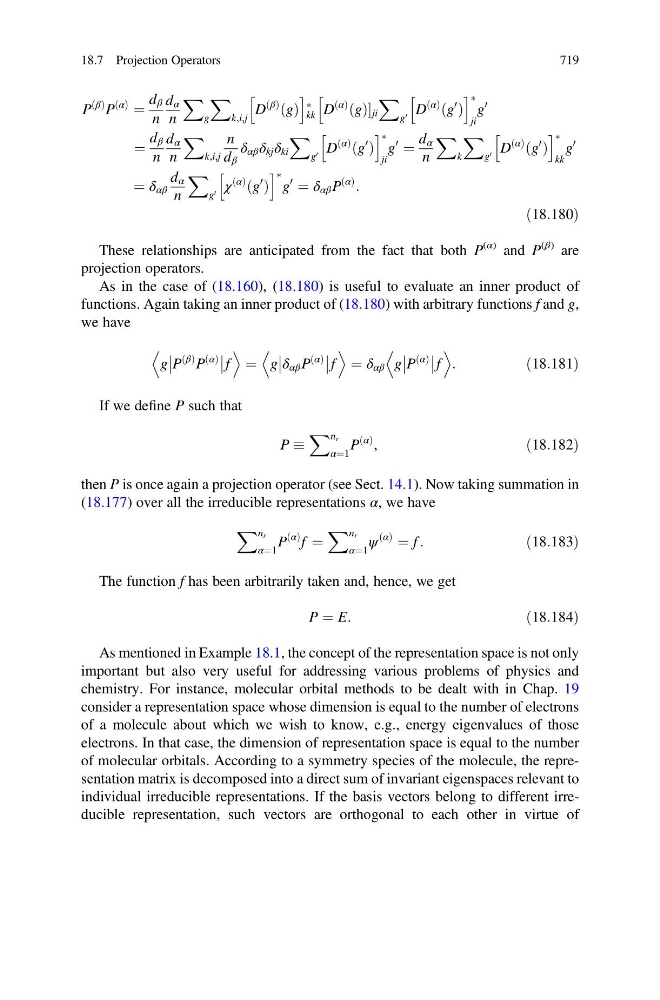
These relationships are anticipated from the fact that both P
(α) and P
(β) are
projection operators.
As in the case of (18.160), (18.180) is useful to evaluate an inner product of
functions. Again taking an inner product of (18.180) with arbitrary functions f and g,
we have
g P
β
ð Þ P
α
ð Þ
f
D
E
¼ g δ αβ P
α
ð Þ
f
D
E
¼ δ αβ g P
α
ð Þ
f
D
E
:
ð18:181Þ
If we define P such that
P
X n r
α¼1
P
α
ð Þ ,
ð18:182Þ
then P is once again a projection operator (see Sect. 14.1). Now taking summation in
(18.177) over all the irreducible representations α, we have
X n r
α¼1
P
α
ð Þ f ¼
X n r
α¼1
ψ
α
ð Þ
¼ f :
ð18:183Þ
The function f has been arbitrarily taken and, hence, we get
P ¼ E:
ð18:184Þ
As mentioned in Example 18.1, the concept of the representation space is not only
important but also very useful for addressing various problems of physics and
chemistry. For instance, molecular orbital methods to be dealt with in Chap. 19
consider a representation space whose dimension is equal to the number of electrons
of a molecule about which we wish to know, e.g., energy eigenvalues of those
electrons. In that case, the dimension of representation space is equal to the number
of molecular orbitals. According to a symmetry species of the molecule, the representation matrix is decomposed into a direct sum of invariant eigenspaces relevant to
individual irreducible representations. If the basis vectors belong to different irreducible representation, such vectors are orthogonal to each other in virtue of
18.7 Projection Operators
719
β
ð Þ P
α
ð Þ
¼
d β
n
d α
n
X
g
X
k,i,j
D
β
ð Þ g
ð Þ
i
Ã
kk
h
h
D
α
ð Þ g
ð Þ ji
X
g 0 D
α
ð Þ g
0
ð Þ
h
i Ã
ji
g
0
¼
d β
n
d α
n
X
k,i,j
n
d β
δ αβ δ kj δ ki
X
g 0 D
α
ð Þ g
0
ð Þ
h
i Ã
ji
g
0
¼
d α
n
X
k
X
g 0 D
α
ð Þ g
0
ð Þ
h
i Ã
kk
g
0
¼ δ αβ
d α
n
X
g 0 χ
α
ð Þ g
0
ð Þ
h
i Ã
g
0
¼ δ αβ P
α
ð Þ
:
ð18:180Þ
These relationships are anticipated from the fact that both P
(α) and P
(β) are
projection operators.
As in the case of (18.160), (18.180) is useful to evaluate an inner product of
functions. Again taking an inner product of (18.180) with arbitrary functions f and g,
we have
g P
β
ð Þ P
α
ð Þ
f
D
E
¼ g δ αβ P
α
ð Þ
f
D
E
¼ δ αβ g P
α
ð Þ
f
D
E
:
ð18:181Þ
If we define P such that
P
X n r
α¼1
P
α
ð Þ ,
ð18:182Þ
then P is once again a projection operator (see Sect. 14.1). Now taking summation in
(18.177) over all the irreducible representations α, we have
X n r
α¼1
P
α
ð Þ f ¼
X n r
α¼1
ψ
α
ð Þ
¼ f :
ð18:183Þ
The function f has been arbitrarily taken and, hence, we get
P ¼ E:
ð18:184Þ
As mentioned in Example 18.1, the concept of the representation space is not only
important but also very useful for addressing various problems of physics and
chemistry. For instance, molecular orbital methods to be dealt with in Chap. 19
consider a representation space whose dimension is equal to the number of electrons
of a molecule about which we wish to know, e.g., energy eigenvalues of those
electrons. In that case, the dimension of representation space is equal to the number
of molecular orbitals. According to a symmetry species of the molecule, the representation matrix is decomposed into a direct sum of invariant eigenspaces relevant to
individual irreducible representations. If the basis vectors belong to different irreducible representation, such vectors are orthogonal to each other in virtue of
18.7 Projection Operators
719