

h P
α
ð Þ
l l
ð Þ P
β
ð Þ
s s
ð Þ
f
D
E
¼ d
α
ð Þ
l ϕ
α
ð Þ
l
c
β
ð Þ
s ψ
β
ð Þ
s
D
E
¼ d
α
ð Þ
l
h
i Ã
c
β
ð Þ
s
ϕ
α
ð Þ
l
ψ
β
ð Þ
s
D
E
ð18:170Þ
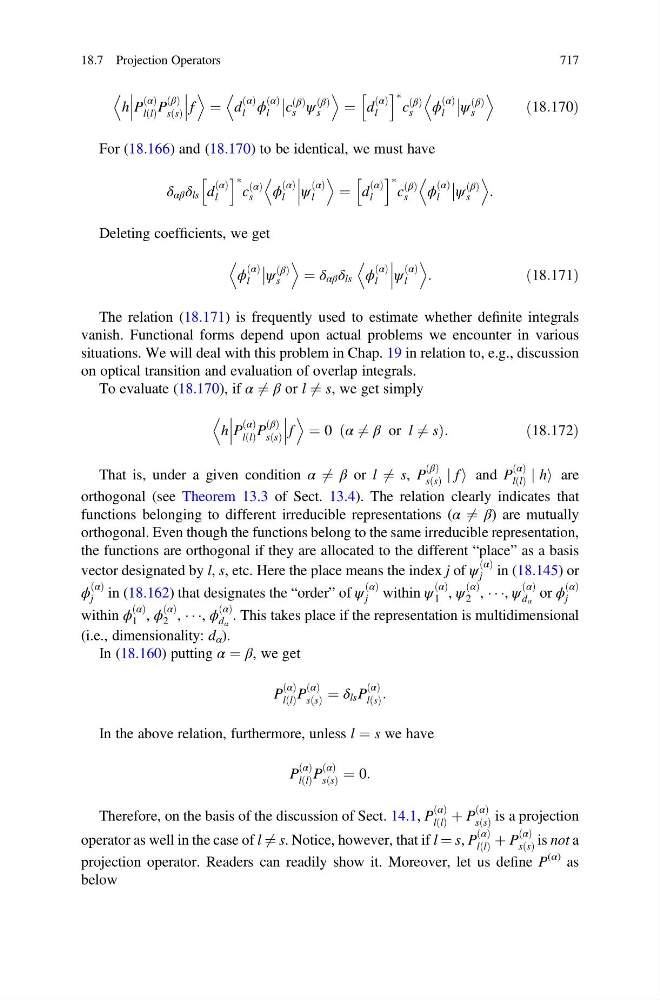
For (18.166) and (18.170) to be identical, we must have
δ αβ δ ls d
α
ð Þ
l
h
i Ã
c
α
ð Þ
s
ϕ
α
ð Þ
l
ψ
α
ð Þ
l
D
E
¼ d
α
ð Þ
l
h
i Ã
c
β
ð Þ
s
ϕ
α
ð Þ
l
ψ
β
ð Þ
s
D
E
:
Deleting coefficients, we get
ϕ
α
ð Þ
l
ψ
β
ð Þ
s
D
E
¼ δ αβ δ ls ϕ
α
ð Þ
l
ψ
α
ð Þ
l
D
E
:
ð18:171Þ
The relation (18.171) is frequently used to estimate whether definite integrals
vanish. Functional forms depend upon actual problems we encounter in various
situations. We will deal with this problem in Chap. 19 in relation to, e.g., discussion
on optical transition and evaluation of overlap integrals.
To evaluate (18.170), if α 6 ¼ β or l 6 ¼ s, we get simply
h P
α
ð Þ
l l
ð Þ P
β
ð Þ
s s
ð Þ
f
D
E
¼ 0 α 6 ¼ β or l 6 ¼ s
ð
Þ :
ð18:172Þ
That is, under a given condition α 6 ¼ β or l 6 ¼ s, P
β
ð Þ
s s
ð Þ j f i and P
α
ð Þ
l l
ð Þ j hi are
orthogonal (see Theorem 13.3 of Sect. 13.4). The relation clearly indicates that
functions belonging to different irreducible representations (α 6 ¼ β) are mutually
orthogonal. Even though the functions belong to the same irreducible representation,
the functions are orthogonal if they are allocated to the different “place” as a basis
vector designated by l, s, etc. Here the place means the index j of ψ
α
ð Þ
j in (18.145) or
ϕ
α
ð Þ
j in (18.162) that designates the “order” of ψ
α
ð Þ
j within ψ
α
ð Þ
1 , ψ
α
ð Þ
2 , Á Á Á, ψ
α
ð Þ
d α
or ϕ
α
ð Þ
j
within ϕ
α
ð Þ
1 , ϕ
α
ð Þ
2 , Á Á Á, ϕ
α
ð Þ
d α
. This takes place if the representation is multidimensional
(i.e., dimensionality: d α ).
In (18.160) putting α ¼ β, we get
P
α
ð Þ
l l
ð Þ P
α
ð Þ
s s
ð Þ ¼ δ ls P
α
ð Þ
l s
ð Þ :
In the above relation, furthermore, unless l ¼ s we have
P
α
ð Þ
l l
ð Þ P
α
ð Þ
s s
ð Þ ¼ 0:
Therefore, on the basis of the discussion of Sect. 14.1, P
α
ð Þ
l l
ð Þ þ P
α
ð Þ
s s
ð Þ is a projection
operator as well in the case of l 6 ¼ s. Notice, however, that if l ¼ s, P
α
ð Þ
l l
ð Þ þ P
α
ð Þ
s s
ð Þ is not a
projection operator. Readers can readily show it. Moreover, let us define P
(α) as
below
18.7 Projection Operators
717
α
ð Þ
l l
ð Þ P
β
ð Þ
s s
ð Þ
f
D
E
¼ d
α
ð Þ
l ϕ
α
ð Þ
l
c
β
ð Þ
s ψ
β
ð Þ
s
D
E
¼ d
α
ð Þ
l
h
i Ã
c
β
ð Þ
s
ϕ
α
ð Þ
l
ψ
β
ð Þ
s
D
E
ð18:170Þ
For (18.166) and (18.170) to be identical, we must have
δ αβ δ ls d
α
ð Þ
l
h
i Ã
c
α
ð Þ
s
ϕ
α
ð Þ
l
ψ
α
ð Þ
l
D
E
¼ d
α
ð Þ
l
h
i Ã
c
β
ð Þ
s
ϕ
α
ð Þ
l
ψ
β
ð Þ
s
D
E
:
Deleting coefficients, we get
ϕ
α
ð Þ
l
ψ
β
ð Þ
s
D
E
¼ δ αβ δ ls ϕ
α
ð Þ
l
ψ
α
ð Þ
l
D
E
:
ð18:171Þ
The relation (18.171) is frequently used to estimate whether definite integrals
vanish. Functional forms depend upon actual problems we encounter in various
situations. We will deal with this problem in Chap. 19 in relation to, e.g., discussion
on optical transition and evaluation of overlap integrals.
To evaluate (18.170), if α 6 ¼ β or l 6 ¼ s, we get simply
h P
α
ð Þ
l l
ð Þ P
β
ð Þ
s s
ð Þ
f
D
E
¼ 0 α 6 ¼ β or l 6 ¼ s
ð
Þ :
ð18:172Þ
That is, under a given condition α 6 ¼ β or l 6 ¼ s, P
β
ð Þ
s s
ð Þ j f i and P
α
ð Þ
l l
ð Þ j hi are
orthogonal (see Theorem 13.3 of Sect. 13.4). The relation clearly indicates that
functions belonging to different irreducible representations (α 6 ¼ β) are mutually
orthogonal. Even though the functions belong to the same irreducible representation,
the functions are orthogonal if they are allocated to the different “place” as a basis
vector designated by l, s, etc. Here the place means the index j of ψ
α
ð Þ
j in (18.145) or
ϕ
α
ð Þ
j in (18.162) that designates the “order” of ψ
α
ð Þ
j within ψ
α
ð Þ
1 , ψ
α
ð Þ
2 , Á Á Á, ψ
α
ð Þ
d α
or ϕ
α
ð Þ
j
within ϕ
α
ð Þ
1 , ϕ
α
ð Þ
2 , Á Á Á, ϕ
α
ð Þ
d α
. This takes place if the representation is multidimensional
(i.e., dimensionality: d α ).
In (18.160) putting α ¼ β, we get
P
α
ð Þ
l l
ð Þ P
α
ð Þ
s s
ð Þ ¼ δ ls P
α
ð Þ
l s
ð Þ :
In the above relation, furthermore, unless l ¼ s we have
P
α
ð Þ
l l
ð Þ P
α
ð Þ
s s
ð Þ ¼ 0:
Therefore, on the basis of the discussion of Sect. 14.1, P
α
ð Þ
l l
ð Þ þ P
α
ð Þ
s s
ð Þ is a projection
operator as well in the case of l 6 ¼ s. Notice, however, that if l ¼ s, P
α
ð Þ
l l
ð Þ þ P
α
ð Þ
s s
ð Þ is not a
projection operator. Readers can readily show it. Moreover, let us define P
(α) as
below
18.7 Projection Operators
717