

Viewing individual components in S as coordinates of a n c -dimensional vector,
(18.78) can be considered as an inner product as expressed using (complex) coordinates of the two vectors. At the same time, (18.78) represents an orthogonal
relationship between the vectors. Since we can obtain at most n c mutually orthogonal
(i.e., linearly independent) vectors in a n c -dimensional space, for the number (n r ) of
such vectors we have
n r n c :
ð18:141Þ
Here n r is equal to the number of different α, i.e., the number of irreducible
representations.
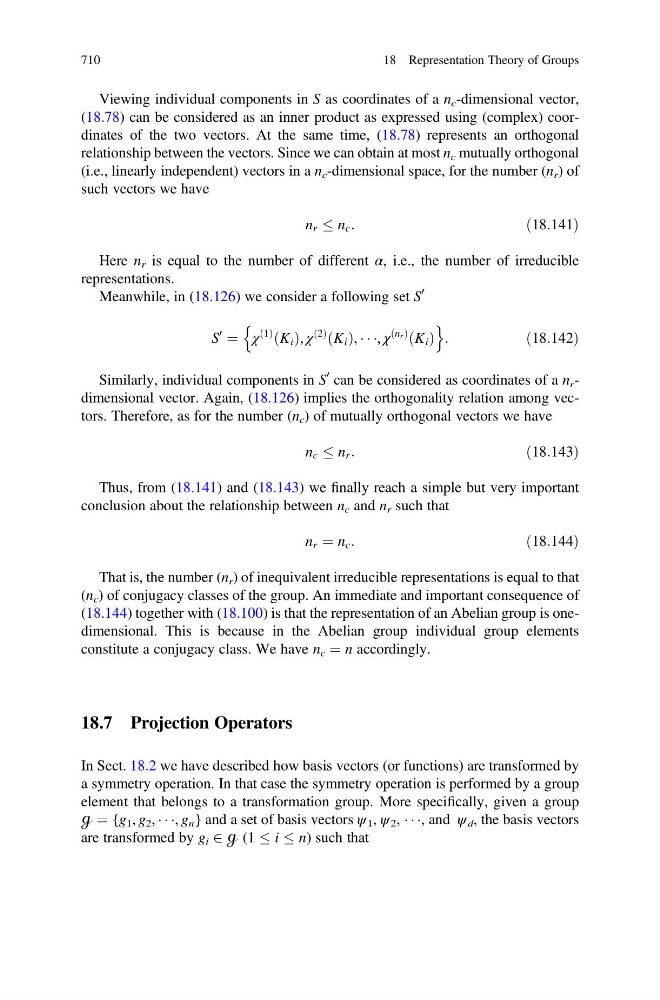
Meanwhile, in (18.126) we consider a following set S
0
S
0
¼ χ
1
ð Þ K i
ð Þ, χ
2
ð Þ K i
ð Þ, Á Á Á, χ
n r
ð Þ K i
ð Þ
n
o
:
ð18:142Þ
Similarly, individual components in S
0 can be considered as coordinates of a n r -
dimensional vector. Again, (18.126) implies the orthogonality relation among vectors. Therefore, as for the number (n c ) of mutually orthogonal vectors we have
n c n r :
ð18:143Þ
Thus, from (18.141) and (18.143) we finally reach a simple but very important
conclusion about the relationship between n c and n r such that
n r ¼ n c :
ð18:144Þ
That is, the number (n r ) of inequivalent irreducible representations is equal to that
(n c ) of conjugacy classes of the group. An immediate and important consequence of
(18.144) together with (18.100) is that the representation of an Abelian group is onedimensional. This is because in the Abelian group individual group elements
constitute a conjugacy class. We have n c ¼ n accordingly.
18.7 Projection Operators
In Sect. 18.2 we have described how basis vectors (or functions) are transformed by
a symmetry operation. In that case the symmetry operation is performed by a group
element that belongs to a transformation group. More specifically, given a group
ℊ ¼ {g 1 , g 2 , Á Á Á, g n } and a set of basis vectors ψ 1 , ψ 2 , Á Á Á, and ψ d , the basis vectors
are transformed by g i 2 ℊ (1 i n) such that
710
18 Representation Theory of Groups