

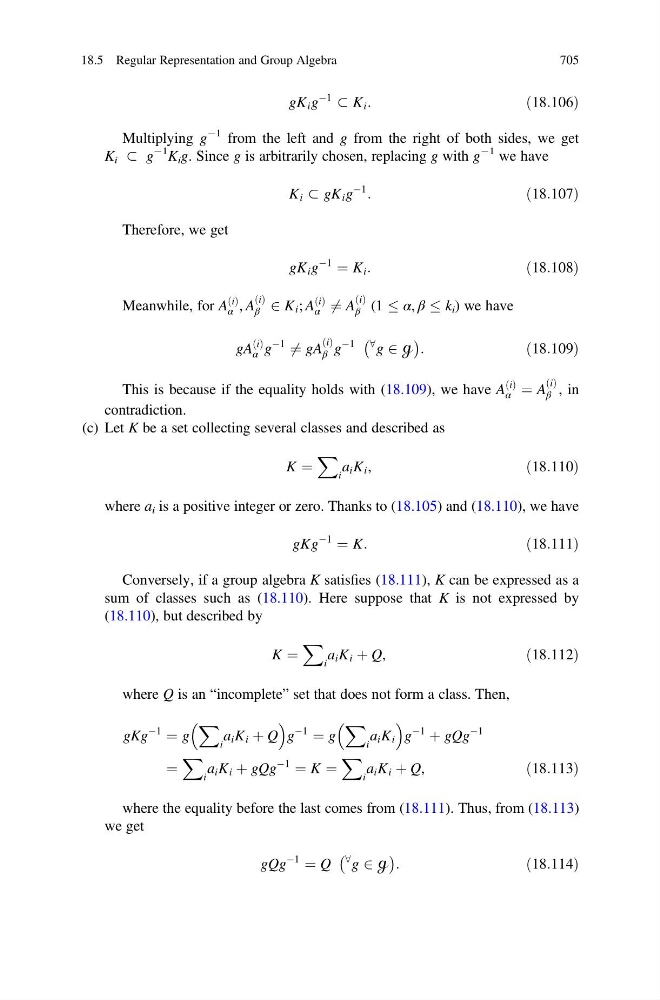
gK i g
À1
⊂ K i :
ð18:106Þ
Multiplying g
À1 from the left and g from the right of both sides, we get
K i ⊂ g
À1 K i g. Since g is arbitrarily chosen, replacing g with g
À1 we have
K i ⊂ gK i g
À1
:
ð18:107Þ
Therefore, we get
gK i g
À1
¼ K i :
ð18:108Þ
Meanwhile, for A
i
ð Þ
α , A
i
ð Þ
β 2 K i ; A
i
ð Þ
α 6 ¼ A
i
ð Þ
β (1 α, β k i ) we have
gA
i
ð Þ
α g
À1
6 ¼ gA
i
ð Þ
β g
À1 8 g 2 ℊ
À
Á :
ð18:109Þ
This is because if the equality holds with (18.109), we have A
i
ð Þ
α ¼ A
i
ð Þ
β , in
contradiction.
(c) Let K be a set collecting several classes and described as
K ¼
X
i
a i K i ,
ð18:110Þ
where a i is a positive integer or zero. Thanks to (18.105) and (18.110), we have
gKg
À1
¼ K:
ð18:111Þ
Conversely, if a group algebra K satisfies (18.111), K can be expressed as a
sum of classes such as (18.110). Here suppose that K is not expressed by
(18.110), but described by
K ¼
X
i
a i K i þ Q,
ð18:112Þ
where Q is an “incomplete” set that does not form a class. Then,
gKg
À1
¼ g
X
i
a i K i þ Q
g
À1
¼ g
X
i
a i K i
g
À1
þ gQg
À1
¼
X
i
a i K i þ gQg
À1
¼ K ¼
X
i
a i K i þ Q,
ð18:113Þ
where the equality before the last comes from (18.111). Thus, from (18.113)
we get
gQg
À1
¼ Q
8 g 2 ℊ
À
Á :
ð18:114Þ
18.5 Regular Representation and Group Algebra
705
À1
⊂ K i :
ð18:106Þ
Multiplying g
À1 from the left and g from the right of both sides, we get
K i ⊂ g
À1 K i g. Since g is arbitrarily chosen, replacing g with g
À1 we have
K i ⊂ gK i g
À1
:
ð18:107Þ
Therefore, we get
gK i g
À1
¼ K i :
ð18:108Þ
Meanwhile, for A
i
ð Þ
α , A
i
ð Þ
β 2 K i ; A
i
ð Þ
α 6 ¼ A
i
ð Þ
β (1 α, β k i ) we have
gA
i
ð Þ
α g
À1
6 ¼ gA
i
ð Þ
β g
À1 8 g 2 ℊ
À
Á :
ð18:109Þ
This is because if the equality holds with (18.109), we have A
i
ð Þ
α ¼ A
i
ð Þ
β , in
contradiction.
(c) Let K be a set collecting several classes and described as
K ¼
X
i
a i K i ,
ð18:110Þ
where a i is a positive integer or zero. Thanks to (18.105) and (18.110), we have
gKg
À1
¼ K:
ð18:111Þ
Conversely, if a group algebra K satisfies (18.111), K can be expressed as a
sum of classes such as (18.110). Here suppose that K is not expressed by
(18.110), but described by
K ¼
X
i
a i K i þ Q,
ð18:112Þ
where Q is an “incomplete” set that does not form a class. Then,
gKg
À1
¼ g
X
i
a i K i þ Q
g
À1
¼ g
X
i
a i K i
g
À1
þ gQg
À1
¼
X
i
a i K i þ gQg
À1
¼ K ¼
X
i
a i K i þ Q,
ð18:113Þ
where the equality before the last comes from (18.111). Thus, from (18.113)
we get
gQg
À1
¼ Q
8 g 2 ℊ
À
Á :
ð18:114Þ
18.5 Regular Representation and Group Algebra
705