

Another characteristic of the regular representation is that the identity is
represented by an identity matrix. In this example, we have
D
R
ð Þ E
ð Þ ¼
1 0 0 0
0 1 0 0
0 0 1 0
0 0 0 1
0
B
B
B
@
1
C
C
C
A
:
ð18:93Þ
For the other symmetry operations, we have
D
R
ð Þ
σ v
ð Þ ¼
0 0 1 0
0 0 0 1
1 0 0 0
0 1 0 0
0
B
B
B
@
1
C
C
C
A
, D
R
ð Þ
σ v 0
ð Þ ¼
0 0 0 1
0 0 1 0
0 1 0 0
1 0 0 0
0
B
B
B
@
1
C
C
C
A
:
Let χ
(R) (g ν ) be a character of the regular representation. Then, according to the
definition of (18.85),
χ
R
ð Þ g ν
ð Þ ¼
X n
i¼1
δ g
À1
i g ν g i
À
Á ¼
n
0
8
> <
> :
for g ν ¼ e,
for g ν 6 ¼ e:
ð18:94Þ
As can be seen from (18.92), the regular representation is reducible because the
matrix is decomposed into block matrices. Therefore, the representation can be
reduced to a direct sum of irreducible representations such that
D
R
ð Þ
¼
X
α
q α D
α
ð Þ ,
ð18:95Þ
where q α is a positive integer or zero and D
(α) is an irreducible representation. Then,
from (18.81), we have
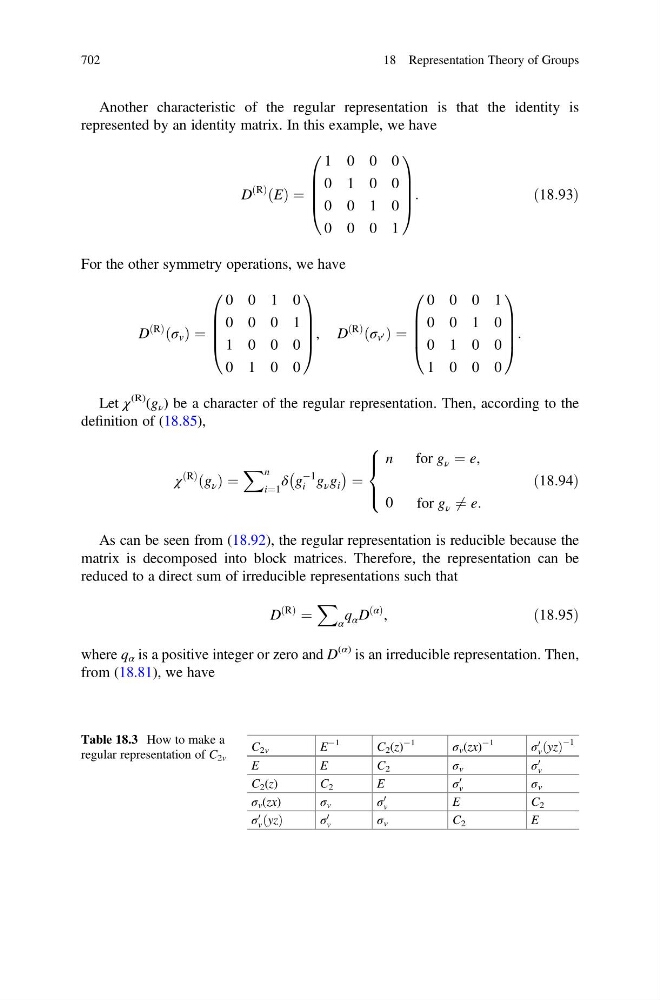
Table 18.3 How to make a
regular representation of C 2v
C 2v
E
À1
C 2 (z)
À1
σ v (zx)
À1
σ
0
v yz
ð Þ
À1
E
E
C 2
σ v
σ
0
v
C 2 (z)
C 2
E
σ
0
v
σ v
σ v (zx)
σ v
σ
0
v
E
C 2
σ
0
v yz
ð Þ
σ
0
v
σ v
C 2
E
702
18 Representation Theory of Groups