

D
α
ð Þ g
0
ð ÞB ¼
X
g
D
α
ð Þ g
0
ð ÞD
α
ð Þ g
ð ÞXD
β
ð Þ g
À1
À Á
¼
X
g
D
α
ð Þ g
0
ð ÞD
α
ð Þ g
ð ÞXD
β
ð Þ g
À1
À Á
D
β
ð Þ g
0 À1
D
β
ð Þ g
0
ð Þ
¼
X
g
D
α
ð Þ g
0 g
ð ÞXD
β
ð Þ g
0 g
ð Þ
À1
h
i
D
β
ð Þ g
0
ð Þ ¼ BD
β
ð Þ g
0
ð Þ:
ð18:65Þ
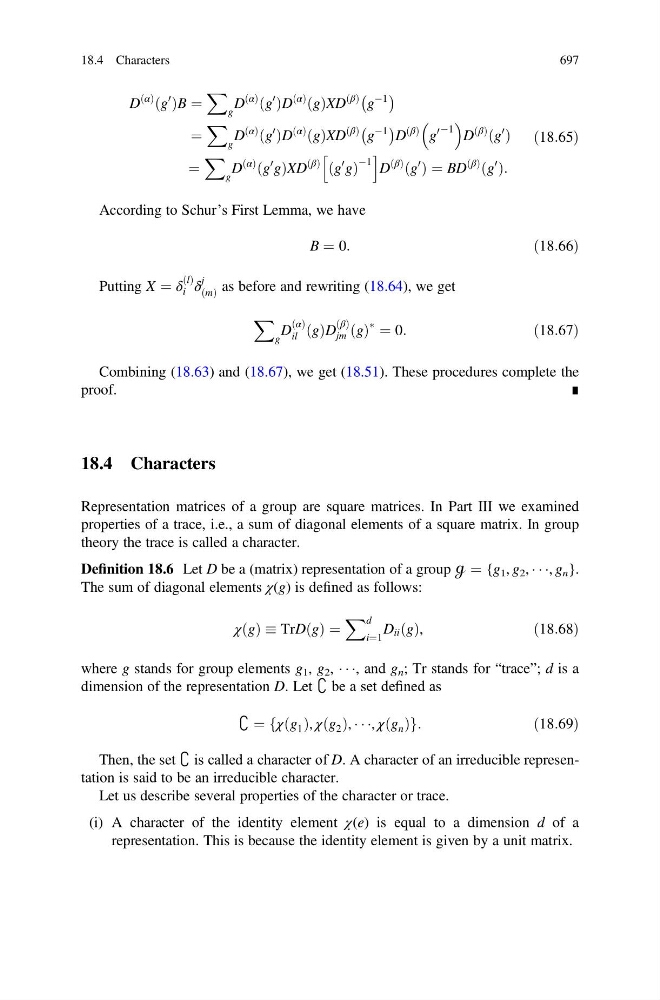
According to Schur’s First Lemma, we have
B ¼ 0:
ð18:66Þ
Putting X ¼ δ
l
ð Þ
i δ
j
m
ð Þ as before and rewriting (18.64), we get
X
g
D
α
ð Þ
il g
ð ÞD
β
ð Þ
jm g
ð Þ
à ¼ 0:
ð18:67Þ
Combining (18.63) and (18.67), we get (18.51). These procedures complete the
proof.
∎
18.4 Characters
Representation matrices of a group are square matrices. In Part III we examined
properties of a trace, i.e., a sum of diagonal elements of a square matrix. In group
theory the trace is called a character.
Definition 18.6 Let D be a (matrix) representation of a group ℊ ¼ {g 1 , g 2 , Á Á Á, g n }.
The sum of diagonal elements χ(g) is defined as follows:
χ g
ð Þ TrD g
ð Þ ¼
X d
i¼1
D ii g
ð Þ,
ð18:68Þ
where g stands for group elements g 1 , g 2 , Á Á Á, and g n ; Tr stands for “trace”; d is a
dimension of the representation D. Let ∁ be a set defined as
∁ ¼ χ g 1
ð Þ, χ g 2
ð Þ, Á Á Á, χ g n
ð Þ
f
g :
ð18:69Þ
Then, the set ∁ is called a character of D. A character of an irreducible representation is said to be an irreducible character.
Let us describe several properties of the character or trace.
(i) A character of the identity element χ(e) is equal to a dimension d of a
representation. This is because the identity element is given by a unit matrix.
18.4 Characters
697
α
ð Þ g
0
ð ÞB ¼
X
g
D
α
ð Þ g
0
ð ÞD
α
ð Þ g
ð ÞXD
β
ð Þ g
À1
À Á
¼
X
g
D
α
ð Þ g
0
ð ÞD
α
ð Þ g
ð ÞXD
β
ð Þ g
À1
À Á
D
β
ð Þ g
0 À1
D
β
ð Þ g
0
ð Þ
¼
X
g
D
α
ð Þ g
0 g
ð ÞXD
β
ð Þ g
0 g
ð Þ
À1
h
i
D
β
ð Þ g
0
ð Þ ¼ BD
β
ð Þ g
0
ð Þ:
ð18:65Þ
According to Schur’s First Lemma, we have
B ¼ 0:
ð18:66Þ
Putting X ¼ δ
l
ð Þ
i δ
j
m
ð Þ as before and rewriting (18.64), we get
X
g
D
α
ð Þ
il g
ð ÞD
β
ð Þ
jm g
ð Þ
à ¼ 0:
ð18:67Þ
Combining (18.63) and (18.67), we get (18.51). These procedures complete the
proof.
∎
18.4 Characters
Representation matrices of a group are square matrices. In Part III we examined
properties of a trace, i.e., a sum of diagonal elements of a square matrix. In group
theory the trace is called a character.
Definition 18.6 Let D be a (matrix) representation of a group ℊ ¼ {g 1 , g 2 , Á Á Á, g n }.
The sum of diagonal elements χ(g) is defined as follows:
χ g
ð Þ TrD g
ð Þ ¼
X d
i¼1
D ii g
ð Þ,
ð18:68Þ
where g stands for group elements g 1 , g 2 , Á Á Á, and g n ; Tr stands for “trace”; d is a
dimension of the representation D. Let ∁ be a set defined as
∁ ¼ χ g 1
ð Þ, χ g 2
ð Þ, Á Á Á, χ g n
ð Þ
f
g :
ð18:69Þ
Then, the set ∁ is called a character of D. A character of an irreducible representation is said to be an irreducible character.
Let us describe several properties of the character or trace.
(i) A character of the identity element χ(e) is equal to a dimension d of a
representation. This is because the identity element is given by a unit matrix.
18.4 Characters
697