

ψ μ ¼
X d
λ¼1
ψ
0
λ T
À1
À
Á
λμ
:
ð18:32Þ
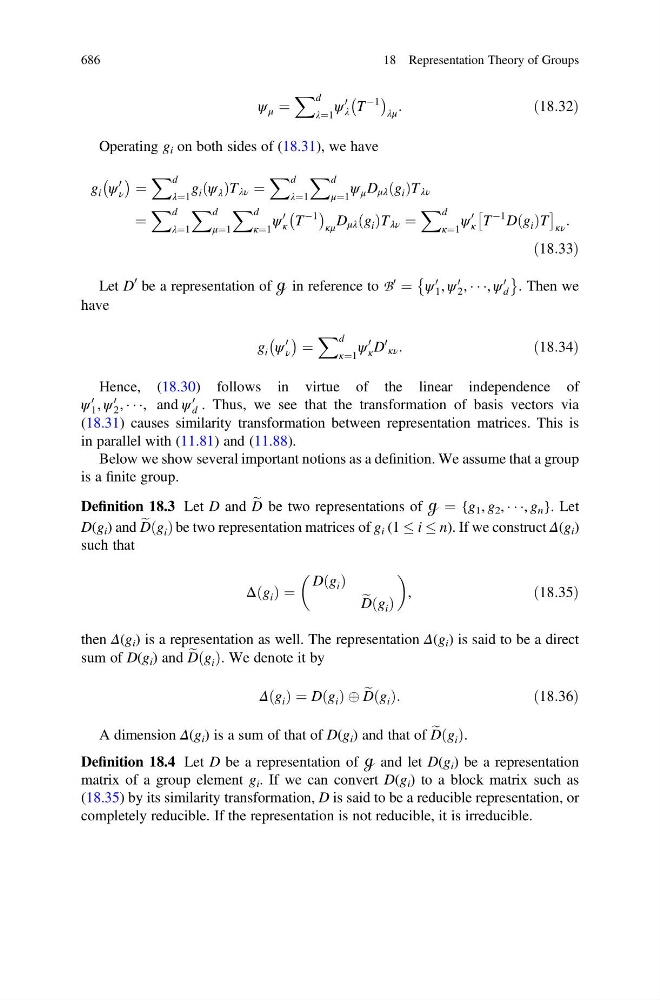
Operating g i on both sides of (18.31), we have
g i ψ
0
ν
À Á ¼
X d
λ¼1
g i ψ λ
ð ÞT λν ¼
X d
λ¼1
X d
μ¼1
ψ μ D μλ g i
ð ÞT λν
¼
X d
λ¼1
X d
μ¼1
X d
κ¼1
ψ
0
κ T
À1
À
Á
κμ
D μλ g i
ð ÞT λν ¼
X d
κ¼1
ψ
0
κ T
À1 D g i
ð ÞT
Â
Ã
κν
:
ð18:33Þ
Let D
0 be a representation of ℊ in reference to B
0
¼ ψ
0
1 , ψ
0
2 , Á Á Á, ψ
0
d
È
É
. Then we
have
g i ψ
0
ν
À Á ¼
X d
κ¼1
ψ
0
κ D
0 κν :
ð18:34Þ
Hence, (18.30) follows in virtue of the linear independence of
ψ
0
1 , ψ
0
2 , Á Á Á, and ψ
0
d . Thus, we see that the transformation of basis vectors via
(18.31) causes similarity transformation between representation matrices. This is
in parallel with (11.81) and (11.88).
Below we show several important notions as a definition. We assume that a group
is a finite group.
Definition 18.3 Let D and e
D be two representations of ℊ ¼ {g 1 , g 2 , Á Á Á, g n }. Let
D(g i ) and e
D g i
ð Þbe two representation matrices of g i (1 i n). If we construct Δ(g i )
such that
Δ g i
ð Þ ¼
D g i
ð Þ
e
D g i
ð Þ
,
ð18:35Þ
then Δ(g i ) is a representation as well. The representation Δ(g i ) is said to be a direct
sum of D(g i ) and e
D g i
ð Þ. We denote it by
Δ g i
ð Þ ¼ D g i
ð Þ È e
D g i
ð Þ:
ð18:36Þ
A dimension Δ(g i ) is a sum of that of D(g i ) and that of e
D g i
ð Þ.
Definition 18.4 Let D be a representation of ℊ and let D(g i ) be a representation
matrix of a group element g i . If we can convert D(g i ) to a block matrix such as
(18.35) by its similarity transformation, D is said to be a reducible representation, or
completely reducible. If the representation is not reducible, it is irreducible.
686
18 Representation Theory of Groups
X d
λ¼1
ψ
0
λ T
À1
À
Á
λμ
:
ð18:32Þ
Operating g i on both sides of (18.31), we have
g i ψ
0
ν
À Á ¼
X d
λ¼1
g i ψ λ
ð ÞT λν ¼
X d
λ¼1
X d
μ¼1
ψ μ D μλ g i
ð ÞT λν
¼
X d
λ¼1
X d
μ¼1
X d
κ¼1
ψ
0
κ T
À1
À
Á
κμ
D μλ g i
ð ÞT λν ¼
X d
κ¼1
ψ
0
κ T
À1 D g i
ð ÞT
Â
Ã
κν
:
ð18:33Þ
Let D
0 be a representation of ℊ in reference to B
0
¼ ψ
0
1 , ψ
0
2 , Á Á Á, ψ
0
d
È
É
. Then we
have
g i ψ
0
ν
À Á ¼
X d
κ¼1
ψ
0
κ D
0 κν :
ð18:34Þ
Hence, (18.30) follows in virtue of the linear independence of
ψ
0
1 , ψ
0
2 , Á Á Á, and ψ
0
d . Thus, we see that the transformation of basis vectors via
(18.31) causes similarity transformation between representation matrices. This is
in parallel with (11.81) and (11.88).
Below we show several important notions as a definition. We assume that a group
is a finite group.
Definition 18.3 Let D and e
D be two representations of ℊ ¼ {g 1 , g 2 , Á Á Á, g n }. Let
D(g i ) and e
D g i
ð Þbe two representation matrices of g i (1 i n). If we construct Δ(g i )
such that
Δ g i
ð Þ ¼
D g i
ð Þ
e
D g i
ð Þ
,
ð18:35Þ
then Δ(g i ) is a representation as well. The representation Δ(g i ) is said to be a direct
sum of D(g i ) and e
D g i
ð Þ. We denote it by
Δ g i
ð Þ ¼ D g i
ð Þ È e
D g i
ð Þ:
ð18:36Þ
A dimension Δ(g i ) is a sum of that of D(g i ) and that of e
D g i
ð Þ.
Definition 18.4 Let D be a representation of ℊ and let D(g i ) be a representation
matrix of a group element g i . If we can convert D(g i ) to a block matrix such as
(18.35) by its similarity transformation, D is said to be a reducible representation, or
completely reducible. If the representation is not reducible, it is irreducible.
686
18 Representation Theory of Groups