

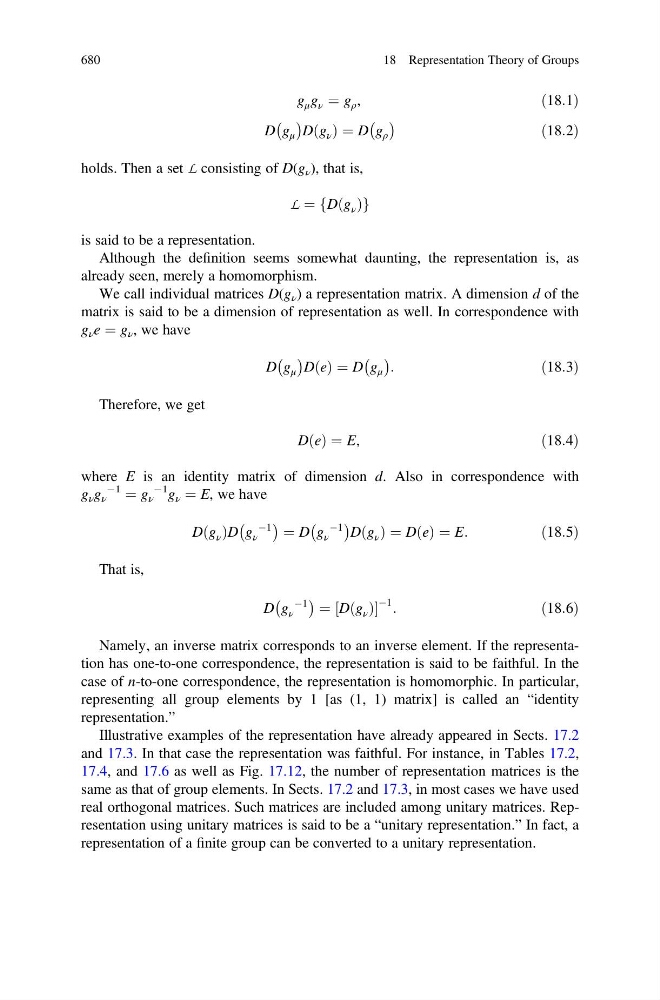
g μ g ν ¼ g ρ ,
ð18:1Þ
D g μ
À Á
D g ν
ð Þ ¼ D g ρ
À Á
ð18:2Þ
holds. Then a set L consisting of D(g ν ), that is,
L ¼ D g ν
ð Þ
f
g
is said to be a representation.
Although the definition seems somewhat daunting, the representation is, as
already seen, merely a homomorphism.
We call individual matrices D(g ν ) a representation matrix. A dimension d of the
matrix is said to be a dimension of representation as well. In correspondence with
g ν e ¼ g ν , we have
D g μ
À Á
D e
ð Þ ¼ D g μ
À Á :
ð18:3Þ
Therefore, we get
D e
ð Þ ¼ E,
ð18:4Þ
where E is an identity matrix of dimension d. Also in correspondence with
g ν g ν
À1
¼ g ν
À1 g ν ¼ E, we have
D g ν
ð ÞD g ν
À1
À
Á ¼ D g ν
À1
À
Á
D g ν
ð Þ ¼ D e
ð Þ ¼ E:
ð18:5Þ
That is,
D g ν
À1
À
Á ¼ D g ν
ð Þ
½
À1 :
ð18:6Þ
Namely, an inverse matrix corresponds to an inverse element. If the representation has one-to-one correspondence, the representation is said to be faithful. In the
case of n-to-one correspondence, the representation is homomorphic. In particular,
representing all group elements by 1 [as (1, 1) matrix] is called an “identity
representation.”
Illustrative examples of the representation have already appeared in Sects. 17.2
and 17.3. In that case the representation was faithful. For instance, in Tables 17.2,
17.4, and 17.6 as well as Fig. 17.12, the number of representation matrices is the
same as that of group elements. In Sects. 17.2 and 17.3, in most cases we have used
real orthogonal matrices. Such matrices are included among unitary matrices. Representation using unitary matrices is said to be a “unitary representation.” In fact, a
representation of a finite group can be converted to a unitary representation.
680
18 Representation Theory of Groups