

invertible and endomorphic linear transformations over a vector space V
n and called
a linear transformation group or a general linear group and denoted by GL(n, ℂ), GL
(V
n ), GL(V ), etc. The relevant transformations are bijective. We can readily make
sure that axioms (A1) to (A4) are satisfied with GL(n, ℂ). Here, the vector space can
be ℂ
n or a function space.
The structure of a finite group is tabulated in a multiplication table. This is made
up such that group elements are arranged in a first row and a first column and that an
intersection of an element g i in the row and g j in the column is designated as a
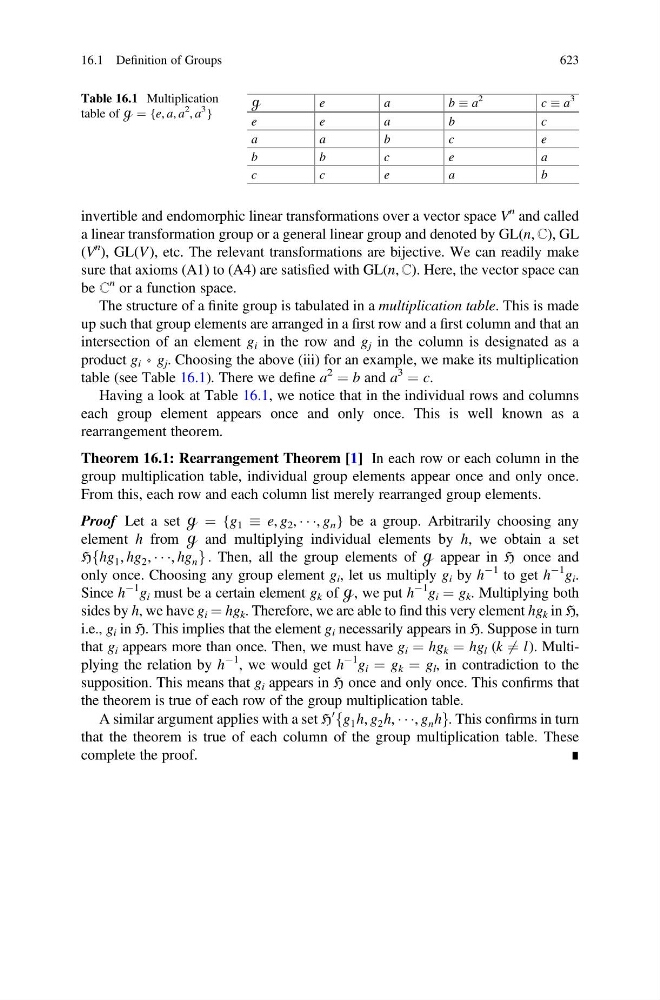
product g i ⋄ g j . Choosing the above (iii) for an example, we make its multiplication
table (see Table 16.1). There we define a
2
¼ b and a
3
¼ c.
Having a look at Table 16.1, we notice that in the individual rows and columns
each group element appears once and only once. This is well known as a
rearrangement theorem.
Theorem 16.1: Rearrangement Theorem [1] In each row or each column in the
group multiplication table, individual group elements appear once and only once.
From this, each row and each column list merely rearranged group elements.
Proof Let a set ℊ ¼ {g 1 e, g 2 , Á Á Á, g n } be a group. Arbitrarily choosing any
element h from ℊ and multiplying individual elements by h, we obtain a set
H hg 1 , hg 2 , Á Á Á, hg n
f
g . Then, all the group elements of ℊ appear in H once and
only once. Choosing any group element g i , let us multiply g i by h
À1 to get h
À1
g i .
Since h
À1
g i must be a certain element g k of ℊ, we put h
À1
g i ¼ g k . Multiplying both
sides by h, we have g i ¼ hg k . Therefore, we are able to find this very element hg k in H,
i.e., g i in H. This implies that the element g i necessarily appears in H. Suppose in turn
that g i appears more than once. Then, we must have g i ¼ hg k ¼ hg l (k 6 ¼ l). Multiplying the relation by h
À1
, we would get h
À1
g i ¼ g k ¼ g l , in contradiction to the
supposition. This means that g i appears in H once and only once. This confirms that
the theorem is true of each row of the group multiplication table.
A similar argument applies with a set H
0
g 1 h, g 2 h, Á Á Á, g n h
f
g . This confirms in turn
that the theorem is true of each column of the group multiplication table. These
complete the proof.
∎
Table 16.1 Multiplication
table of ℊ ¼ {e, a, a
2
, a
3
}
ℊ
e
a
b a
2
c a
3
e
e
a
b
c
a
a
b
c
e
b
b
c
e
a
c
c
e
a
b
16.1 Definition of Groups
623