

cos x sin t
ð
Þ¼
X 1
m¼À1
J m x
ð Þ cos mt,
sin x sin t
ð
Þ¼
X 1
m¼À1
J m x
ð Þ sin mt,
ð15:185Þ
where the functions J m (x) are called the Bessel functions that satisfy the following
equation:
d
2 J n x
ð Þ
dx 2 þ
1
x
dJ n x
ð Þ
dx
þ 1 À
n
2
x 2
J n x
ð Þ ¼ 0:
ð15:186Þ
/
/
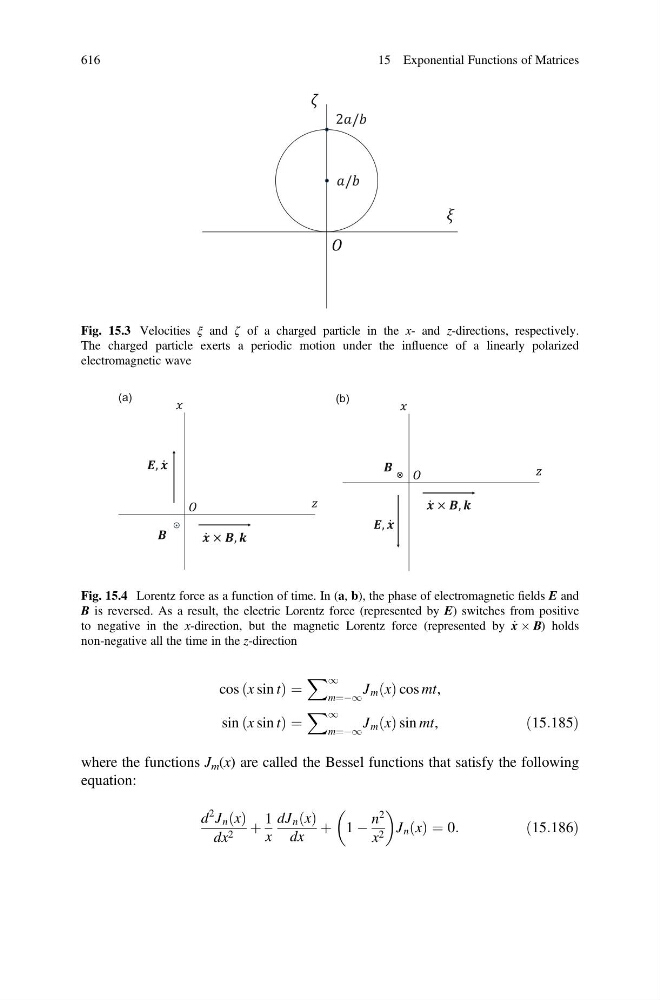
Fig. 15.3 Velocities ξ and ζ of a charged particle in the x- and z-directions, respectively.
The charged particle exerts a periodic motion under the influence of a linearly polarized
electromagnetic wave
, ̇
̇ × ,
(a)
, ̇
̇ × ,
(b)
Fig. 15.4 Lorentz force as a function of time. In (a, b), the phase of electromagnetic fields E and
B is reversed. As a result, the electric Lorentz force (represented by E) switches from positive
to negative in the x-direction, but the magnetic Lorentz force (represented by _
x  B) holds
non-negative all the time in the z-direction
616
15 Exponential Functions of Matrices
ð
Þ¼
X 1
m¼À1
J m x
ð Þ cos mt,
sin x sin t
ð
Þ¼
X 1
m¼À1
J m x
ð Þ sin mt,
ð15:185Þ
where the functions J m (x) are called the Bessel functions that satisfy the following
equation:
d
2 J n x
ð Þ
dx 2 þ
1
x
dJ n x
ð Þ
dx
þ 1 À
n
2
x 2
J n x
ð Þ ¼ 0:
ð15:186Þ
/
/
Fig. 15.3 Velocities ξ and ζ of a charged particle in the x- and z-directions, respectively.
The charged particle exerts a periodic motion under the influence of a linearly polarized
electromagnetic wave
, ̇
̇ × ,
(a)
, ̇
̇ × ,
(b)
Fig. 15.4 Lorentz force as a function of time. In (a, b), the phase of electromagnetic fields E and
B is reversed. As a result, the electric Lorentz force (represented by E) switches from positive
to negative in the x-direction, but the magnetic Lorentz force (represented by _
x  B) holds
non-negative all the time in the z-direction
616
15 Exponential Functions of Matrices