

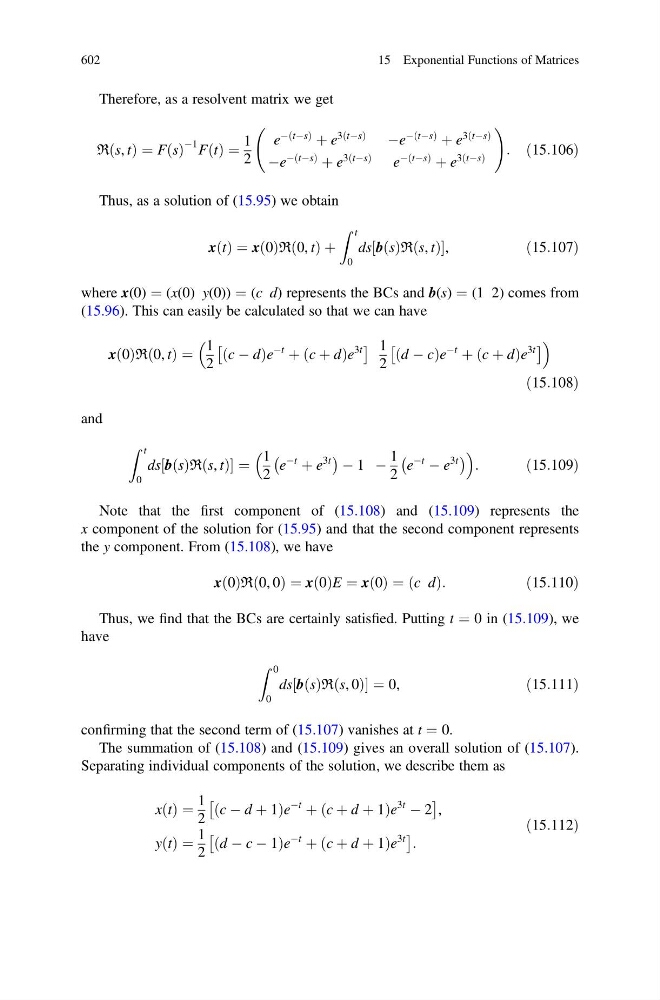
Therefore, as a resolvent matrix we get
R s, t
ð Þ ¼ F s
ð Þ
À1 F t
ð Þ ¼
1
2
e
À tÀs
ð Þ
þ e
3 tÀs
ð Þ
Àe
À tÀs
ð Þ
þ e
3 tÀs
ð Þ
Àe
À tÀs
ð Þ
þ e
3 tÀs
ð Þ
e
À tÀs
ð Þ
þ e
3 tÀs
ð Þ
!
: ð15:106Þ
Thus, as a solution of (15.95) we obtain
x t
ð Þ ¼ x 0
ð ÞR 0, t
ð Þ þ
Z t
0
ds b s
ð ÞR s, t
ð Þ
½
,
ð15:107Þ
where x(0) ¼ (x(0) y(0)) ¼ (c d) represents the BCs and b(s) ¼ (1 2) comes from
(15.96). This can easily be calculated so that we can have
x 0
ð ÞR 0, t
ð Þ ¼
1
2
c À d
ð
Þe
Àt
þ c þ d
ð
Þe
3t
Â
à 1
2
d À c
ð
Þe
Àt
þ c þ d
ð
Þe
3t
Â
Ã
ð15:108Þ
and
Z t
0
ds b s
ð ÞR s, t
ð Þ
½
¼
1
2
e
Àt
þ e
3t
À
Á À 1 À
1
2
e
Àt
À e
3t
À
Á
:
ð15:109Þ
Note that the first component of (15.108) and (15.109) represents the
x component of the solution for (15.95) and that the second component represents
the y component. From (15.108), we have
x 0
ð ÞR 0, 0
ð Þ ¼ x 0
ð ÞE ¼ x 0
ð Þ ¼ c d
ð Þ:
ð15:110Þ
Thus, we find that the BCs are certainly satisfied. Putting t ¼ 0 in (15.109), we
have
Z 0
0
ds b s
ð ÞR s, 0
ð Þ
½
¼0,
ð15:111Þ
confirming that the second term of (15.107) vanishes at t ¼ 0.
The summation of (15.108) and (15.109) gives an overall solution of (15.107).
Separating individual components of the solution, we describe them as
x t
ð Þ ¼
1
2
c À d þ 1
ð
Þ e
Àt
þ c þ d þ 1
ð
Þ e
3t
À 2
Â
Ã
,
y t
ð Þ ¼
1
2
d À c À 1
ð
Þ e
Àt
þ c þ d þ 1
ð
Þ e
3t
Â
Ã
:
ð15:112Þ
602
15 Exponential Functions of Matrices