

a n À A
nÀ1
ð
Þ À1 a
½ > 0:
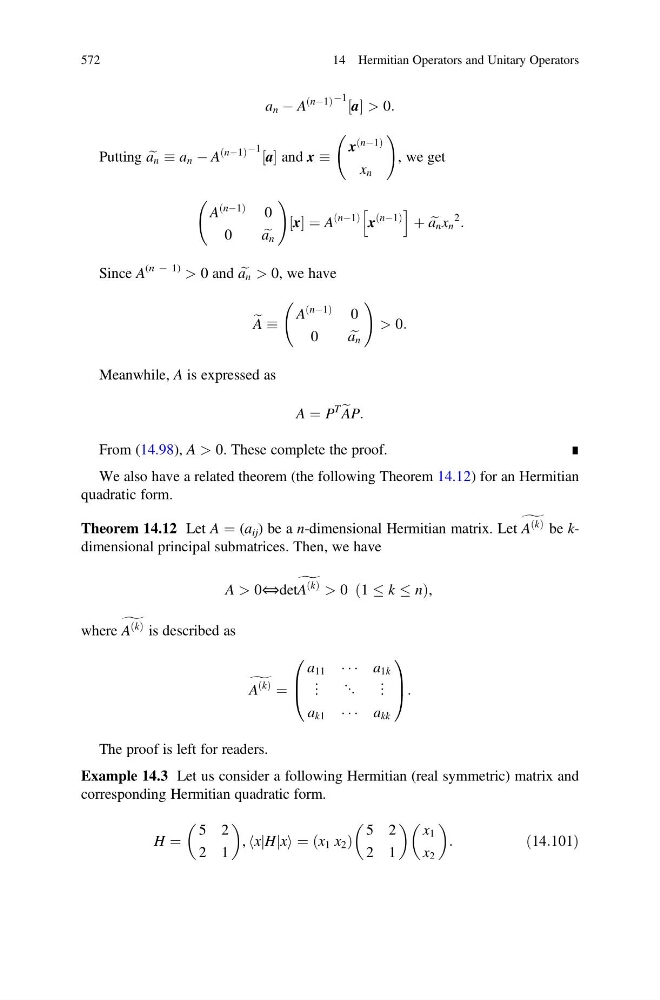
Putting e
a n a n À A
nÀ1
ð
Þ À1 a
½ and x
x
nÀ1
ð
Þ
x n
!
, we get
A
nÀ1
ð
Þ
0
0
e
a n
!
x
½ ¼ A
nÀ1
ð
Þ
x
nÀ1
ð
Þ
h
i
þ e
a n x n
2
:
Since A
(n À 1) > 0 and e
a n > 0, we have
e
A
A
nÀ1
ð
Þ
0
0
e
a n
!
> 0:
Meanwhile, A is expressed as
A ¼ P
T e
AP:
From (14.98), A > 0. These complete the proof.
∎
We also have a related theorem (the following Theorem 14.12) for an Hermitian
quadratic form.
Theorem 14.12 Let A ¼ (a ij ) be a n-dimensional Hermitian matrix. Let g
A
k
ð Þ be kdimensional principal submatrices. Then, we have
A > 0⟺det g
A
k
ð Þ
> 0 1 k n
ð
Þ ,
where g
A
k
ð Þ is described as
g
A
k
ð Þ
¼
a 11 Á Á Á a 1k
⋮ ⋱ ⋮
a k1 Á Á Á a kk
0
B
@
1
C
A:
The proof is left for readers.
Example 14.3 Let us consider a following Hermitian (real symmetric) matrix and
corresponding Hermitian quadratic form.
H ¼
5 2
2 1
, x H
j jx
h
i¼ x 1 x 2
ð
Þ
5 2
2 1
x 1
x 2
:
ð14:101Þ
572
14 Hermitian Operators and Unitary Operators
nÀ1
ð
Þ À1 a
½ > 0:
Putting e
a n a n À A
nÀ1
ð
Þ À1 a
½ and x
x
nÀ1
ð
Þ
x n
!
, we get
A
nÀ1
ð
Þ
0
0
e
a n
!
x
½ ¼ A
nÀ1
ð
Þ
x
nÀ1
ð
Þ
h
i
þ e
a n x n
2
:
Since A
(n À 1) > 0 and e
a n > 0, we have
e
A
A
nÀ1
ð
Þ
0
0
e
a n
!
> 0:
Meanwhile, A is expressed as
A ¼ P
T e
AP:
From (14.98), A > 0. These complete the proof.
∎
We also have a related theorem (the following Theorem 14.12) for an Hermitian
quadratic form.
Theorem 14.12 Let A ¼ (a ij ) be a n-dimensional Hermitian matrix. Let g
A
k
ð Þ be kdimensional principal submatrices. Then, we have
A > 0⟺det g
A
k
ð Þ
> 0 1 k n
ð
Þ ,
where g
A
k
ð Þ is described as
g
A
k
ð Þ
¼
a 11 Á Á Á a 1k
⋮ ⋱ ⋮
a k1 Á Á Á a kk
0
B
@
1
C
A:
The proof is left for readers.
Example 14.3 Let us consider a following Hermitian (real symmetric) matrix and
corresponding Hermitian quadratic form.
H ¼
5 2
2 1
, x H
j jx
h
i¼ x 1 x 2
ð
Þ
5 2
2 1
x 1
x 2
:
ð14:101Þ
572
14 Hermitian Operators and Unitary Operators