

In the above, J
2
ð Þ
1 and J
2
ð Þ
2 are obtained from (12.152). Thus, Fig. 12.2 gives a
constitution of Jordan blocks for eigenvalues 4 and 2. The overall number of Jordan
blocks is three; the number of the first-order and second-order Jordan blocks is two
and one, respectively.
The proper eigenvector e
2
ð Þ
1
is related to J
2
ð Þ
1
of (12.164). A set of the proper
eigenvector e
2
ð Þ
2 and the corresponding generalized eigenvector g
2
ð Þ
2 is pertinent to
J
2
ð Þ
2 of (12.165). We must have the generalized eigenvector g
2
ð Þ
2 in such a way that
A À 2E
ð
Þ
2 g
2
ð Þ
2 ¼ A À 2E
ð
Þ A À 2E
ð
Þg
2
ð Þ
2
h
i
= A À 2E
ð
Þe
2
ð Þ
2 = 0:
ð12:166Þ
From (12.161), we can put c 1 ¼ c 3 ¼ c 4 ¼ 0 and c 2 ¼ À 1. Thus, the matrix
representation of the generalized eigenvector g
2
ð Þ
2 is
g
2
ð Þ
2 ¼
0
À1
0
0
0
B
B
B
@
1
C
C
C
A
:
ð12:167Þ
We stress here that e
2
ð Þ
1 is not eligible for a proper pair with g
2
ð Þ
2 in J 2 . It is because
from (12.166) we have
A À 2E
ð
Þ g
2
ð Þ
2 ¼ e
2
ð Þ
2 ,
A À 2E
ð
Þg
2
ð Þ
2 6 ¼ e
2
ð Þ
1 :
ð12:168Þ
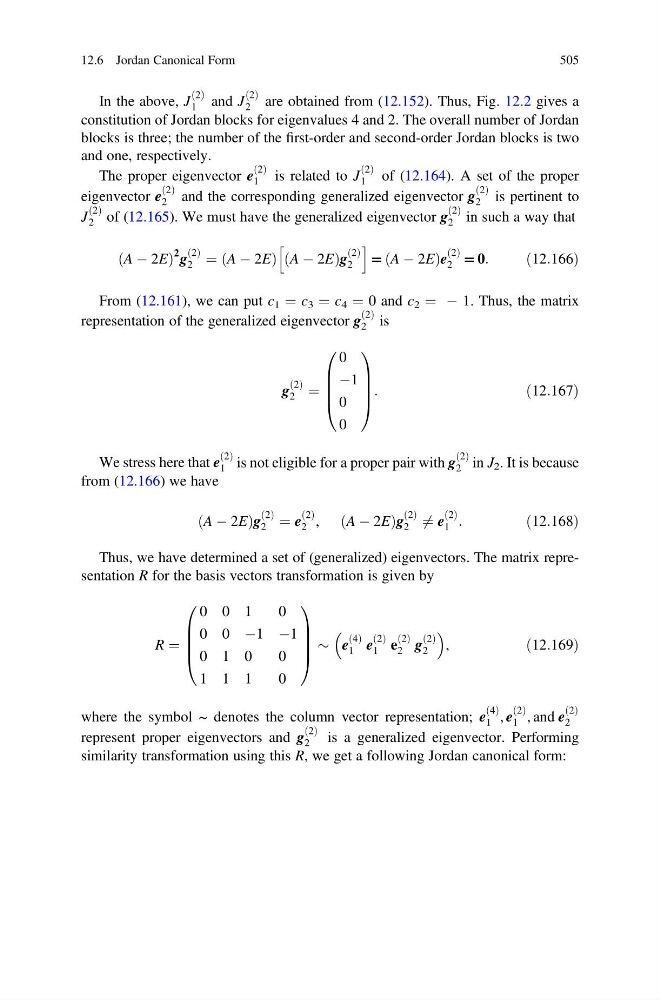
Thus, we have determined a set of (generalized) eigenvectors. The matrix representation R for the basis vectors transformation is given by
R ¼
0 0 1
0
0 0 À1 À1
0 1 0
0
1 1 1
0
0
B
B
B
@
1
C
C
C
A
$ e
4
ð Þ
1 e
2
ð Þ
1 e
2
ð Þ
2 g
2
ð Þ
2
,
ð12:169Þ
where the symbol ~ denotes the column vector representation; e
4
ð Þ
1 , e
2
ð Þ
1 , and e
2
ð Þ
2
represent proper eigenvectors and g
2
ð Þ
2
is a generalized eigenvector. Performing
similarity transformation using this R, we get a following Jordan canonical form:
12.6 Jordan Canonical Form
505
2
ð Þ
1 and J
2
ð Þ
2 are obtained from (12.152). Thus, Fig. 12.2 gives a
constitution of Jordan blocks for eigenvalues 4 and 2. The overall number of Jordan
blocks is three; the number of the first-order and second-order Jordan blocks is two
and one, respectively.
The proper eigenvector e
2
ð Þ
1
is related to J
2
ð Þ
1
of (12.164). A set of the proper
eigenvector e
2
ð Þ
2 and the corresponding generalized eigenvector g
2
ð Þ
2 is pertinent to
J
2
ð Þ
2 of (12.165). We must have the generalized eigenvector g
2
ð Þ
2 in such a way that
A À 2E
ð
Þ
2 g
2
ð Þ
2 ¼ A À 2E
ð
Þ A À 2E
ð
Þg
2
ð Þ
2
h
i
= A À 2E
ð
Þe
2
ð Þ
2 = 0:
ð12:166Þ
From (12.161), we can put c 1 ¼ c 3 ¼ c 4 ¼ 0 and c 2 ¼ À 1. Thus, the matrix
representation of the generalized eigenvector g
2
ð Þ
2 is
g
2
ð Þ
2 ¼
0
À1
0
0
0
B
B
B
@
1
C
C
C
A
:
ð12:167Þ
We stress here that e
2
ð Þ
1 is not eligible for a proper pair with g
2
ð Þ
2 in J 2 . It is because
from (12.166) we have
A À 2E
ð
Þ g
2
ð Þ
2 ¼ e
2
ð Þ
2 ,
A À 2E
ð
Þg
2
ð Þ
2 6 ¼ e
2
ð Þ
1 :
ð12:168Þ
Thus, we have determined a set of (generalized) eigenvectors. The matrix representation R for the basis vectors transformation is given by
R ¼
0 0 1
0
0 0 À1 À1
0 1 0
0
1 1 1
0
0
B
B
B
@
1
C
C
C
A
$ e
4
ð Þ
1 e
2
ð Þ
1 e
2
ð Þ
2 g
2
ð Þ
2
,
ð12:169Þ
where the symbol ~ denotes the column vector representation; e
4
ð Þ
1 , e
2
ð Þ
1 , and e
2
ð Þ
2
represent proper eigenvectors and g
2
ð Þ
2
is a generalized eigenvector. Performing
similarity transformation using this R, we get a following Jordan canonical form:
12.6 Jordan Canonical Form
505