

This means that N would be a zero matrix, in contradiction. Thus, a nilpotent
matrix N is not diagonalizable.
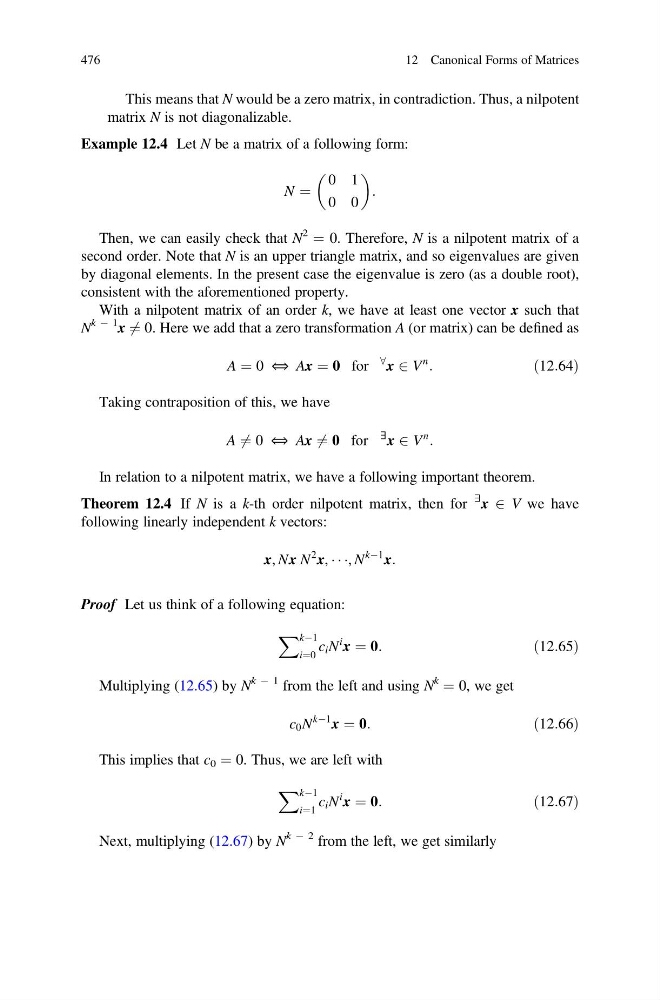
Example 12.4 Let N be a matrix of a following form:
N ¼
0 1
0 0
:
Then, we can easily check that N
2
¼ 0. Therefore, N is a nilpotent matrix of a
second order. Note that N is an upper triangle matrix, and so eigenvalues are given
by diagonal elements. In the present case the eigenvalue is zero (as a double root),
consistent with the aforementioned property.
With a nilpotent matrix of an order k, we have at least one vector x such that
N
k À 1 x 6 ¼ 0. Here we add that a zero transformation A (or matrix) can be defined as
A ¼ 0 ⟺ Ax ¼ 0 for
8 x 2 V
n
:
ð12:64Þ
Taking contraposition of this, we have
A 6 ¼ 0 ⟺ Ax 6 ¼ 0 for
∃ x 2 V
n
:
In relation to a nilpotent matrix, we have a following important theorem.
Theorem 12.4 If N is a k-th order nilpotent matrix, then for
∃ x 2 V we have
following linearly independent k vectors:
x, Nx N
2 x, Á Á Á, N
kÀ1 x:
Proof Let us think of a following equation:
X kÀ1
i¼0
c i N
i x ¼ 0:
ð12:65Þ
Multiplying (12.65) by N
k À 1 from the left and using N
k
¼ 0, we get
c 0 N
kÀ1 x ¼ 0:
ð12:66Þ
This implies that c 0 ¼ 0. Thus, we are left with
X kÀ1
i¼1
c i N
i x ¼ 0:
ð12:67Þ
Next, multiplying (12.67) by N
k À 2 from the left, we get similarly
476
12 Canonical Forms of Matrices
matrix N is not diagonalizable.
Example 12.4 Let N be a matrix of a following form:
N ¼
0 1
0 0
:
Then, we can easily check that N
2
¼ 0. Therefore, N is a nilpotent matrix of a
second order. Note that N is an upper triangle matrix, and so eigenvalues are given
by diagonal elements. In the present case the eigenvalue is zero (as a double root),
consistent with the aforementioned property.
With a nilpotent matrix of an order k, we have at least one vector x such that
N
k À 1 x 6 ¼ 0. Here we add that a zero transformation A (or matrix) can be defined as
A ¼ 0 ⟺ Ax ¼ 0 for
8 x 2 V
n
:
ð12:64Þ
Taking contraposition of this, we have
A 6 ¼ 0 ⟺ Ax 6 ¼ 0 for
∃ x 2 V
n
:
In relation to a nilpotent matrix, we have a following important theorem.
Theorem 12.4 If N is a k-th order nilpotent matrix, then for
∃ x 2 V we have
following linearly independent k vectors:
x, Nx N
2 x, Á Á Á, N
kÀ1 x:
Proof Let us think of a following equation:
X kÀ1
i¼0
c i N
i x ¼ 0:
ð12:65Þ
Multiplying (12.65) by N
k À 1 from the left and using N
k
¼ 0, we get
c 0 N
kÀ1 x ¼ 0:
ð12:66Þ
This implies that c 0 ¼ 0. Thus, we are left with
X kÀ1
i¼1
c i N
i x ¼ 0:
ð12:67Þ
Next, multiplying (12.67) by N
k À 2 from the left, we get similarly
476
12 Canonical Forms of Matrices