

λ
Ã
¼ ψjG
h
ψi
à ¼ ψjG
{
ψ
¼ À ψjGψi
h
¼ Àλ,
ð1:149Þ
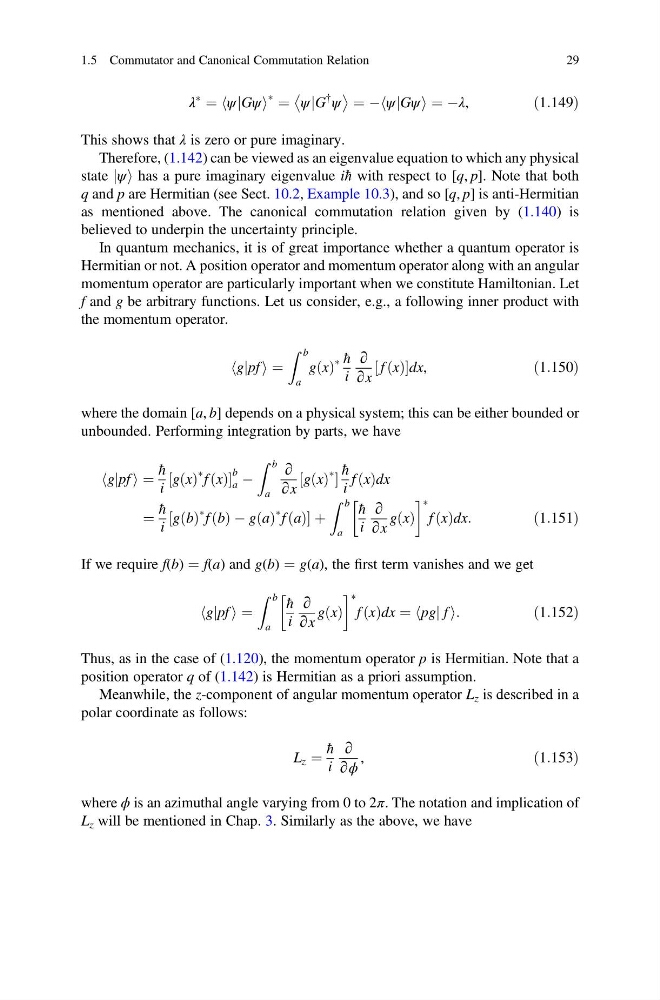
This shows that λ is zero or pure imaginary.
Therefore, (1.142) can be viewed as an eigenvalue equation to which any physical
state jψi has a pure imaginary eigenvalue iħ with respect to [q, p]. Note that both
q and p are Hermitian (see Sect. 10.2, Example 10.3), and so [q, p] is anti-Hermitian
as mentioned above. The canonical commutation relation given by (1.140) is
believed to underpin the uncertainty principle.
In quantum mechanics, it is of great importance whether a quantum operator is
Hermitian or not. A position operator and momentum operator along with an angular
momentum operator are particularly important when we constitute Hamiltonian. Let
f and g be arbitrary functions. Let us consider, e.g., a following inner product with
the momentum operator.
gjpf
h
i ¼
Z b
a
g x
ð Þ
à ħ
i
∂
∂x
f x
ð Þ
½
dx,
ð1:150Þ
where the domain [a, b] depends on a physical system; this can be either bounded or
unbounded. Performing integration by parts, we have
gjpf
h
i ¼
ħ
i
g x
ð Þ
à f x
ð Þ
½
b
a À
Z b
a
∂
∂x
g x
ð Þ
Ã
½
ħ
i
f x
ð Þdx
¼
ħ
i
g b
ð Þ
à f b
ð Þ À g a
ð Þ
à f a
ð Þ
½
þ
Z b
a
ħ
i
∂
∂x
g x
ð Þ
! Ã
f x
ð Þdx:
ð1:151Þ
If we require f(b) ¼ f(a) and g(b) ¼ g(a), the first term vanishes and we get
gjpf
h
i ¼
Z b
a
ħ
i
∂
∂x
g x
ð Þ
! Ã
f x
ð Þdx ¼ pgj f
h
i:
ð1:152Þ
Thus, as in the case of (1.120), the momentum operator p is Hermitian. Note that a
position operator q of (1.142) is Hermitian as a priori assumption.
Meanwhile, the z-component of angular momentum operator L z is described in a
polar coordinate as follows:
L z ¼
ħ
i
∂
∂ϕ
,
ð1:153Þ
where ϕ is an azimuthal angle varying from 0 to 2π. The notation and implication of
L z will be mentioned in Chap. 3. Similarly as the above, we have
1.5 Commutator and Canonical Commutation Relation
29
Ã
¼ ψjG
h
ψi
à ¼ ψjG
{
ψ
¼ À ψjGψi
h
¼ Àλ,
ð1:149Þ
This shows that λ is zero or pure imaginary.
Therefore, (1.142) can be viewed as an eigenvalue equation to which any physical
state jψi has a pure imaginary eigenvalue iħ with respect to [q, p]. Note that both
q and p are Hermitian (see Sect. 10.2, Example 10.3), and so [q, p] is anti-Hermitian
as mentioned above. The canonical commutation relation given by (1.140) is
believed to underpin the uncertainty principle.
In quantum mechanics, it is of great importance whether a quantum operator is
Hermitian or not. A position operator and momentum operator along with an angular
momentum operator are particularly important when we constitute Hamiltonian. Let
f and g be arbitrary functions. Let us consider, e.g., a following inner product with
the momentum operator.
gjpf
h
i ¼
Z b
a
g x
ð Þ
à ħ
i
∂
∂x
f x
ð Þ
½
dx,
ð1:150Þ
where the domain [a, b] depends on a physical system; this can be either bounded or
unbounded. Performing integration by parts, we have
gjpf
h
i ¼
ħ
i
g x
ð Þ
à f x
ð Þ
½
b
a À
Z b
a
∂
∂x
g x
ð Þ
Ã
½
ħ
i
f x
ð Þdx
¼
ħ
i
g b
ð Þ
à f b
ð Þ À g a
ð Þ
à f a
ð Þ
½
þ
Z b
a
ħ
i
∂
∂x
g x
ð Þ
! Ã
f x
ð Þdx:
ð1:151Þ
If we require f(b) ¼ f(a) and g(b) ¼ g(a), the first term vanishes and we get
gjpf
h
i ¼
Z b
a
ħ
i
∂
∂x
g x
ð Þ
! Ã
f x
ð Þdx ¼ pgj f
h
i:
ð1:152Þ
Thus, as in the case of (1.120), the momentum operator p is Hermitian. Note that a
position operator q of (1.142) is Hermitian as a priori assumption.
Meanwhile, the z-component of angular momentum operator L z is described in a
polar coordinate as follows:
L z ¼
ħ
i
∂
∂ϕ
,
ð1:153Þ
where ϕ is an azimuthal angle varying from 0 to 2π. The notation and implication of
L z will be mentioned in Chap. 3. Similarly as the above, we have
1.5 Commutator and Canonical Commutation Relation
29