

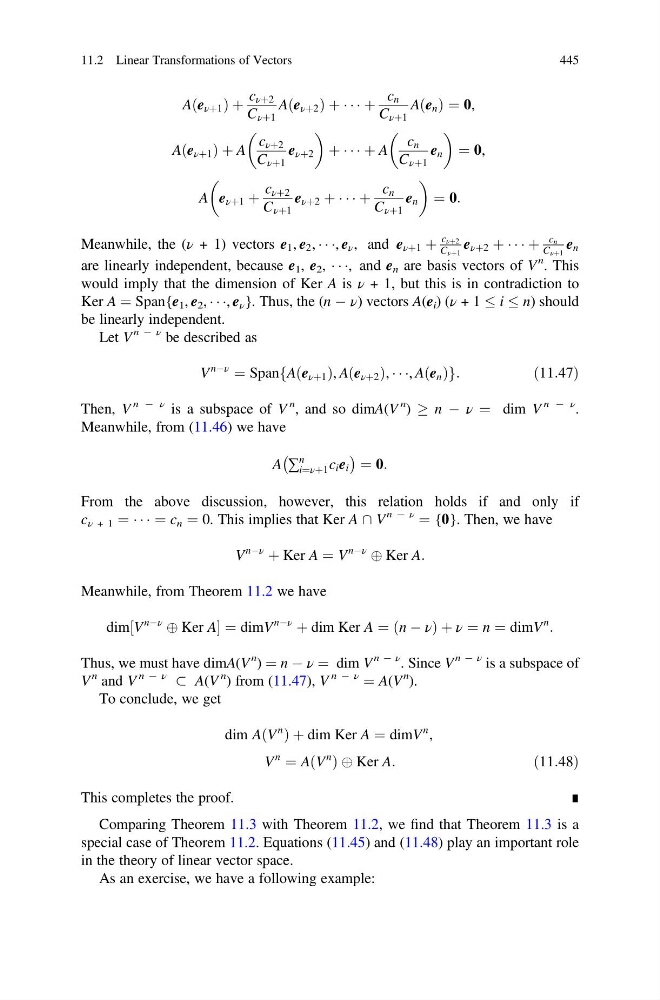
A e νþ1
ð
Þþ
c νþ2
C νþ1
A e νþ2
ð
Þ þ Á Á Á þ
c n
C νþ1
A e n
ð Þ ¼ 0,
A e νþ1
ð
ÞþA
c νþ2
C νþ1
e νþ2
þ Á Á Á þ A
c n
C νþ1
e n
¼ 0,
A e νþ1 þ
c νþ2
C νþ1
e νþ2 þ Á Á Á þ
c n
C νþ1
e n
¼ 0:
Meanwhile, the (ν + 1) vectors e 1 , e 2 , Á Á Á, e ν , and e νþ1 þ
c νþ2
C νþ1
e νþ2 þ Á Á Á þ
c n
C νþ1
e n
are linearly independent, because e 1 , e 2 , Á Á Á, and e n are basis vectors of V
n . This
would imply that the dimension of Ker A is ν + 1, but this is in contradiction to
Ker A ¼ Span{e 1 , e 2 , Á Á Á, e ν }. Thus, the (n À ν) vectors A(e i ) (ν + 1 i n) should
be linearly independent.
Let V
n À ν be described as
V
nÀν
¼ Span A e νþ1
ð
Þ, A e νþ2
ð
Þ, Á Á Á, A e n
ð Þ
f
g :
ð11:47Þ
Then, V
n À ν is a subspace of V
n , and so dimA(V
n ) ! n À ν ¼ dim V
n À ν .
Meanwhile, from (11.46) we have
A ∑
n
i¼νþ1 c i e i
À
Á ¼ 0:
From the above discussion, however, this relation holds if and only if
c ν + 1 ¼ Á Á Á ¼ c n ¼ 0. This implies that Ker A \ V
n À ν
¼ {0}. Then, we have
V
nÀν
þ Ker A ¼ V
nÀν
È Ker A:
Meanwhile, from Theorem 11.2 we have
dim V
nÀν
È Ker A
½
¼dimV
nÀν
þ dim Ker A ¼ n À ν
ð
Þþν ¼ n ¼ dimV
n
:
Thus, we must have dimA(V
n ) ¼ n À ν ¼ dim V
n À ν . Since V
n À ν is a subspace of
V
n and V
n À ν
⊂ A(V
n ) from (11.47), V
n À ν
¼ A(V
n ).
To conclude, we get
dim A V
n
ð Þ þ dim Ker A ¼ dimV
n ,
V
n
¼ A V
n
ð Þ È Ker A:
ð11:48Þ
This completes the proof.
∎
Comparing Theorem 11.3 with Theorem 11.2, we find that Theorem 11.3 is a
special case of Theorem 11.2. Equations (11.45) and (11.48) play an important role
in the theory of linear vector space.
As an exercise, we have a following example:
11.2 Linear Transformations of Vectors
445
ð
Þþ
c νþ2
C νþ1
A e νþ2
ð
Þ þ Á Á Á þ
c n
C νþ1
A e n
ð Þ ¼ 0,
A e νþ1
ð
ÞþA
c νþ2
C νþ1
e νþ2
þ Á Á Á þ A
c n
C νþ1
e n
¼ 0,
A e νþ1 þ
c νþ2
C νþ1
e νþ2 þ Á Á Á þ
c n
C νþ1
e n
¼ 0:
Meanwhile, the (ν + 1) vectors e 1 , e 2 , Á Á Á, e ν , and e νþ1 þ
c νþ2
C νþ1
e νþ2 þ Á Á Á þ
c n
C νþ1
e n
are linearly independent, because e 1 , e 2 , Á Á Á, and e n are basis vectors of V
n . This
would imply that the dimension of Ker A is ν + 1, but this is in contradiction to
Ker A ¼ Span{e 1 , e 2 , Á Á Á, e ν }. Thus, the (n À ν) vectors A(e i ) (ν + 1 i n) should
be linearly independent.
Let V
n À ν be described as
V
nÀν
¼ Span A e νþ1
ð
Þ, A e νþ2
ð
Þ, Á Á Á, A e n
ð Þ
f
g :
ð11:47Þ
Then, V
n À ν is a subspace of V
n , and so dimA(V
n ) ! n À ν ¼ dim V
n À ν .
Meanwhile, from (11.46) we have
A ∑
n
i¼νþ1 c i e i
À
Á ¼ 0:
From the above discussion, however, this relation holds if and only if
c ν + 1 ¼ Á Á Á ¼ c n ¼ 0. This implies that Ker A \ V
n À ν
¼ {0}. Then, we have
V
nÀν
þ Ker A ¼ V
nÀν
È Ker A:
Meanwhile, from Theorem 11.2 we have
dim V
nÀν
È Ker A
½
¼dimV
nÀν
þ dim Ker A ¼ n À ν
ð
Þþν ¼ n ¼ dimV
n
:
Thus, we must have dimA(V
n ) ¼ n À ν ¼ dim V
n À ν . Since V
n À ν is a subspace of
V
n and V
n À ν
⊂ A(V
n ) from (11.47), V
n À ν
¼ A(V
n ).
To conclude, we get
dim A V
n
ð Þ þ dim Ker A ¼ dimV
n ,
V
n
¼ A V
n
ð Þ È Ker A:
ð11:48Þ
This completes the proof.
∎
Comparing Theorem 11.3 with Theorem 11.2, we find that Theorem 11.3 is a
special case of Theorem 11.2. Equations (11.45) and (11.48) play an important role
in the theory of linear vector space.
As an exercise, we have a following example:
11.2 Linear Transformations of Vectors
445