

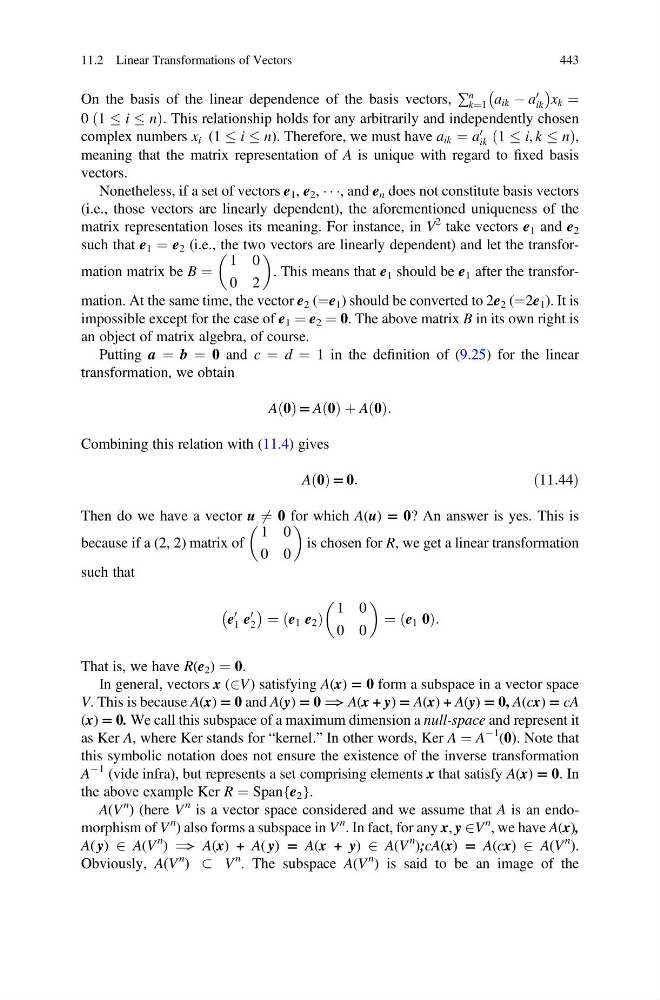
On the basis of the linear dependence of the basis vectors, ∑
n
k¼1 a ik À a
0
ik
À
Á
x k ¼
0 1 i n
ð
Þ : This relationship holds for any arbitrarily and independently chosen
complex numbers x i (1 i n). Therefore, we must have a ik ¼ a
0
ik 1 i, k n
ð
Þ ,
meaning that the matrix representation of A is unique with regard to fixed basis
vectors.
Nonetheless, if a set of vectors e 1 , e 2 , Á Á Á, and e n does not constitute basis vectors
(i.e., those vectors are linearly dependent), the aforementioned uniqueness of the
matrix representation loses its meaning. For instance, in V
2 take vectors e 1 and e 2
such that e 1 ¼ e 2 (i.e., the two vectors are linearly dependent) and let the transformation matrix be B ¼
1 0
0 2
. This means that e 1 should be e 1 after the transformation. At the same time, the vector e 2 (¼e 1 ) should be converted to 2e 2 (¼2e 1 ). It is
impossible except for the case of e 1 ¼ e 2 ¼ 0. The above matrix B in its own right is
an object of matrix algebra, of course.
Putting a ¼ b ¼ 0 and c ¼ d ¼ 1 in the definition of (9.25) for the linear
transformation, we obtain
A 0
ð Þ = A 0
ð Þ þ A 0
ð Þ:
Combining this relation with (11.4) gives
A 0
ð Þ = 0:
ð11:44Þ
Then do we have a vector u 6 ¼ 0 for which A(u) = 0? An answer is yes. This is
because if a (2, 2) matrix of
1 0
0 0
is chosen for R, we get a linear transformation
such that
e
0
1 e
0
2
À
Á ¼ e 1 e 2
ð
Þ
1 0
0 0
¼ e 1 0
ð
Þ:
That is, we have R(e 2 ) ¼ 0.
In general, vectors x (2V ) satisfying A(x) = 0 form a subspace in a vector space
V. This is because A(x) = 0 and A(y) = 0 ⟹ A(x + y) = A(x) + A(y) = 0, A(cx) = cA
(x) = 0. We call this subspace of a maximum dimension a null-space and represent it
as Ker A, where Ker stands for “kernel.” In other words, Ker A ¼ A
À1 (0). Note that
this symbolic notation does not ensure the existence of the inverse transformation
A
À1 (vide infra), but represents a set comprising elements x that satisfy A(x) = 0. In
the above example Ker R ¼ Span{e 2 }.
A(V
n ) (here V
n is a vector space considered and we assume that A is an endomorphism of V
n ) also forms a subspace in V
n . In fact, for any x, y 2V
n , we have A(x),
A( y) 2 A(V
n ) ⟹ A(x) + A( y) = A(x + y) 2 A(V
n );cA(x) = A(cx) 2 A(V
n ).
Obviously, A(V
n ) ⊂ V
n . The subspace A(V
n ) is said to be an image of the
11.2 Linear Transformations of Vectors
443
n
k¼1 a ik À a
0
ik
À
Á
x k ¼
0 1 i n
ð
Þ : This relationship holds for any arbitrarily and independently chosen
complex numbers x i (1 i n). Therefore, we must have a ik ¼ a
0
ik 1 i, k n
ð
Þ ,
meaning that the matrix representation of A is unique with regard to fixed basis
vectors.
Nonetheless, if a set of vectors e 1 , e 2 , Á Á Á, and e n does not constitute basis vectors
(i.e., those vectors are linearly dependent), the aforementioned uniqueness of the
matrix representation loses its meaning. For instance, in V
2 take vectors e 1 and e 2
such that e 1 ¼ e 2 (i.e., the two vectors are linearly dependent) and let the transformation matrix be B ¼
1 0
0 2
. This means that e 1 should be e 1 after the transformation. At the same time, the vector e 2 (¼e 1 ) should be converted to 2e 2 (¼2e 1 ). It is
impossible except for the case of e 1 ¼ e 2 ¼ 0. The above matrix B in its own right is
an object of matrix algebra, of course.
Putting a ¼ b ¼ 0 and c ¼ d ¼ 1 in the definition of (9.25) for the linear
transformation, we obtain
A 0
ð Þ = A 0
ð Þ þ A 0
ð Þ:
Combining this relation with (11.4) gives
A 0
ð Þ = 0:
ð11:44Þ
Then do we have a vector u 6 ¼ 0 for which A(u) = 0? An answer is yes. This is
because if a (2, 2) matrix of
1 0
0 0
is chosen for R, we get a linear transformation
such that
e
0
1 e
0
2
À
Á ¼ e 1 e 2
ð
Þ
1 0
0 0
¼ e 1 0
ð
Þ:
That is, we have R(e 2 ) ¼ 0.
In general, vectors x (2V ) satisfying A(x) = 0 form a subspace in a vector space
V. This is because A(x) = 0 and A(y) = 0 ⟹ A(x + y) = A(x) + A(y) = 0, A(cx) = cA
(x) = 0. We call this subspace of a maximum dimension a null-space and represent it
as Ker A, where Ker stands for “kernel.” In other words, Ker A ¼ A
À1 (0). Note that
this symbolic notation does not ensure the existence of the inverse transformation
A
À1 (vide infra), but represents a set comprising elements x that satisfy A(x) = 0. In
the above example Ker R ¼ Span{e 2 }.
A(V
n ) (here V
n is a vector space considered and we assume that A is an endomorphism of V
n ) also forms a subspace in V
n . In fact, for any x, y 2V
n , we have A(x),
A( y) 2 A(V
n ) ⟹ A(x) + A( y) = A(x + y) 2 A(V
n );cA(x) = A(cx) 2 A(V
n ).
Obviously, A(V
n ) ⊂ V
n . The subspace A(V
n ) is said to be an image of the
11.2 Linear Transformations of Vectors
443