

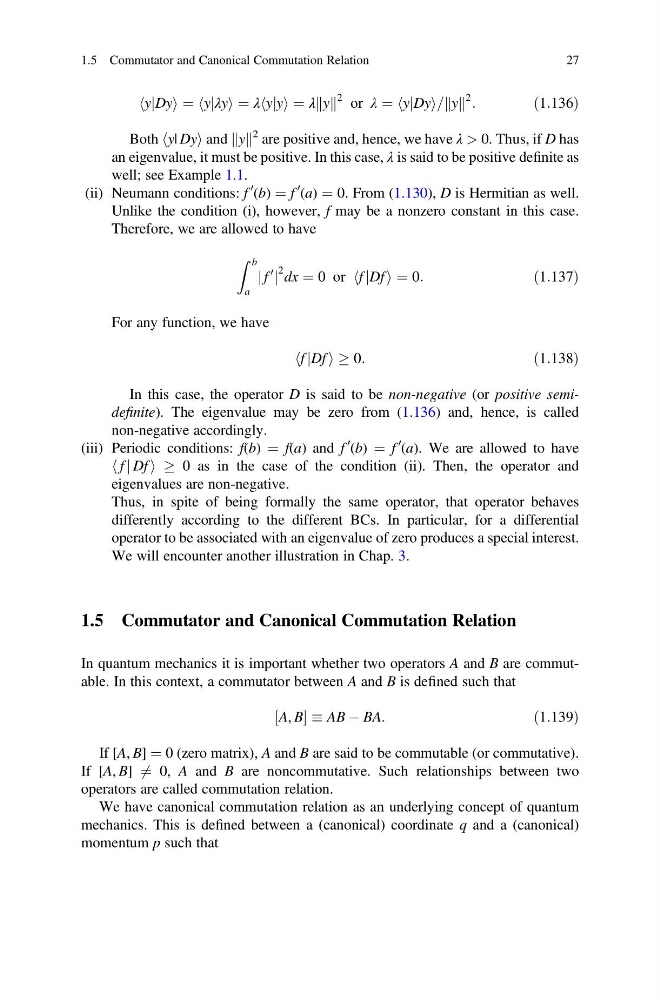
yjDy
h
i¼ yjλy
h
i ¼ λ yjy
h i ¼ λ y
k k
2 or λ ¼ yjDy
h
i= y
k k
2 :
ð1:136Þ
Both hy| Dyi and kyk
2 are positive and, hence, we have λ > 0. Thus, if D has
an eigenvalue, it must be positive. In this case, λ is said to be positive definite as
well; see Example 1.1.
(ii) Neumann conditions: f
0 (b) ¼ f
0 (a) ¼ 0. From (1.130), D is Hermitian as well.
Unlike the condition (i), however, f may be a nonzero constant in this case.
Therefore, we are allowed to have
Z b
a
f
0
j j
2 dx ¼ 0 or f jDf
h
i¼ 0:
ð1:137Þ
For any function, we have
f jDf
h
i! 0:
ð1:138Þ
In this case, the operator D is said to be non-negative (or positive semidefinite). The eigenvalue may be zero from (1.136) and, hence, is called
non-negative accordingly.
(iii) Periodic conditions: f(b) ¼ f(a) and f
0 (b) ¼ f
0
(a). We are allowed to have
h f j Df i ! 0 as in the case of the condition (ii). Then, the operator and
eigenvalues are non-negative.
Thus, in spite of being formally the same operator, that operator behaves
differently according to the different BCs. In particular, for a differential
operator to be associated with an eigenvalue of zero produces a special interest.
We will encounter another illustration in Chap. 3.
1.5 Commutator and Canonical Commutation Relation
In quantum mechanics it is important whether two operators A and B are commutable. In this context, a commutator between A and B is defined such that
A, B
½
AB À BA:
ð1:139Þ
If [A, B] ¼ 0 (zero matrix), A and B are said to be commutable (or commutative).
If [A, B] 6 ¼ 0, A and B are noncommutative. Such relationships between two
operators are called commutation relation.
We have canonical commutation relation as an underlying concept of quantum
mechanics. This is defined between a (canonical) coordinate q and a (canonical)
momentum p such that
1.5 Commutator and Canonical Commutation Relation
27
h
i¼ yjλy
h
i ¼ λ yjy
h i ¼ λ y
k k
2 or λ ¼ yjDy
h
i= y
k k
2 :
ð1:136Þ
Both hy| Dyi and kyk
2 are positive and, hence, we have λ > 0. Thus, if D has
an eigenvalue, it must be positive. In this case, λ is said to be positive definite as
well; see Example 1.1.
(ii) Neumann conditions: f
0 (b) ¼ f
0 (a) ¼ 0. From (1.130), D is Hermitian as well.
Unlike the condition (i), however, f may be a nonzero constant in this case.
Therefore, we are allowed to have
Z b
a
f
0
j j
2 dx ¼ 0 or f jDf
h
i¼ 0:
ð1:137Þ
For any function, we have
f jDf
h
i! 0:
ð1:138Þ
In this case, the operator D is said to be non-negative (or positive semidefinite). The eigenvalue may be zero from (1.136) and, hence, is called
non-negative accordingly.
(iii) Periodic conditions: f(b) ¼ f(a) and f
0 (b) ¼ f
0
(a). We are allowed to have
h f j Df i ! 0 as in the case of the condition (ii). Then, the operator and
eigenvalues are non-negative.
Thus, in spite of being formally the same operator, that operator behaves
differently according to the different BCs. In particular, for a differential
operator to be associated with an eigenvalue of zero produces a special interest.
We will encounter another illustration in Chap. 3.
1.5 Commutator and Canonical Commutation Relation
In quantum mechanics it is important whether two operators A and B are commutable. In this context, a commutator between A and B is defined such that
A, B
½
AB À BA:
ð1:139Þ
If [A, B] ¼ 0 (zero matrix), A and B are said to be commutable (or commutative).
If [A, B] 6 ¼ 0, A and B are noncommutative. Such relationships between two
operators are called commutation relation.
We have canonical commutation relation as an underlying concept of quantum
mechanics. This is defined between a (canonical) coordinate q and a (canonical)
momentum p such that
1.5 Commutator and Canonical Commutation Relation
27