

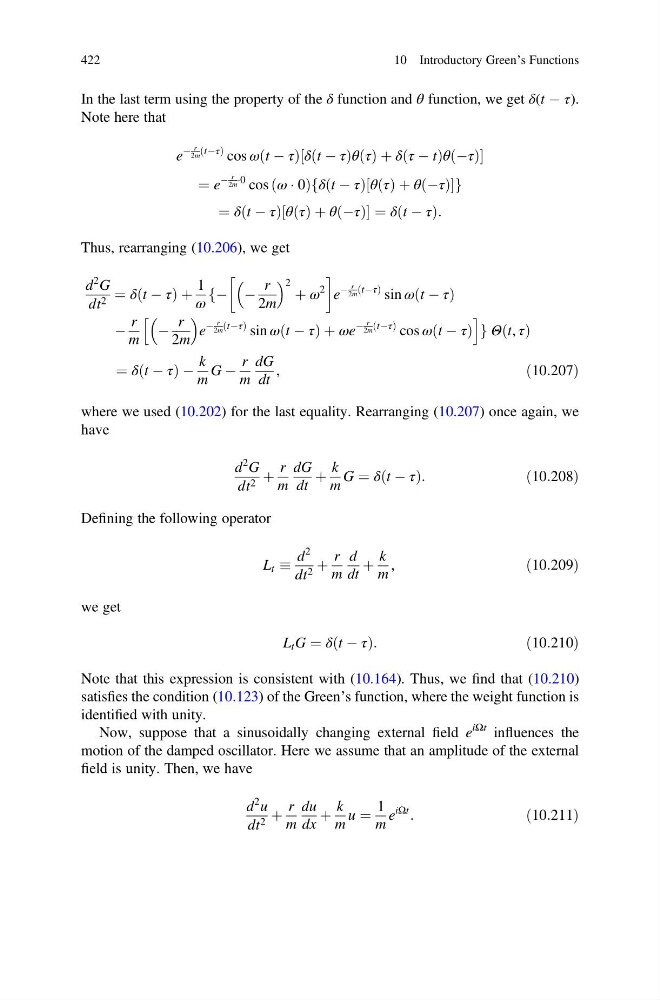
In the last term using the property of the δ function and θ function, we get δ(t À τ).
Note here that
e
À
r
2m tÀτ
ð
Þ cos ω t À τ
ð
Þδ t À τ
ð
Þθ τ
ð Þ þ δ τ À t
ð
Þθ Àτ
ð Þ
½
¼ e
À
r
2m Á0 cos ω Á 0
ð
Þ δ t À τ
ð
Þθ τ
ð Þ þ θ Àτ
ð Þ
½
f
g
¼ δ t À τ
ð
Þθ τ
ð Þ þ θ Àτ
ð Þ
½
¼δ t À τ
ð
Þ:
Thus, rearranging (10.206), we get
d
2 G
dt 2 ¼ δ t À τ
ð
Þþ
1
ω
fÀ À
r
2m
2 þ ω
2
!
e
À
r
2m tÀτ
ð
Þ sin ω t À τ
ð
Þ
À
r
m
À
r
2m
e
À
r
2m tÀτ
ð
Þ sin ω t À τ
ð
Þþωe
À
r
2m tÀτ
ð
Þ cos ω t À τ
ð
Þ
h
i
g Θ t, τ
ð Þ
¼ δ t À τ
ð
ÞÀ
k
m
G À
r
m
dG
dt
,
ð10:207Þ
where we used (10.202) for the last equality. Rearranging (10.207) once again, we
have
d
2 G
dt 2 þ
r
m
dG
dt
þ
k
m
G ¼ δ t À τ
ð
Þ:
ð10:208Þ
Defining the following operator
L t
d
2
dt 2 þ
r
m
d
dt
þ
k
m
,
ð10:209Þ
we get
L t G ¼ δ t À τ
ð
Þ:
ð10:210Þ
Note that this expression is consistent with (10.164). Thus, we find that (10.210)
satisfies the condition (10.123) of the Green’s function, where the weight function is
identified with unity.
Now, suppose that a sinusoidally changing external field e
iΩt influences the
motion of the damped oscillator. Here we assume that an amplitude of the external
field is unity. Then, we have
d
2 u
dt 2 þ
r
m
du
dx
þ
k
m
u ¼
1
m
e
iΩt
:
ð10:211Þ
422
10 Introductory Green’s Functions
Note here that
e
À
r
2m tÀτ
ð
Þ cos ω t À τ
ð
Þδ t À τ
ð
Þθ τ
ð Þ þ δ τ À t
ð
Þθ Àτ
ð Þ
½
¼ e
À
r
2m Á0 cos ω Á 0
ð
Þ δ t À τ
ð
Þθ τ
ð Þ þ θ Àτ
ð Þ
½
f
g
¼ δ t À τ
ð
Þθ τ
ð Þ þ θ Àτ
ð Þ
½
¼δ t À τ
ð
Þ:
Thus, rearranging (10.206), we get
d
2 G
dt 2 ¼ δ t À τ
ð
Þþ
1
ω
fÀ À
r
2m
2 þ ω
2
!
e
À
r
2m tÀτ
ð
Þ sin ω t À τ
ð
Þ
À
r
m
À
r
2m
e
À
r
2m tÀτ
ð
Þ sin ω t À τ
ð
Þþωe
À
r
2m tÀτ
ð
Þ cos ω t À τ
ð
Þ
h
i
g Θ t, τ
ð Þ
¼ δ t À τ
ð
ÞÀ
k
m
G À
r
m
dG
dt
,
ð10:207Þ
where we used (10.202) for the last equality. Rearranging (10.207) once again, we
have
d
2 G
dt 2 þ
r
m
dG
dt
þ
k
m
G ¼ δ t À τ
ð
Þ:
ð10:208Þ
Defining the following operator
L t
d
2
dt 2 þ
r
m
d
dt
þ
k
m
,
ð10:209Þ
we get
L t G ¼ δ t À τ
ð
Þ:
ð10:210Þ
Note that this expression is consistent with (10.164). Thus, we find that (10.210)
satisfies the condition (10.123) of the Green’s function, where the weight function is
identified with unity.
Now, suppose that a sinusoidally changing external field e
iΩt influences the
motion of the damped oscillator. Here we assume that an amplitude of the external
field is unity. Then, we have
d
2 u
dt 2 þ
r
m
du
dx
þ
k
m
u ¼
1
m
e
iΩt
:
ð10:211Þ
422
10 Introductory Green’s Functions