

n g ¼
A 1 À
c
λ
À Á 2
h
i 2 þ B
ffiffiffiffiffiffiffiffiffiffiffiffiffiffiffiffiffiffiffiffiffiffi ffi
1 À
c
λ
À Á 2
h
i 3
r
ffiffiffiffiffiffiffiffiffiffiffiffiffiffiffiffiffiffiffiffiffiffiffiffiffiffiffiffiffiffiffiffi ffi
A 1 À
c
λ
À Á 2
h
i
þ B
r
:
ð9:103Þ
Determining optimum constants A, B, and C, a set of these constants yields a reliable
dispersion formula in (9.101). Numerical calculations can be utilized effectively.
The procedures are as follows: (i) Tentatively choosing probable numbers for A, B,
and C for (9.103), n g can be expressed as a function of λ. (ii) The resulting fitting
curve is then compared with n g data experimentally decided from (9.102). After this
procedure, one can choose another set of A, and B, and C and again compare the
fitting curve with the experimental data. (iii) This procedure can be repeated many
times through iterative numerical computations of (9.103) using different sets of
A, B, and C.
Thus, we should be able to adjust and determine better and better combination of
A, B, and C so that the refined function (9.103) can reproduce the experimental
results as precise as one pleases. At the same time, we can determine the most
reliable combination of A, B, and C with the dispersion formula of (9.101). Figure 9.9
[6] shows several examples of the wavelength dispersion for organic semiconductor
crystals. Optimized constants A, B, and C of (9.101) are listed in Table 9.1 [6].
The formulae (9.101) and (9.103) along with associated procedures to determine
the constants A, B, and C are expected to apply to various laser and light-emitting
materials consisting of semiconducting inorganic and organic materials.
Example 9.2 [7] If we wish to construct a laser device, it will be highly desired to
equip the laser material with a suitable diffraction grating or resonator [8, 9]. In that
case, besides the information about the dispersion of phase refractive index, we need
numerical data of the propagation constant. The propagation constant has appeared
in Sect. 8.7.1 and is defined as
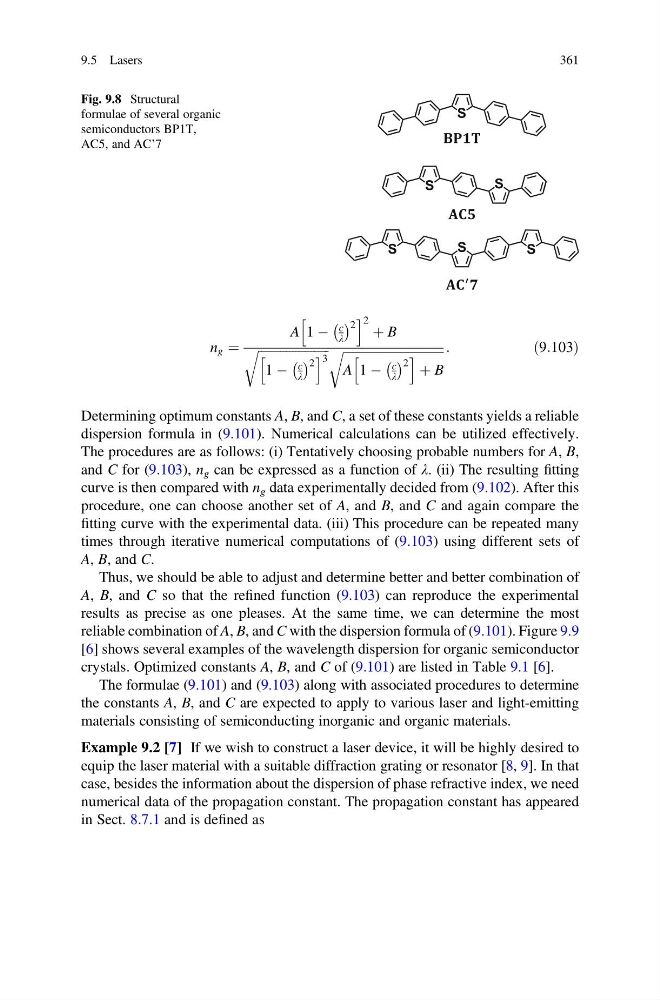
Fig. 9.8 Structural
formulae of several organic
semiconductors BP1T,
AC5, and AC’7
9.5 Lasers
361
A 1 À
c
λ
À Á 2
h
i 2 þ B
ffiffiffiffiffiffiffiffiffiffiffiffiffiffiffiffiffiffiffiffiffiffi ffi
1 À
c
λ
À Á 2
h
i 3
r
ffiffiffiffiffiffiffiffiffiffiffiffiffiffiffiffiffiffiffiffiffiffiffiffiffiffiffiffiffiffiffiffi ffi
A 1 À
c
λ
À Á 2
h
i
þ B
r
:
ð9:103Þ
Determining optimum constants A, B, and C, a set of these constants yields a reliable
dispersion formula in (9.101). Numerical calculations can be utilized effectively.
The procedures are as follows: (i) Tentatively choosing probable numbers for A, B,
and C for (9.103), n g can be expressed as a function of λ. (ii) The resulting fitting
curve is then compared with n g data experimentally decided from (9.102). After this
procedure, one can choose another set of A, and B, and C and again compare the
fitting curve with the experimental data. (iii) This procedure can be repeated many
times through iterative numerical computations of (9.103) using different sets of
A, B, and C.
Thus, we should be able to adjust and determine better and better combination of
A, B, and C so that the refined function (9.103) can reproduce the experimental
results as precise as one pleases. At the same time, we can determine the most
reliable combination of A, B, and C with the dispersion formula of (9.101). Figure 9.9
[6] shows several examples of the wavelength dispersion for organic semiconductor
crystals. Optimized constants A, B, and C of (9.101) are listed in Table 9.1 [6].
The formulae (9.101) and (9.103) along with associated procedures to determine
the constants A, B, and C are expected to apply to various laser and light-emitting
materials consisting of semiconducting inorganic and organic materials.
Example 9.2 [7] If we wish to construct a laser device, it will be highly desired to
equip the laser material with a suitable diffraction grating or resonator [8, 9]. In that
case, besides the information about the dispersion of phase refractive index, we need
numerical data of the propagation constant. The propagation constant has appeared
in Sect. 8.7.1 and is defined as
Fig. 9.8 Structural
formulae of several organic
semiconductors BP1T,
AC5, and AC’7
9.5 Lasers
361