

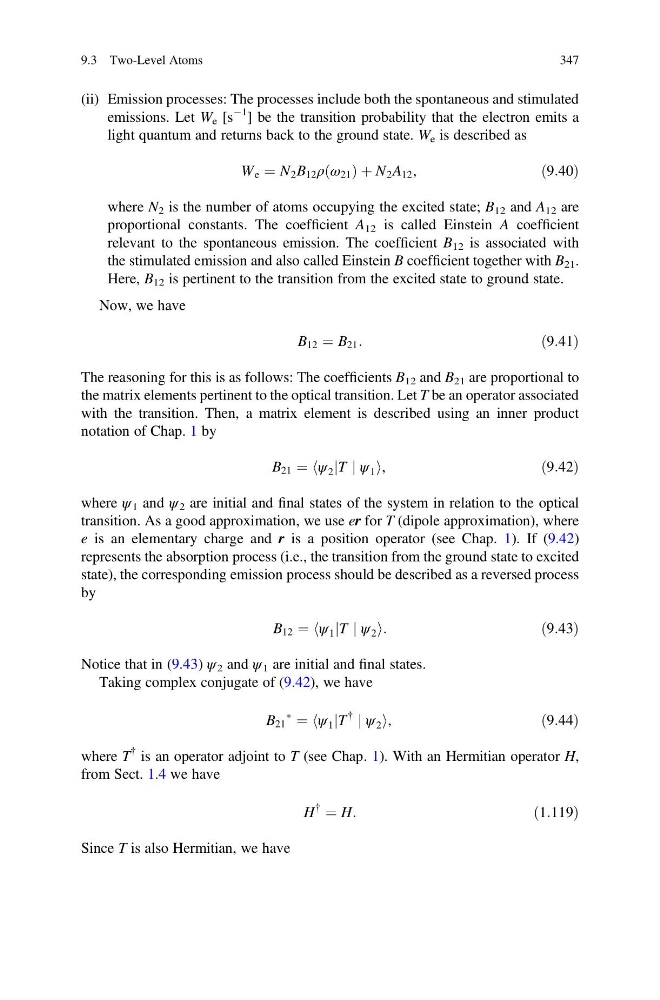
(ii) Emission processes: The processes include both the spontaneous and stimulated
emissions. Let W e [s
À1 ] be the transition probability that the electron emits a
light quantum and returns back to the ground state. W e is described as
W e ¼ N 2 B 12 ρ ω 21
ð ÞþN 2 A 12 ,
ð9:40Þ
where N 2 is the number of atoms occupying the excited state; B 12 and A 12 are
proportional constants. The coefficient A 12 is called Einstein A coefficient
relevant to the spontaneous emission. The coefficient B 12 is associated with
the stimulated emission and also called Einstein B coefficient together with B 21 .
Here, B 12 is pertinent to the transition from the excited state to ground state.
Now, we have
B 12 ¼ B 21 :
ð9:41Þ
The reasoning for this is as follows: The coefficients B 12 and B 21 are proportional to
the matrix elements pertinent to the optical transition. Let T be an operator associated
with the transition. Then, a matrix element is described using an inner product
notation of Chap. 1 by
B 21 ¼ ψ 2 j
h T j ψ 1 i,
ð9:42Þ
where ψ 1 and ψ 2 are initial and final states of the system in relation to the optical
transition. As a good approximation, we use er for T (dipole approximation), where
e is an elementary charge and r is a position operator (see Chap. 1). If (9.42)
represents the absorption process (i.e., the transition from the ground state to excited
state), the corresponding emission process should be described as a reversed process
by
B 12 ¼ ψ 1 j
h T j ψ 2 i:
ð9:43Þ
Notice that in (9.43) ψ 2 and ψ 1 are initial and final states.
Taking complex conjugate of (9.42), we have
B 21
Ã
¼ ψ 1 j
h T
{
j ψ 2 i,
ð9:44Þ
where T
{ is an operator adjoint to T (see Chap. 1). With an Hermitian operator H,
from Sect. 1.4 we have
H
{
¼ H:
ð1:119Þ
Since T is also Hermitian, we have
9.3 Two-Level Atoms
347
emissions. Let W e [s
À1 ] be the transition probability that the electron emits a
light quantum and returns back to the ground state. W e is described as
W e ¼ N 2 B 12 ρ ω 21
ð ÞþN 2 A 12 ,
ð9:40Þ
where N 2 is the number of atoms occupying the excited state; B 12 and A 12 are
proportional constants. The coefficient A 12 is called Einstein A coefficient
relevant to the spontaneous emission. The coefficient B 12 is associated with
the stimulated emission and also called Einstein B coefficient together with B 21 .
Here, B 12 is pertinent to the transition from the excited state to ground state.
Now, we have
B 12 ¼ B 21 :
ð9:41Þ
The reasoning for this is as follows: The coefficients B 12 and B 21 are proportional to
the matrix elements pertinent to the optical transition. Let T be an operator associated
with the transition. Then, a matrix element is described using an inner product
notation of Chap. 1 by
B 21 ¼ ψ 2 j
h T j ψ 1 i,
ð9:42Þ
where ψ 1 and ψ 2 are initial and final states of the system in relation to the optical
transition. As a good approximation, we use er for T (dipole approximation), where
e is an elementary charge and r is a position operator (see Chap. 1). If (9.42)
represents the absorption process (i.e., the transition from the ground state to excited
state), the corresponding emission process should be described as a reversed process
by
B 12 ¼ ψ 1 j
h T j ψ 2 i:
ð9:43Þ
Notice that in (9.43) ψ 2 and ψ 1 are initial and final states.
Taking complex conjugate of (9.42), we have
B 21
Ã
¼ ψ 1 j
h T
{
j ψ 2 i,
ð9:44Þ
where T
{ is an operator adjoint to T (see Chap. 1). With an Hermitian operator H,
from Sect. 1.4 we have
H
{
¼ H:
ð1:119Þ
Since T is also Hermitian, we have
9.3 Two-Level Atoms
347