

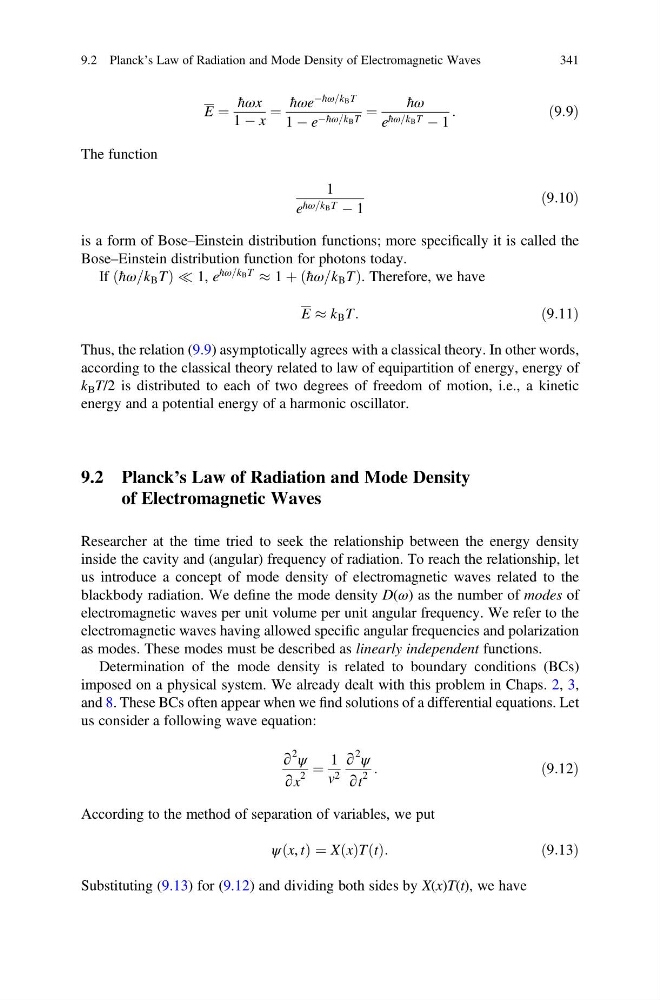
E ¼
ħωx
1 À x
¼
ħωe
Àħω=k B T
1 À e Àħω=k B T ¼
ħω
e ħω=k B T À 1
:
ð9:9Þ
The function
1
e ħω=k B T À 1
ð9:10Þ
is a form of Bose–Einstein distribution functions; more specifically it is called the
Bose–Einstein distribution function for photons today.
If ħω=k B T
ð
Þ(1, e
ħω=k B T
% 1 þ ħω=k B T
ð
Þ . Therefore, we have
E % k B T:
ð9:11Þ
Thus, the relation (9.9) asymptotically agrees with a classical theory. In other words,
according to the classical theory related to law of equipartition of energy, energy of
k B T/2 is distributed to each of two degrees of freedom of motion, i.e., a kinetic
energy and a potential energy of a harmonic oscillator.
9.2 Planck’s Law of Radiation and Mode Density
of Electromagnetic Waves
Researcher at the time tried to seek the relationship between the energy density
inside the cavity and (angular) frequency of radiation. To reach the relationship, let
us introduce a concept of mode density of electromagnetic waves related to the
blackbody radiation. We define the mode density D(ω) as the number of modes of
electromagnetic waves per unit volume per unit angular frequency. We refer to the
electromagnetic waves having allowed specific angular frequencies and polarization
as modes. These modes must be described as linearly independent functions.
Determination of the mode density is related to boundary conditions (BCs)
imposed on a physical system. We already dealt with this problem in Chaps. 2, 3,
and 8. These BCs often appear when we find solutions of a differential equations. Let
us consider a following wave equation:
∂
2 ψ
∂x
2
¼
1
v 2
∂
2 ψ
∂t
2
:
ð9:12Þ
According to the method of separation of variables, we put
ψ x, t
ð Þ ¼ X x
ð ÞT t
ð Þ:
ð9:13Þ
Substituting (9.13) for (9.12) and dividing both sides by X(x)T(t), we have
9.2 Planck’s Law of Radiation and Mode Density of Electromagnetic Waves
341
ħωx
1 À x
¼
ħωe
Àħω=k B T
1 À e Àħω=k B T ¼
ħω
e ħω=k B T À 1
:
ð9:9Þ
The function
1
e ħω=k B T À 1
ð9:10Þ
is a form of Bose–Einstein distribution functions; more specifically it is called the
Bose–Einstein distribution function for photons today.
If ħω=k B T
ð
Þ(1, e
ħω=k B T
% 1 þ ħω=k B T
ð
Þ . Therefore, we have
E % k B T:
ð9:11Þ
Thus, the relation (9.9) asymptotically agrees with a classical theory. In other words,
according to the classical theory related to law of equipartition of energy, energy of
k B T/2 is distributed to each of two degrees of freedom of motion, i.e., a kinetic
energy and a potential energy of a harmonic oscillator.
9.2 Planck’s Law of Radiation and Mode Density
of Electromagnetic Waves
Researcher at the time tried to seek the relationship between the energy density
inside the cavity and (angular) frequency of radiation. To reach the relationship, let
us introduce a concept of mode density of electromagnetic waves related to the
blackbody radiation. We define the mode density D(ω) as the number of modes of
electromagnetic waves per unit volume per unit angular frequency. We refer to the
electromagnetic waves having allowed specific angular frequencies and polarization
as modes. These modes must be described as linearly independent functions.
Determination of the mode density is related to boundary conditions (BCs)
imposed on a physical system. We already dealt with this problem in Chaps. 2, 3,
and 8. These BCs often appear when we find solutions of a differential equations. Let
us consider a following wave equation:
∂
2 ψ
∂x
2
¼
1
v 2
∂
2 ψ
∂t
2
:
ð9:12Þ
According to the method of separation of variables, we put
ψ x, t
ð Þ ¼ X x
ð ÞT t
ð Þ:
ð9:13Þ
Substituting (9.13) for (9.12) and dividing both sides by X(x)T(t), we have
9.2 Planck’s Law of Radiation and Mode Density of Electromagnetic Waves
341