

where λ 0 is a wavelength in vacuum; n 1 and n 2 are refractive indices of D1 and D2,
respectively. Combining (8.35) with (8.32), (8.36), and (8.38), we have several
relations such that
sin θ
sin ϕ
¼
k t
k i
¼
λ 1
λ 2
¼
n 2
n 1
n
ð
Þ,
ð8:39Þ
where n is said to be a relative refractive index of D2 relative to D1. The relation
(8.39) is called Snell’s law. Notice that (8.39) reflects the kinematic aspect of light
and that this characteristic comes from the exponents of (8.20).
8.3 Transverse Electric (TE) Waves and Transverse
Magnetic (TM) Waves
On the basis of the above argument, we are now in the position to determine the
relations among amplitudes of the electromagnetic fields of waves of incidence,
reflection, and transmission. Notice that since we are dealing with non-absorbing
media, the relevant amplitudes are real (i.e., positive or negative). In other words,
when the phase is retained upon reflection, we have a positive amplitude due to
e
i0
¼ 1. When the phase is reversed upon reflection, on the other hand, we will be
treating a negative amplitude due to e
iπ
¼ À 1. Nevertheless, when we consider the
total reflection, we deal with a complex amplitude (vide infra).
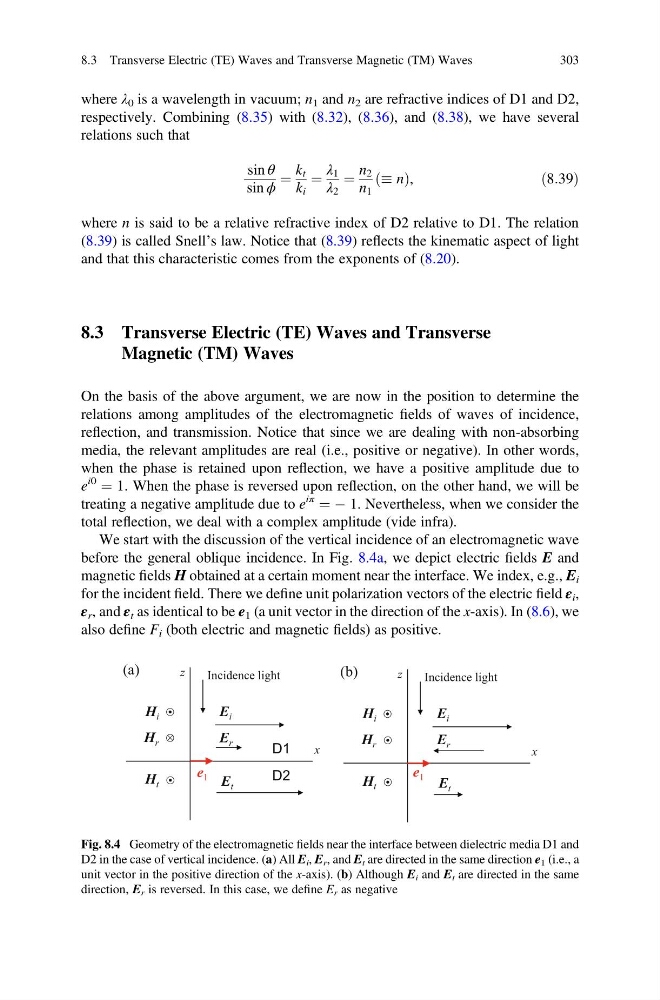
We start with the discussion of the vertical incidence of an electromagnetic wave
before the general oblique incidence. In Fig. 8.4a, we depict electric fields E and
magnetic fields H obtained at a certain moment near the interface. We index, e.g., E i
for the incident field. There we define unit polarization vectors of the electric field ε i ,
ε r , and ε t as identical to be e 1 (a unit vector in the direction of the x-axis). In (8.6), we
also define F i (both electric and magnetic fields) as positive.
x
z
E i
E r
E t
(a)
Incidence light
H t
H r
H i
x
z
E i
E r
E t
(b)
Incidence light
H t
H r
H i
e 1
e 1
'
'
Fig. 8.4 Geometry of the electromagnetic fields near the interface between dielectric media D1 and
D2 in the case of vertical incidence. (a) All E i , E r , and E t are directed in the same direction e 1 (i.e., a
unit vector in the positive direction of the x-axis). (b) Although E i and E t are directed in the same
direction, E r is reversed. In this case, we define E r as negative
8.3 Transverse Electric (TE) Waves and Transverse Magnetic (TM) Waves
303
respectively. Combining (8.35) with (8.32), (8.36), and (8.38), we have several
relations such that
sin θ
sin ϕ
¼
k t
k i
¼
λ 1
λ 2
¼
n 2
n 1
n
ð
Þ,
ð8:39Þ
where n is said to be a relative refractive index of D2 relative to D1. The relation
(8.39) is called Snell’s law. Notice that (8.39) reflects the kinematic aspect of light
and that this characteristic comes from the exponents of (8.20).
8.3 Transverse Electric (TE) Waves and Transverse
Magnetic (TM) Waves
On the basis of the above argument, we are now in the position to determine the
relations among amplitudes of the electromagnetic fields of waves of incidence,
reflection, and transmission. Notice that since we are dealing with non-absorbing
media, the relevant amplitudes are real (i.e., positive or negative). In other words,
when the phase is retained upon reflection, we have a positive amplitude due to
e
i0
¼ 1. When the phase is reversed upon reflection, on the other hand, we will be
treating a negative amplitude due to e
iπ
¼ À 1. Nevertheless, when we consider the
total reflection, we deal with a complex amplitude (vide infra).
We start with the discussion of the vertical incidence of an electromagnetic wave
before the general oblique incidence. In Fig. 8.4a, we depict electric fields E and
magnetic fields H obtained at a certain moment near the interface. We index, e.g., E i
for the incident field. There we define unit polarization vectors of the electric field ε i ,
ε r , and ε t as identical to be e 1 (a unit vector in the direction of the x-axis). In (8.6), we
also define F i (both electric and magnetic fields) as positive.
x
z
E i
E r
E t
(a)
Incidence light
H t
H r
H i
x
z
E i
E r
E t
(b)
Incidence light
H t
H r
H i
e 1
e 1
'
'
Fig. 8.4 Geometry of the electromagnetic fields near the interface between dielectric media D1 and
D2 in the case of vertical incidence. (a) All E i , E r , and E t are directed in the same direction e 1 (i.e., a
unit vector in the positive direction of the x-axis). (b) Although E i and E t are directed in the same
direction, E r is reversed. In this case, we define E r as negative
8.3 Transverse Electric (TE) Waves and Transverse Magnetic (TM) Waves
303