

u
2
E
2
1
þ
v
2
E
2
1
¼ 1:
ð7:91Þ
This represents a circle. For this reason, the wave described by (7.91) is called a
circularly polarized light. In (7.90) where δ 6 ¼ Æ π/2, the wave is said to be an
elliptically polarized light. Thus, we have linearly, elliptically, and circularly polarized lights depending on a magnitude of δ.
Let us closely examine characteristics of the elliptically and circularly polarized
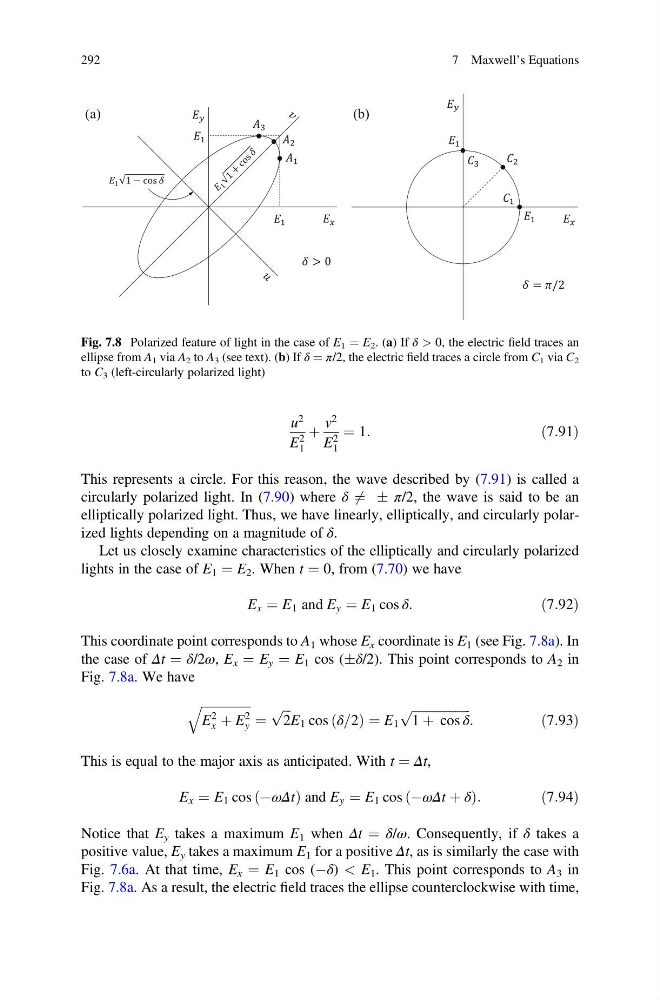
lights in the case of E 1 ¼ E 2 . When t ¼ 0, from (7.70) we have
E x ¼ E 1 and E y ¼ E 1 cos δ:
ð7:92Þ
This coordinate point corresponds to A 1 whose E x coordinate is E 1 (see Fig. 7.8a). In
the case of Δt ¼ δ/2ω, E x ¼ E y ¼ E 1 cos (Æδ/2). This point corresponds to A 2 in
Fig. 7.8a. We have
ffiffiffiffiffiffiffiffiffiffiffiffiffiffiffiffi
E
2
x þ E
2
y
q
¼
ffiffi ffi
2
p
E 1 cos δ=2
ð Þ ¼ E 1
ffiffiffiffiffiffiffiffiffiffiffiffiffiffiffiffiffiffi ffi
1 þ cos δ
p
:
ð7:93Þ
This is equal to the major axis as anticipated. With t ¼ Δt,
E x ¼ E 1 cos ÀωΔt
ð
Þand E y ¼ E 1 cos ÀωΔt þ δ
ð
Þ :
ð7:94Þ
Notice that E y takes a maximum E 1 when Δt ¼ δ/ω. Consequently, if δ takes a
positive value, E y takes a maximum E 1 for a positive Δt, as is similarly the case with
Fig. 7.6a. At that time, E x ¼ E 1 cos (Àδ) < E 1 . This point corresponds to A 3 in
Fig. 7.8a. As a result, the electric field traces the ellipse counterclockwise with time,
1 − cos
> 0
(a)
= /2
(b)
Fig. 7.8 Polarized feature of light in the case of E 1 ¼ E 2 . (a) If δ > 0, the electric field traces an
ellipse from A 1 via A 2 to A 3 (see text). (b) If δ ¼ π/2, the electric field traces a circle from C 1 via C 2
to C 3 (left-circularly polarized light)
292
7 Maxwell’s Equations
2
E
2
1
þ
v
2
E
2
1
¼ 1:
ð7:91Þ
This represents a circle. For this reason, the wave described by (7.91) is called a
circularly polarized light. In (7.90) where δ 6 ¼ Æ π/2, the wave is said to be an
elliptically polarized light. Thus, we have linearly, elliptically, and circularly polarized lights depending on a magnitude of δ.
Let us closely examine characteristics of the elliptically and circularly polarized
lights in the case of E 1 ¼ E 2 . When t ¼ 0, from (7.70) we have
E x ¼ E 1 and E y ¼ E 1 cos δ:
ð7:92Þ
This coordinate point corresponds to A 1 whose E x coordinate is E 1 (see Fig. 7.8a). In
the case of Δt ¼ δ/2ω, E x ¼ E y ¼ E 1 cos (Æδ/2). This point corresponds to A 2 in
Fig. 7.8a. We have
ffiffiffiffiffiffiffiffiffiffiffiffiffiffiffiffi
E
2
x þ E
2
y
q
¼
ffiffi ffi
2
p
E 1 cos δ=2
ð Þ ¼ E 1
ffiffiffiffiffiffiffiffiffiffiffiffiffiffiffiffiffiffi ffi
1 þ cos δ
p
:
ð7:93Þ
This is equal to the major axis as anticipated. With t ¼ Δt,
E x ¼ E 1 cos ÀωΔt
ð
Þand E y ¼ E 1 cos ÀωΔt þ δ
ð
Þ :
ð7:94Þ
Notice that E y takes a maximum E 1 when Δt ¼ δ/ω. Consequently, if δ takes a
positive value, E y takes a maximum E 1 for a positive Δt, as is similarly the case with
Fig. 7.6a. At that time, E x ¼ E 1 cos (Àδ) < E 1 . This point corresponds to A 3 in
Fig. 7.8a. As a result, the electric field traces the ellipse counterclockwise with time,
1 − cos
> 0
(a)
= /2
(b)
Fig. 7.8 Polarized feature of light in the case of E 1 ¼ E 2 . (a) If δ > 0, the electric field traces an
ellipse from A 1 via A 2 to A 3 (see text). (b) If δ ¼ π/2, the electric field traces a circle from C 1 via C 2
to C 3 (left-circularly polarized light)
292
7 Maxwell’s Equations