

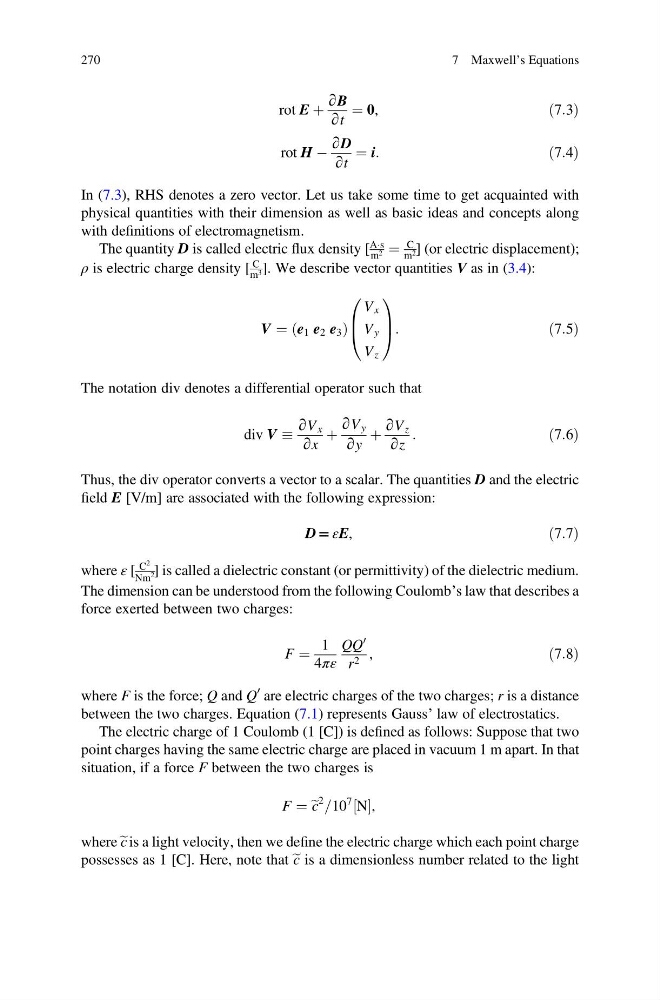
rot E þ
∂B
∂t
¼ 0,
ð7:3Þ
rot H À
∂D
∂t
¼ i:
ð7:4Þ
In (7.3), RHS denotes a zero vector. Let us take some time to get acquainted with
physical quantities with their dimension as well as basic ideas and concepts along
with definitions of electromagnetism.
The quantity D is called electric flux density [
AÁs
m 2 ¼
C
m 2 ] (or electric displacement);
ρ is electric charge density [
C
m 3 ]. We describe vector quantities V as in (3.4):
V ¼ e 1 e 2 e 3
ð
Þ
V x
V y
V z
0
B
@
1
C
A:
ð7:5Þ
The notation div denotes a differential operator such that
div V
∂V x
∂x
þ
∂V y
∂y
þ
∂V z
∂z
:
ð7:6Þ
Thus, the div operator converts a vector to a scalar. The quantities D and the electric
field E [V/m] are associated with the following expression:
D = εE,
ð7:7Þ
where ε [
C
2
Nm
2 ] is called a dielectric constant (or permittivity) of the dielectric medium.
The dimension can be understood from the following Coulomb’s law that describes a
force exerted between two charges:
F ¼
1
4πε
QQ
0
r 2 ,
ð7:8Þ
where F is the force; Q and Q
0 are electric charges of the two charges; r is a distance
between the two charges. Equation (7.1) represents Gauss’ law of electrostatics.
The electric charge of 1 Coulomb (1 [C]) is defined as follows: Suppose that two
point charges having the same electric charge are placed in vacuum 1 m apart. In that
situation, if a force F between the two charges is
F ¼ e c
2 =10
7 N
½ ,
where e c is a light velocity, then we define the electric charge which each point charge
possesses as 1 [C]. Here, note that e c is a dimensionless number related to the light
270
7 Maxwell’s Equations
∂B
∂t
¼ 0,
ð7:3Þ
rot H À
∂D
∂t
¼ i:
ð7:4Þ
In (7.3), RHS denotes a zero vector. Let us take some time to get acquainted with
physical quantities with their dimension as well as basic ideas and concepts along
with definitions of electromagnetism.
The quantity D is called electric flux density [
AÁs
m 2 ¼
C
m 2 ] (or electric displacement);
ρ is electric charge density [
C
m 3 ]. We describe vector quantities V as in (3.4):
V ¼ e 1 e 2 e 3
ð
Þ
V x
V y
V z
0
B
@
1
C
A:
ð7:5Þ
The notation div denotes a differential operator such that
div V
∂V x
∂x
þ
∂V y
∂y
þ
∂V z
∂z
:
ð7:6Þ
Thus, the div operator converts a vector to a scalar. The quantities D and the electric
field E [V/m] are associated with the following expression:
D = εE,
ð7:7Þ
where ε [
C
2
Nm
2 ] is called a dielectric constant (or permittivity) of the dielectric medium.
The dimension can be understood from the following Coulomb’s law that describes a
force exerted between two charges:
F ¼
1
4πε
0
r 2 ,
ð7:8Þ
where F is the force; Q and Q
0 are electric charges of the two charges; r is a distance
between the two charges. Equation (7.1) represents Gauss’ law of electrostatics.
The electric charge of 1 Coulomb (1 [C]) is defined as follows: Suppose that two
point charges having the same electric charge are placed in vacuum 1 m apart. In that
situation, if a force F between the two charges is
F ¼ e c
2 =10
7 N
½ ,
where e c is a light velocity, then we define the electric charge which each point charge
possesses as 1 [C]. Here, note that e c is a dimensionless number related to the light
270
7 Maxwell’s Equations