

Z
Q
0 P
0
1
ffiffiffiffiffiffiffiffiffiffiffiffiffiffiffiffiffiffiffiffiffiffiffiffiffiffiffiffi
z À a
ð
Þ z À b
ð
Þ
p
dz ¼
Z a
b
e
Àiπ=2
ffiffiffiffiffiffiffiffiffiffiffiffiffiffiffiffiffiffiffiffiffiffiffiffiffiffiffiffi ffi
x À a
ð
Þ b À x
ð
Þ
p
dx ¼ À
Z a
b
i
ffiffiffiffiffiffiffiffiffiffiffiffiffiffiffiffiffiffiffiffiffiffiffiffiffiffiffiffi ffi
x À a
ð
Þ b À x
ð
Þ
p
dx
¼ i
Z b
a
1
ffiffiffiffiffiffiffiffiffiffiffiffiffiffiffiffiffiffiffiffiffiffiffiffiffiffiffiffi ffi
x À a
ð
Þ b À x
ð
Þ
p
dx:
ð6:260Þ
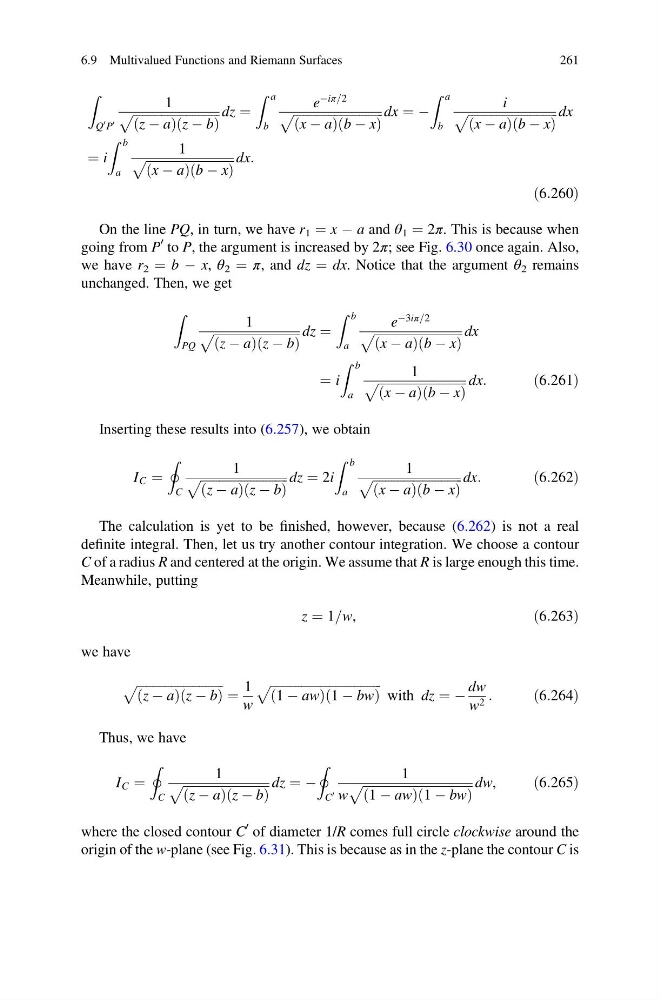
On the line PQ, in turn, we have r 1 ¼ x À a and θ 1 ¼ 2π. This is because when
going from P
0 to P, the argument is increased by 2π; see Fig. 6.30 once again. Also,
we have r 2 ¼ b À x, θ 2 ¼ π, and dz ¼ dx. Notice that the argument θ 2 remains
unchanged. Then, we get
Z
PQ
1
ffiffiffiffiffiffiffiffiffiffiffiffiffiffiffiffiffiffiffiffiffiffiffiffiffiffiffiffi
z À a
ð
Þ z À b
ð
Þ
p
dz ¼
Z b
a
e
À3iπ=2
ffiffiffiffiffiffiffiffiffiffiffiffiffiffiffiffiffiffiffiffiffiffiffiffiffiffiffiffi ffi
x À a
ð
Þ b À x
ð
Þ
p
dx
¼ i
Z b
a
1
ffiffiffiffiffiffiffiffiffiffiffiffiffiffiffiffiffiffiffiffiffiffiffiffiffiffiffiffi ffi
x À a
ð
Þ b À x
ð
Þ
p
dx:
ð6:261Þ
Inserting these results into (6.257), we obtain
I C ¼
I
C
1
ffiffiffiffiffiffiffiffiffiffiffiffiffiffiffiffiffiffiffiffiffiffiffiffiffiffiffiffi
z À a
ð
Þ z À b
ð
Þ
p
dz ¼ 2i
Z b
a
1
ffiffiffiffiffiffiffiffiffiffiffiffiffiffiffiffiffiffiffiffiffiffiffiffiffiffiffiffi ffi
x À a
ð
Þ b À x
ð
Þ
p
dx:
ð6:262Þ
The calculation is yet to be finished, however, because (6.262) is not a real
definite integral. Then, let us try another contour integration. We choose a contour
C of a radius R and centered at the origin. We assume that R is large enough this time.
Meanwhile, putting
z ¼ 1=w,
ð6:263Þ
we have
ffiffiffiffiffiffiffiffiffiffiffiffiffiffiffiffiffiffiffiffiffiffiffiffiffiffiffiffi
z À a
ð
Þ z À b
ð
Þ
p
¼
1
w
ffiffiffiffiffiffiffiffiffiffiffiffiffiffiffiffiffiffiffiffiffiffiffiffiffiffiffiffiffiffiffiffiffiffiffi ffi
1 À aw
ð
Þ1 À bw
ð
Þ
p
with dz ¼ À
dw
w 2 :
ð6:264Þ
Thus, we have
I C ¼
I
C
1
ffiffiffiffiffiffiffiffiffiffiffiffiffiffiffiffiffiffiffiffiffiffiffiffiffiffiffiffi
z À a
ð
Þ z À b
ð
Þ
p
dz ¼ À
I
C
0
1
w
ffiffiffiffiffiffiffiffiffiffiffiffiffiffiffiffiffiffiffiffiffiffiffiffiffiffiffiffiffiffiffiffiffiffiffi ffi
1 À aw
ð
Þ1 À bw
ð
Þ
p
dw,
ð6:265Þ
where the closed contour C
0 of diameter 1/R comes full circle clockwise around the
origin of the w-plane (see Fig. 6.31). This is because as in the z-plane the contour C is
6.9 Multivalued Functions and Riemann Surfaces
261
Q
0 P
0
1
ffiffiffiffiffiffiffiffiffiffiffiffiffiffiffiffiffiffiffiffiffiffiffiffiffiffiffiffi
z À a
ð
Þ z À b
ð
Þ
p
dz ¼
Z a
b
e
Àiπ=2
ffiffiffiffiffiffiffiffiffiffiffiffiffiffiffiffiffiffiffiffiffiffiffiffiffiffiffiffi ffi
x À a
ð
Þ b À x
ð
Þ
p
dx ¼ À
Z a
b
i
ffiffiffiffiffiffiffiffiffiffiffiffiffiffiffiffiffiffiffiffiffiffiffiffiffiffiffiffi ffi
x À a
ð
Þ b À x
ð
Þ
p
dx
¼ i
Z b
a
1
ffiffiffiffiffiffiffiffiffiffiffiffiffiffiffiffiffiffiffiffiffiffiffiffiffiffiffiffi ffi
x À a
ð
Þ b À x
ð
Þ
p
dx:
ð6:260Þ
On the line PQ, in turn, we have r 1 ¼ x À a and θ 1 ¼ 2π. This is because when
going from P
0 to P, the argument is increased by 2π; see Fig. 6.30 once again. Also,
we have r 2 ¼ b À x, θ 2 ¼ π, and dz ¼ dx. Notice that the argument θ 2 remains
unchanged. Then, we get
Z
PQ
1
ffiffiffiffiffiffiffiffiffiffiffiffiffiffiffiffiffiffiffiffiffiffiffiffiffiffiffiffi
z À a
ð
Þ z À b
ð
Þ
p
dz ¼
Z b
a
e
À3iπ=2
ffiffiffiffiffiffiffiffiffiffiffiffiffiffiffiffiffiffiffiffiffiffiffiffiffiffiffiffi ffi
x À a
ð
Þ b À x
ð
Þ
p
dx
¼ i
Z b
a
1
ffiffiffiffiffiffiffiffiffiffiffiffiffiffiffiffiffiffiffiffiffiffiffiffiffiffiffiffi ffi
x À a
ð
Þ b À x
ð
Þ
p
dx:
ð6:261Þ
Inserting these results into (6.257), we obtain
I C ¼
I
C
1
ffiffiffiffiffiffiffiffiffiffiffiffiffiffiffiffiffiffiffiffiffiffiffiffiffiffiffiffi
z À a
ð
Þ z À b
ð
Þ
p
dz ¼ 2i
Z b
a
1
ffiffiffiffiffiffiffiffiffiffiffiffiffiffiffiffiffiffiffiffiffiffiffiffiffiffiffiffi ffi
x À a
ð
Þ b À x
ð
Þ
p
dx:
ð6:262Þ
The calculation is yet to be finished, however, because (6.262) is not a real
definite integral. Then, let us try another contour integration. We choose a contour
C of a radius R and centered at the origin. We assume that R is large enough this time.
Meanwhile, putting
z ¼ 1=w,
ð6:263Þ
we have
ffiffiffiffiffiffiffiffiffiffiffiffiffiffiffiffiffiffiffiffiffiffiffiffiffiffiffiffi
z À a
ð
Þ z À b
ð
Þ
p
¼
1
w
ffiffiffiffiffiffiffiffiffiffiffiffiffiffiffiffiffiffiffiffiffiffiffiffiffiffiffiffiffiffiffiffiffiffiffi ffi
1 À aw
ð
Þ1 À bw
ð
Þ
p
with dz ¼ À
dw
w 2 :
ð6:264Þ
Thus, we have
I C ¼
I
C
1
ffiffiffiffiffiffiffiffiffiffiffiffiffiffiffiffiffiffiffiffiffiffiffiffiffiffiffiffi
z À a
ð
Þ z À b
ð
Þ
p
dz ¼ À
I
C
0
1
w
ffiffiffiffiffiffiffiffiffiffiffiffiffiffiffiffiffiffiffiffiffiffiffiffiffiffiffiffiffiffiffiffiffiffiffi ffi
1 À aw
ð
Þ1 À bw
ð
Þ
p
dw,
ð6:265Þ
where the closed contour C
0 of diameter 1/R comes full circle clockwise around the
origin of the w-plane (see Fig. 6.31). This is because as in the z-plane the contour C is
6.9 Multivalued Functions and Riemann Surfaces
261