

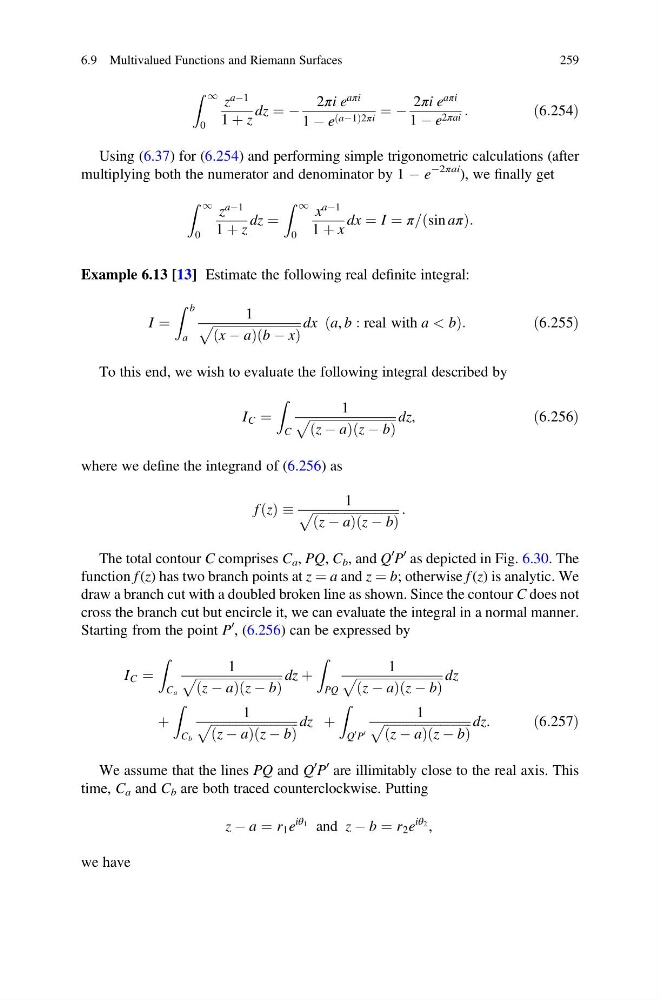
Z 1
0
z
aÀ1
1 þ z
dz ¼ À
2πi e
aπi
1 À e aÀ1
ð
Þ2πi
¼ À
2πi e
aπi
1 À e 2πai :
ð6:254Þ
Using (6.37) for (6.254) and performing simple trigonometric calculations (after
multiplying both the numerator and denominator by 1 À e
À2πai ), we finally get
Z 1
0
z
aÀ1
1 þ z
dz ¼
Z 1
0
x
aÀ1
1 þ x
dx ¼ I ¼ π= sin aπ
ð
Þ:
Example 6.13 [13] Estimate the following real definite integral:
I ¼
Z b
a
1
ffiffiffiffiffiffiffiffiffiffiffiffiffiffiffiffiffiffiffiffiffiffiffiffiffiffiffiffi ffi
x À a
ð
Þ b À x
ð
Þ
p
dx a, b : real with a < b
ð
Þ :
ð6:255Þ
To this end, we wish to evaluate the following integral described by
I C ¼
Z
C
1
ffiffiffiffiffiffiffiffiffiffiffiffiffiffiffiffiffiffiffiffiffiffiffiffiffiffiffiffi
z À a
ð
Þ z À b
ð
Þ
p
dz,
ð6:256Þ
where we define the integrand of (6.256) as
f z
ð Þ
1
ffiffiffiffiffiffiffiffiffiffiffiffiffiffiffiffiffiffiffiffiffiffiffiffiffiffiffiffi
z À a
ð
Þ z À b
ð
Þ
p
:
The total contour C comprises C a , PQ, C b , and Q
0 P
0 as depicted in Fig. 6.30. The
function f (z) has two branch points at z ¼ a and z ¼ b; otherwise f (z) is analytic. We
draw a branch cut with a doubled broken line as shown. Since the contour C does not
cross the branch cut but encircle it, we can evaluate the integral in a normal manner.
Starting from the point P
0 , (6.256) can be expressed by
I C ¼
Z
C a
1
ffiffiffiffiffiffiffiffiffiffiffiffiffiffiffiffiffiffiffiffiffiffiffiffiffiffiffiffi
z À a
ð
Þ z À b
ð
Þ
p
dz þ
Z
PQ
1
ffiffiffiffiffiffiffiffiffiffiffiffiffiffiffiffiffiffiffiffiffiffiffiffiffiffiffiffi
z À a
ð
Þ z À b
ð
Þ
p
dz
þ
Z
C b
1
ffiffiffiffiffiffiffiffiffiffiffiffiffiffiffiffiffiffiffiffiffiffiffiffiffiffiffiffi
z À a
ð
Þ z À b
ð
Þ
p
dz þ
Z
Q
0 P
0
1
ffiffiffiffiffiffiffiffiffiffiffiffiffiffiffiffiffiffiffiffiffiffiffiffiffiffiffiffi
z À a
ð
Þ z À b
ð
Þ
p
dz:
ð6:257Þ
We assume that the lines PQ and Q
0
P
0 are illimitably close to the real axis. This
time, C a and C b are both traced counterclockwise. Putting
z À a ¼ r 1 e
iθ 1 and z À b ¼ r 2 e
iθ 2 ,
we have
6.9 Multivalued Functions and Riemann Surfaces
259
0
z
aÀ1
1 þ z
dz ¼ À
2πi e
aπi
1 À e aÀ1
ð
Þ2πi
¼ À
2πi e
aπi
1 À e 2πai :
ð6:254Þ
Using (6.37) for (6.254) and performing simple trigonometric calculations (after
multiplying both the numerator and denominator by 1 À e
À2πai ), we finally get
Z 1
0
z
aÀ1
1 þ z
dz ¼
Z 1
0
x
aÀ1
1 þ x
dx ¼ I ¼ π= sin aπ
ð
Þ:
Example 6.13 [13] Estimate the following real definite integral:
I ¼
Z b
a
1
ffiffiffiffiffiffiffiffiffiffiffiffiffiffiffiffiffiffiffiffiffiffiffiffiffiffiffiffi ffi
x À a
ð
Þ b À x
ð
Þ
p
dx a, b : real with a < b
ð
Þ :
ð6:255Þ
To this end, we wish to evaluate the following integral described by
I C ¼
Z
C
1
ffiffiffiffiffiffiffiffiffiffiffiffiffiffiffiffiffiffiffiffiffiffiffiffiffiffiffiffi
z À a
ð
Þ z À b
ð
Þ
p
dz,
ð6:256Þ
where we define the integrand of (6.256) as
f z
ð Þ
1
ffiffiffiffiffiffiffiffiffiffiffiffiffiffiffiffiffiffiffiffiffiffiffiffiffiffiffiffi
z À a
ð
Þ z À b
ð
Þ
p
:
The total contour C comprises C a , PQ, C b , and Q
0 P
0 as depicted in Fig. 6.30. The
function f (z) has two branch points at z ¼ a and z ¼ b; otherwise f (z) is analytic. We
draw a branch cut with a doubled broken line as shown. Since the contour C does not
cross the branch cut but encircle it, we can evaluate the integral in a normal manner.
Starting from the point P
0 , (6.256) can be expressed by
I C ¼
Z
C a
1
ffiffiffiffiffiffiffiffiffiffiffiffiffiffiffiffiffiffiffiffiffiffiffiffiffiffiffiffi
z À a
ð
Þ z À b
ð
Þ
p
dz þ
Z
PQ
1
ffiffiffiffiffiffiffiffiffiffiffiffiffiffiffiffiffiffiffiffiffiffiffiffiffiffiffiffi
z À a
ð
Þ z À b
ð
Þ
p
dz
þ
Z
C b
1
ffiffiffiffiffiffiffiffiffiffiffiffiffiffiffiffiffiffiffiffiffiffiffiffiffiffiffiffi
z À a
ð
Þ z À b
ð
Þ
p
dz þ
Z
Q
0 P
0
1
ffiffiffiffiffiffiffiffiffiffiffiffiffiffiffiffiffiffiffiffiffiffiffiffiffiffiffiffi
z À a
ð
Þ z À b
ð
Þ
p
dz:
ð6:257Þ
We assume that the lines PQ and Q
0
P
0 are illimitably close to the real axis. This
time, C a and C b are both traced counterclockwise. Putting
z À a ¼ r 1 e
iθ 1 and z À b ¼ r 2 e
iθ 2 ,
we have
6.9 Multivalued Functions and Riemann Surfaces
259