

From (6.242), we find that adding 2π to θ a or θ b , w 0 and w 1 are switched to each
other as before. We also find that after the variable z has come full circle around one
of a and b, w 0 (θ a , θ b ) changes sign as in the case of (6.235).
We also have
w 0 θ a À 2π, θ b À 2π
ð
Þ ¼ w 0 θ a , θ b
ð
Þ, w 1 θ a À 2π, θ b À 2π
ð
Þ ¼ w 1 θ a , θ b
ð
Þ: ð6:243Þ
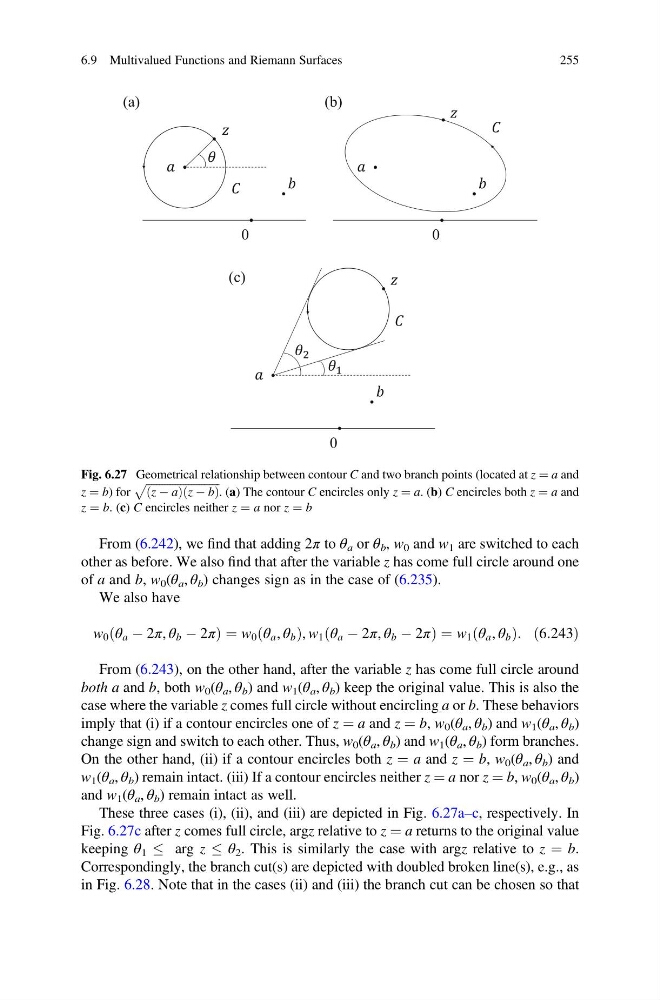
From (6.243), on the other hand, after the variable z has come full circle around
both a and b, both w 0 (θ a , θ b ) and w 1 (θ a , θ b ) keep the original value. This is also the
case where the variable z comes full circle without encircling a or b. These behaviors
imply that (i) if a contour encircles one of z ¼ a and z ¼ b, w 0 (θ a , θ b ) and w 1 (θ a , θ b )
change sign and switch to each other. Thus, w 0 (θ a , θ b ) and w 1 (θ a , θ b ) form branches.
On the other hand, (ii) if a contour encircles both z ¼ a and z ¼ b, w 0 (θ a , θ b ) and
w 1 (θ a , θ b ) remain intact. (iii) If a contour encircles neither z ¼ a nor z ¼ b, w 0 (θ a , θ b )
and w 1 (θ a , θ b ) remain intact as well.
These three cases (i), (ii), and (iii) are depicted in Fig. 6.27a–c, respectively. In
Fig. 6.27c after z comes full circle, argz relative to z ¼ a returns to the original value
keeping θ 1
arg z
θ 2 . This is similarly the case with argz relative to z ¼ b.
Correspondingly, the branch cut(s) are depicted with doubled broken line(s), e.g., as
in Fig. 6.28. Note that in the cases (ii) and (iii) the branch cut can be chosen so that
0
(a)
0
(b)
0
(c)
Fig. 6.27 Geometrical relationship between contour C and two branch points (located at z ¼ a and
z ¼ b) for
ffiffiffiffiffiffiffiffiffiffiffiffiffiffiffiffiffiffiffiffiffiffiffiffiffiffiffiffi
z À a
ð
Þ z À b
ð
Þ
p
. (a) The contour C encircles only z ¼ a. (b) C encircles both z ¼ a and
z ¼ b. (c) C encircles neither z ¼ a nor z ¼ b
6.9 Multivalued Functions and Riemann Surfaces
255
other as before. We also find that after the variable z has come full circle around one
of a and b, w 0 (θ a , θ b ) changes sign as in the case of (6.235).
We also have
w 0 θ a À 2π, θ b À 2π
ð
Þ ¼ w 0 θ a , θ b
ð
Þ, w 1 θ a À 2π, θ b À 2π
ð
Þ ¼ w 1 θ a , θ b
ð
Þ: ð6:243Þ
From (6.243), on the other hand, after the variable z has come full circle around
both a and b, both w 0 (θ a , θ b ) and w 1 (θ a , θ b ) keep the original value. This is also the
case where the variable z comes full circle without encircling a or b. These behaviors
imply that (i) if a contour encircles one of z ¼ a and z ¼ b, w 0 (θ a , θ b ) and w 1 (θ a , θ b )
change sign and switch to each other. Thus, w 0 (θ a , θ b ) and w 1 (θ a , θ b ) form branches.
On the other hand, (ii) if a contour encircles both z ¼ a and z ¼ b, w 0 (θ a , θ b ) and
w 1 (θ a , θ b ) remain intact. (iii) If a contour encircles neither z ¼ a nor z ¼ b, w 0 (θ a , θ b )
and w 1 (θ a , θ b ) remain intact as well.
These three cases (i), (ii), and (iii) are depicted in Fig. 6.27a–c, respectively. In
Fig. 6.27c after z comes full circle, argz relative to z ¼ a returns to the original value
keeping θ 1
arg z
θ 2 . This is similarly the case with argz relative to z ¼ b.
Correspondingly, the branch cut(s) are depicted with doubled broken line(s), e.g., as
in Fig. 6.28. Note that in the cases (ii) and (iii) the branch cut can be chosen so that
0
(a)
0
(b)
0
(c)
Fig. 6.27 Geometrical relationship between contour C and two branch points (located at z ¼ a and
z ¼ b) for
ffiffiffiffiffiffiffiffiffiffiffiffiffiffiffiffiffiffiffiffiffiffiffiffiffiffiffiffi
z À a
ð
Þ z À b
ð
Þ
p
. (a) The contour C encircles only z ¼ a. (b) C encircles both z ¼ a and
z ¼ b. (c) C encircles neither z ¼ a nor z ¼ b
6.9 Multivalued Functions and Riemann Surfaces
255