

w ¼ z
1=n
:
ð6:227Þ
We have expressly shown this simple thing. It is because if we think of real z, z
1/n
is uniquely determined only when n is odd regardless of whether z is positive or
negative. In case we think of even n, (i) if z is positive, we have two n-th root of Æz
1/n
.
(ii) If z is negative, on the other hand, we have no n-th root. Meanwhile, if we think
of complex z, we have a totally different situation. That is, regardless of whether n is
odd or even, we always have n different z
1/n for any given complex number z.
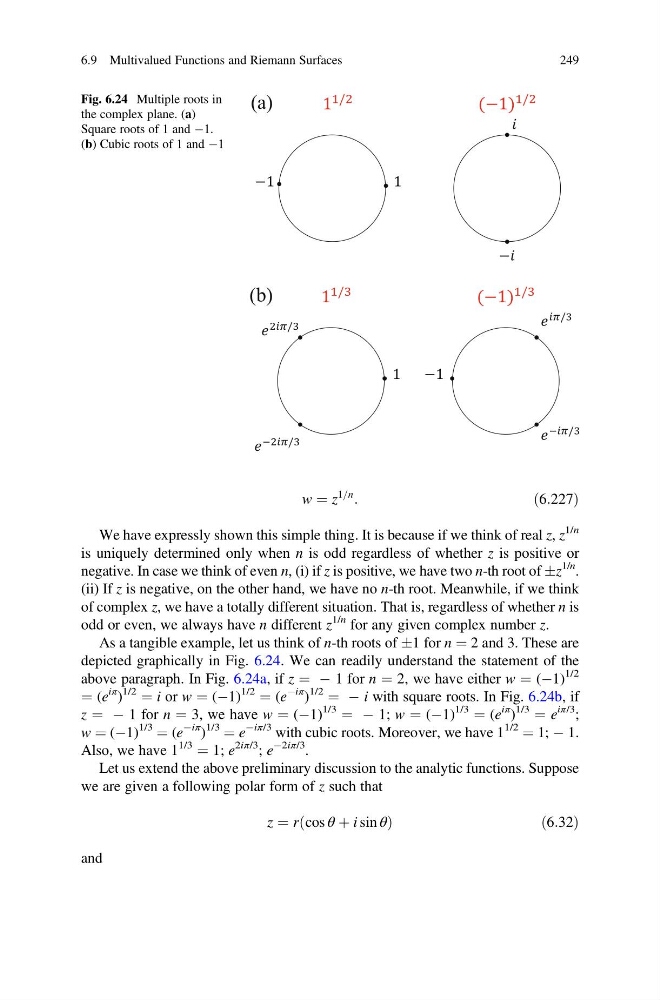
As a tangible example, let us think of n-th roots of Æ1 for n ¼ 2 and 3. These are
depicted graphically in Fig. 6.24. We can readily understand the statement of the
above paragraph. In Fig. 6.24a, if z ¼ À 1 for n ¼ 2, we have either w ¼ (À1)
1/2
¼ (e
iπ )
1/2
¼ i or w ¼ (À1)
1/2
¼ (e
Àiπ )
1/2
¼ À i with square roots. In Fig. 6.24b, if
z ¼ À 1 for n ¼ 3, we have w ¼ (À1)
1/3 ¼ À 1; w ¼ (À1)
1/3 ¼ (e
iπ )
1/3 ¼ e
iπ/3
;
w ¼ (À1)
1/3
¼ (e
Àiπ )
1/3
¼ e
Àiπ/3 with cubic roots. Moreover, we have 1
1/2
¼ 1; À 1.
Also, we have 1
1/3
¼ 1; e
2iπ/3 ; e
À2iπ/3 .
Let us extend the above preliminary discussion to the analytic functions. Suppose
we are given a following polar form of z such that
z ¼ r cos θ þ i sin θ
ð
Þ
ð 6:32Þ
and
−1
1
−
(a)
1
/
(−1)
/
(b)
1
−1
/
/
/
/
1
/
(−1)
/
Fig. 6.24 Multiple roots in
the complex plane. (a)
Square roots of 1 and À1.
(b) Cubic roots of 1 and À1
6.9 Multivalued Functions and Riemann Surfaces
249
1=n
:
ð6:227Þ
We have expressly shown this simple thing. It is because if we think of real z, z
1/n
is uniquely determined only when n is odd regardless of whether z is positive or
negative. In case we think of even n, (i) if z is positive, we have two n-th root of Æz
1/n
.
(ii) If z is negative, on the other hand, we have no n-th root. Meanwhile, if we think
of complex z, we have a totally different situation. That is, regardless of whether n is
odd or even, we always have n different z
1/n for any given complex number z.
As a tangible example, let us think of n-th roots of Æ1 for n ¼ 2 and 3. These are
depicted graphically in Fig. 6.24. We can readily understand the statement of the
above paragraph. In Fig. 6.24a, if z ¼ À 1 for n ¼ 2, we have either w ¼ (À1)
1/2
¼ (e
iπ )
1/2
¼ i or w ¼ (À1)
1/2
¼ (e
Àiπ )
1/2
¼ À i with square roots. In Fig. 6.24b, if
z ¼ À 1 for n ¼ 3, we have w ¼ (À1)
1/3 ¼ À 1; w ¼ (À1)
1/3 ¼ (e
iπ )
1/3 ¼ e
iπ/3
;
w ¼ (À1)
1/3
¼ (e
Àiπ )
1/3
¼ e
Àiπ/3 with cubic roots. Moreover, we have 1
1/2
¼ 1; À 1.
Also, we have 1
1/3
¼ 1; e
2iπ/3 ; e
À2iπ/3 .
Let us extend the above preliminary discussion to the analytic functions. Suppose
we are given a following polar form of z such that
z ¼ r cos θ þ i sin θ
ð
Þ
ð 6:32Þ
and
−1
1
−
(a)
1
/
(−1)
/
(b)
1
−1
/
/
/
/
1
/
(−1)
/
Fig. 6.24 Multiple roots in
the complex plane. (a)
Square roots of 1 and À1.
(b) Cubic roots of 1 and À1
6.9 Multivalued Functions and Riemann Surfaces
249