

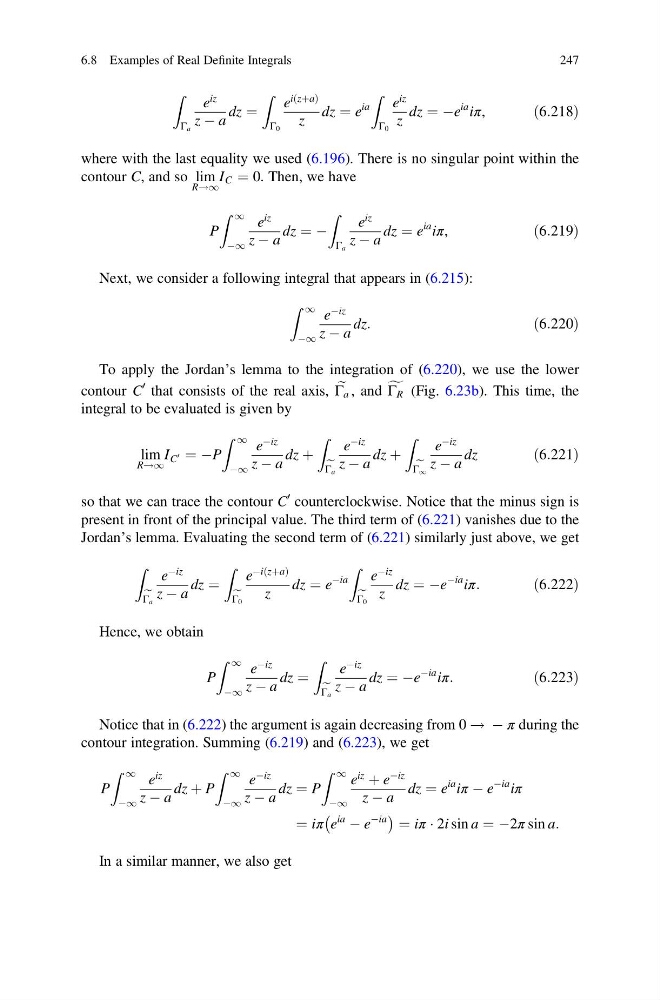
Z
Γ a
e
iz
z À a
dz ¼
Z
Γ 0
e
i zþa
ð
Þ
z
dz ¼ e
ia
Z
Γ 0
e
iz
z
dz ¼ Àe
ia iπ,
ð6:218Þ
where with the last equality we used (6.196). There is no singular point within the
contour C, and so lim
R!1
I C ¼ 0. Then, we have
P
Z 1
À1
e
iz
z À a
dz ¼ À
Z
Γ a
e
iz
z À a
dz ¼ e
ia iπ,
ð6:219Þ
Next, we consider a following integral that appears in (6.215):
Z 1
À1
e
Àiz
z À a
dz:
ð6:220Þ
To apply the Jordan’s lemma to the integration of (6.220), we use the lower
contour C
0 that consists of the real axis, e
Γ a , and f
Γ R (Fig. 6.23b). This time, the
integral to be evaluated is given by
lim
R!1
I C
0 ¼ ÀP
Z 1
À1
e
Àiz
z À a
dz þ
Z
e
Γ a
e
Àiz
z À a
dz þ
Z
e
Γ 1
e
Àiz
z À a
dz
ð6:221Þ
so that we can trace the contour C
0 counterclockwise. Notice that the minus sign is
present in front of the principal value. The third term of (6.221) vanishes due to the
Jordan’s lemma. Evaluating the second term of (6.221) similarly just above, we get
Z
e
Γ a
e
Àiz
z À a
dz ¼
Z
e
Γ 0
e
Ài zþa
ð
Þ
z
dz ¼ e
Àia
Z
e
Γ 0
e
Àiz
z
dz ¼ Àe
Àia iπ:
ð6:222Þ
Hence, we obtain
P
Z 1
À1
e
Àiz
z À a
dz ¼
Z
e
Γ a
e
Àiz
z À a
dz ¼ Àe
Àia iπ:
ð6:223Þ
Notice that in (6.222) the argument is again decreasing from 0 ! À π during the
contour integration. Summing (6.219) and (6.223), we get
P
Z 1
À1
e
iz
z À a
dz þ P
Z 1
À1
e
Àiz
z À a
dz ¼ P
Z 1
À1
e
iz
þ e
Àiz
z À a
dz ¼ e
ia iπ À e
Àia iπ
¼ iπ e
ia
À e
Àia
À
Á ¼ iπ Á 2i sin a ¼ À2π sin a:
In a similar manner, we also get
6.8 Examples of Real Definite Integrals
247
Γ a
e
iz
z À a
dz ¼
Z
Γ 0
e
i zþa
ð
Þ
z
dz ¼ e
ia
Z
Γ 0
e
iz
z
dz ¼ Àe
ia iπ,
ð6:218Þ
where with the last equality we used (6.196). There is no singular point within the
contour C, and so lim
R!1
I C ¼ 0. Then, we have
P
Z 1
À1
e
iz
z À a
dz ¼ À
Z
Γ a
e
iz
z À a
dz ¼ e
ia iπ,
ð6:219Þ
Next, we consider a following integral that appears in (6.215):
Z 1
À1
e
Àiz
z À a
dz:
ð6:220Þ
To apply the Jordan’s lemma to the integration of (6.220), we use the lower
contour C
0 that consists of the real axis, e
Γ a , and f
Γ R (Fig. 6.23b). This time, the
integral to be evaluated is given by
lim
R!1
I C
0 ¼ ÀP
Z 1
À1
e
Àiz
z À a
dz þ
Z
e
Γ a
e
Àiz
z À a
dz þ
Z
e
Γ 1
e
Àiz
z À a
dz
ð6:221Þ
so that we can trace the contour C
0 counterclockwise. Notice that the minus sign is
present in front of the principal value. The third term of (6.221) vanishes due to the
Jordan’s lemma. Evaluating the second term of (6.221) similarly just above, we get
Z
e
Γ a
e
Àiz
z À a
dz ¼
Z
e
Γ 0
e
Ài zþa
ð
Þ
z
dz ¼ e
Àia
Z
e
Γ 0
e
Àiz
z
dz ¼ Àe
Àia iπ:
ð6:222Þ
Hence, we obtain
P
Z 1
À1
e
Àiz
z À a
dz ¼
Z
e
Γ a
e
Àiz
z À a
dz ¼ Àe
Àia iπ:
ð6:223Þ
Notice that in (6.222) the argument is again decreasing from 0 ! À π during the
contour integration. Summing (6.219) and (6.223), we get
P
Z 1
À1
e
iz
z À a
dz þ P
Z 1
À1
e
Àiz
z À a
dz ¼ P
Z 1
À1
e
iz
þ e
Àiz
z À a
dz ¼ e
ia iπ À e
Àia iπ
¼ iπ e
ia
À e
Àia
À
Á ¼ iπ Á 2i sin a ¼ À2π sin a:
In a similar manner, we also get
6.8 Examples of Real Definite Integrals
247