

lim
R!1
I C ¼ P
Z 1
À1
1 À e
2iz
z 2 dz þ
Z
Γ 0
1 À e
2iz
z 2 dz þ
Z
Γ 1
1 À e
2iz
z 2 dz:
ð6:207Þ
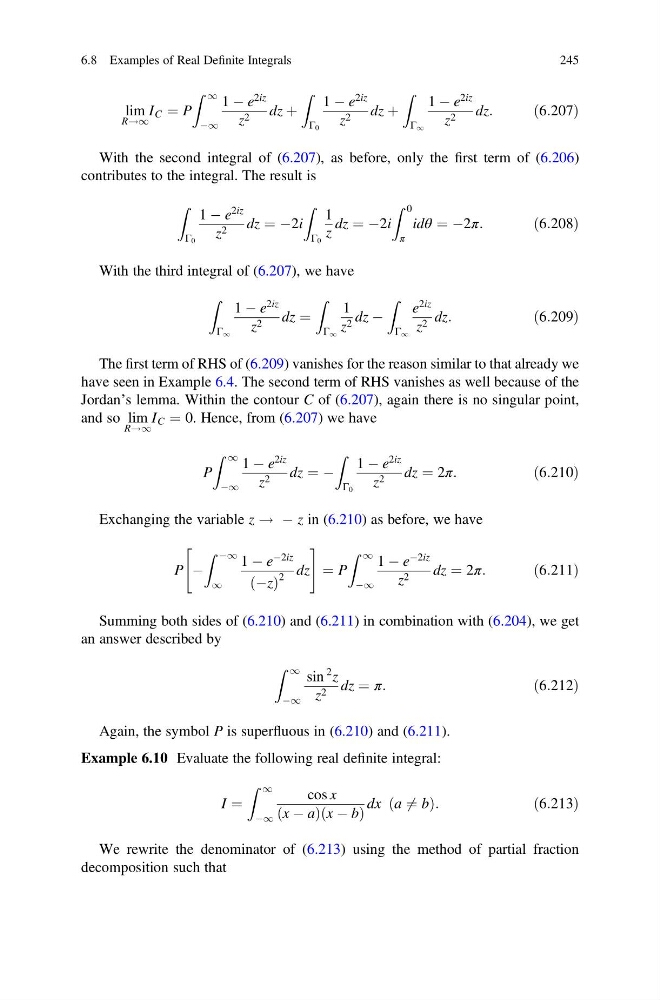
With the second integral of (6.207), as before, only the first term of (6.206)
contributes to the integral. The result is
Z
Γ 0
1 À e
2iz
z 2 dz ¼ À2i
Z
Γ 0
1
z
dz ¼ À2i
Z 0
π
idθ ¼ À2π:
ð6:208Þ
With the third integral of (6.207), we have
Z
Γ 1
1 À e
2iz
z 2 dz ¼
Z
Γ 1
1
z 2 dz À
Z
Γ 1
e
2iz
z 2 dz:
ð6:209Þ
The first term of RHS of (6.209) vanishes for the reason similar to that already we
have seen in Example 6.4. The second term of RHS vanishes as well because of the
Jordan’s lemma. Within the contour C of (6.207), again there is no singular point,
and so lim
R!1
I C ¼ 0. Hence, from (6.207) we have
P
Z 1
À1
1 À e
2iz
z 2 dz ¼ À
Z
Γ 0
1 À e
2iz
z 2 dz ¼ 2π:
ð6:210Þ
Exchanging the variable z ! À z in (6.210) as before, we have
P À
Z À1
1
1 À e
À2iz
Àz
ð Þ
2
dz
"
#
¼ P
Z 1
À1
1 À e
À2iz
z 2
dz ¼ 2π:
ð6:211Þ
Summing both sides of (6.210) and (6.211) in combination with (6.204), we get
an answer described by
Z 1
À1
sin
2 z
z 2 dz ¼ π:
ð6:212Þ
Again, the symbol P is superfluous in (6.210) and (6.211).
Example 6.10 Evaluate the following real definite integral:
I ¼
Z 1
À1
cos x
x À a
ð
Þ x À b
ð
Þ
dx a 6 ¼ b
ð
Þ:
ð6:213Þ
We rewrite the denominator of (6.213) using the method of partial fraction
decomposition such that
6.8 Examples of Real Definite Integrals
245
R!1
I C ¼ P
Z 1
À1
1 À e
2iz
z 2 dz þ
Z
Γ 0
1 À e
2iz
z 2 dz þ
Z
Γ 1
1 À e
2iz
z 2 dz:
ð6:207Þ
With the second integral of (6.207), as before, only the first term of (6.206)
contributes to the integral. The result is
Z
Γ 0
1 À e
2iz
z 2 dz ¼ À2i
Z
Γ 0
1
z
dz ¼ À2i
Z 0
π
idθ ¼ À2π:
ð6:208Þ
With the third integral of (6.207), we have
Z
Γ 1
1 À e
2iz
z 2 dz ¼
Z
Γ 1
1
z 2 dz À
Z
Γ 1
e
2iz
z 2 dz:
ð6:209Þ
The first term of RHS of (6.209) vanishes for the reason similar to that already we
have seen in Example 6.4. The second term of RHS vanishes as well because of the
Jordan’s lemma. Within the contour C of (6.207), again there is no singular point,
and so lim
R!1
I C ¼ 0. Hence, from (6.207) we have
P
Z 1
À1
1 À e
2iz
z 2 dz ¼ À
Z
Γ 0
1 À e
2iz
z 2 dz ¼ 2π:
ð6:210Þ
Exchanging the variable z ! À z in (6.210) as before, we have
P À
Z À1
1
1 À e
À2iz
Àz
ð Þ
2
dz
"
#
¼ P
Z 1
À1
1 À e
À2iz
z 2
dz ¼ 2π:
ð6:211Þ
Summing both sides of (6.210) and (6.211) in combination with (6.204), we get
an answer described by
Z 1
À1
sin
2 z
z 2 dz ¼ π:
ð6:212Þ
Again, the symbol P is superfluous in (6.210) and (6.211).
Example 6.10 Evaluate the following real definite integral:
I ¼
Z 1
À1
cos x
x À a
ð
Þ x À b
ð
Þ
dx a 6 ¼ b
ð
Þ:
ð6:213Þ
We rewrite the denominator of (6.213) using the method of partial fraction
decomposition such that
6.8 Examples of Real Definite Integrals
245