

These axioms are obvious from those of (O1)–(O3) along with de Morgan’s law
(6.6).
Next, we classify and characterize a variety of elements (or points) and subsets as
well as relationships among them in terms of the open sets and closed sets. We make
the most of these notions and properties to study various aspects of topological
spaces and their structures. In what follows, we assume the presence of a topological
space (T, τ).
(a) Neighborhoods [4]
Definition 6.2 Let (T, τ) be a topological space and S be a subset of T. If S contains
an open set
∃ O that contains an element (or point) a 2 T, i.e.,
a 2 O ⊂ S,
then S is called a neighborhood of a.
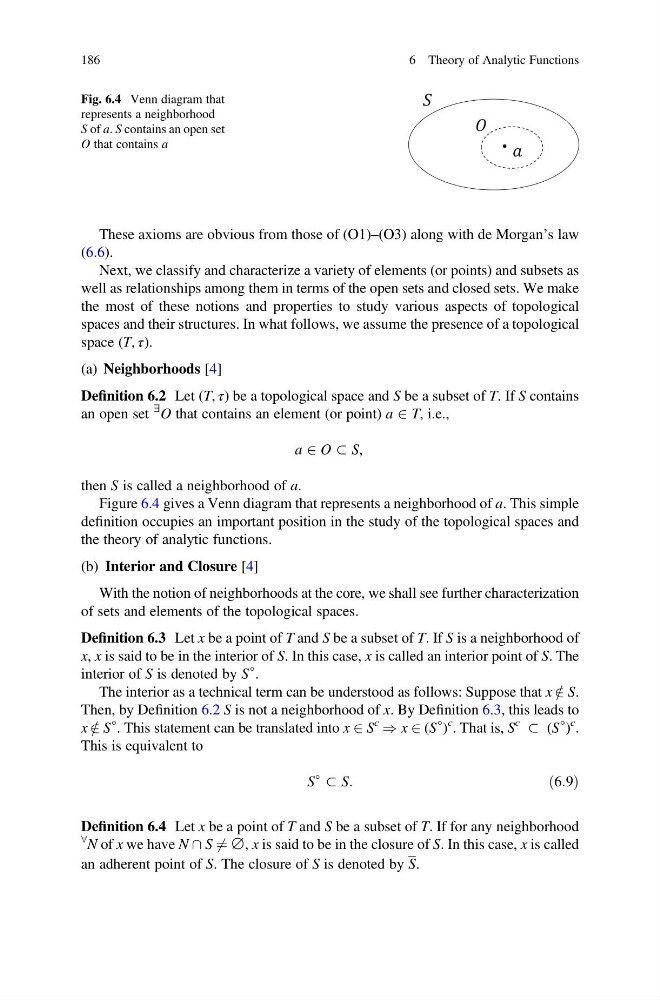
Figure 6.4 gives a Venn diagram that represents a neighborhood of a. This simple
definition occupies an important position in the study of the topological spaces and
the theory of analytic functions.
(b) Interior and Closure [4]
With the notion of neighborhoods at the core, we shall see further characterization
of sets and elements of the topological spaces.
Definition 6.3 Let x be a point of T and S be a subset of T. If S is a neighborhood of
x, x is said to be in the interior of S. In this case, x is called an interior point of S. The
interior of S is denoted by S
∘
.
The interior as a technical term can be understood as follows: Suppose that x =
2 S.
Then, by Definition 6.2 S is not a neighborhood of x. By Definition 6.3, this leads to
x =
2 S
∘
. This statement can be translated into x 2 S
c
) x 2 (S
∘
)
c . That is, S
c
⊂ (S
∘
)
c .
This is equivalent to
S
∘
⊂ S:
ð6:9Þ
Definition 6.4 Let x be a point of T and S be a subset of T. If for any neighborhood
8 N of x we have N \ S 6 ¼ ∅, x is said to be in the closure of S. In this case, x is called
an adherent point of S. The closure of S is denoted by S.
Fig. 6.4 Venn diagram that
represents a neighborhood
S of a. S contains an open set
O that contains a
186
6 Theory of Analytic Functions
(6.6).
Next, we classify and characterize a variety of elements (or points) and subsets as
well as relationships among them in terms of the open sets and closed sets. We make
the most of these notions and properties to study various aspects of topological
spaces and their structures. In what follows, we assume the presence of a topological
space (T, τ).
(a) Neighborhoods [4]
Definition 6.2 Let (T, τ) be a topological space and S be a subset of T. If S contains
an open set
∃ O that contains an element (or point) a 2 T, i.e.,
a 2 O ⊂ S,
then S is called a neighborhood of a.
Figure 6.4 gives a Venn diagram that represents a neighborhood of a. This simple
definition occupies an important position in the study of the topological spaces and
the theory of analytic functions.
(b) Interior and Closure [4]
With the notion of neighborhoods at the core, we shall see further characterization
of sets and elements of the topological spaces.
Definition 6.3 Let x be a point of T and S be a subset of T. If S is a neighborhood of
x, x is said to be in the interior of S. In this case, x is called an interior point of S. The
interior of S is denoted by S
∘
.
The interior as a technical term can be understood as follows: Suppose that x =
2 S.
Then, by Definition 6.2 S is not a neighborhood of x. By Definition 6.3, this leads to
x =
2 S
∘
. This statement can be translated into x 2 S
c
) x 2 (S
∘
)
c . That is, S
c
⊂ (S
∘
)
c .
This is equivalent to
S
∘
⊂ S:
ð6:9Þ
Definition 6.4 Let x be a point of T and S be a subset of T. If for any neighborhood
8 N of x we have N \ S 6 ¼ ∅, x is said to be in the closure of S. In this case, x is called
an adherent point of S. The closure of S is denoted by S.
Fig. 6.4 Venn diagram that
represents a neighborhood
S of a. S contains an open set
O that contains a
186
6 Theory of Analytic Functions