

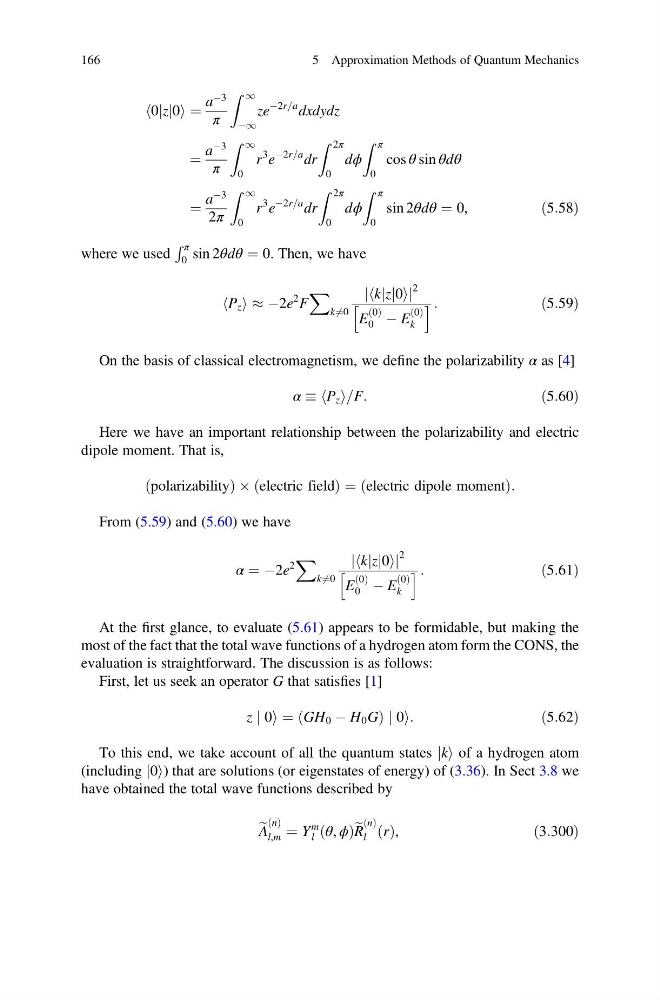
0jzj0
h
i¼
a
À3
π
Z 1
À1
ze
À2r=a dxdydz
¼
a
À3
π
Z 1
0
r
3 e
À2r=a dr
Z 2π
0
dϕ
Z π
0
cos θ sin θdθ
¼
a
À3
2π
Z 1
0
r
3 e
À2r=a dr
Z 2π
0
dϕ
Z π
0
sin 2θdθ ¼ 0,
ð5:58Þ
where we used
R π
0 sin 2θdθ ¼ 0. Then, we have
P z
h i % À2e
2 F
X
k6 ¼0
kjzj0
h
i
j
j
2
E
0
ð Þ
0 À E
0
ð Þ
k
h
i:
ð5:59Þ
On the basis of classical electromagnetism, we define the polarizability α as [4]
α P z
h i=F:
ð5:60Þ
Here we have an important relationship between the polarizability and electric
dipole moment. That is,
polarizability
ð
Þ Âelectric field
ð
Þ¼ electric dipole moment
ð
Þ :
From (5.59) and (5.60) we have
α ¼ À2e
2
X
k6 ¼0
kjzj0
h
i
j
j
2
E
0
ð Þ
0 À E
0
ð Þ
k
h
i:
ð5:61Þ
At the first glance, to evaluate (5.61) appears to be formidable, but making the
most of the fact that the total wave functions of a hydrogen atom form the CONS, the
evaluation is straightforward. The discussion is as follows:
First, let us seek an operator G that satisfies [1]
z j 0i ¼ GH 0 À H 0 G
ð
Þj0i:
ð5:62Þ
To this end, we take account of all the quantum states jki of a hydrogen atom
(including j0i) that are solutions (or eigenstates of energy) of (3.36). In Sect 3.8 we
have obtained the total wave functions described by
e
Λ
n
ð Þ
l,m ¼ Y
m
l θ, ϕ
ð
Þ e
R
n
ð Þ
l
r
ð Þ,
ð3:300Þ
166
5 Approximation Methods of Quantum Mechanics
h
i¼
a
À3
π
Z 1
À1
ze
À2r=a dxdydz
¼
a
À3
π
Z 1
0
r
3 e
À2r=a dr
Z 2π
0
dϕ
Z π
0
cos θ sin θdθ
¼
a
À3
2π
Z 1
0
r
3 e
À2r=a dr
Z 2π
0
dϕ
Z π
0
sin 2θdθ ¼ 0,
ð5:58Þ
where we used
R π
0 sin 2θdθ ¼ 0. Then, we have
P z
h i % À2e
2 F
X
k6 ¼0
kjzj0
h
i
j
j
2
E
0
ð Þ
0 À E
0
ð Þ
k
h
i:
ð5:59Þ
On the basis of classical electromagnetism, we define the polarizability α as [4]
α P z
h i=F:
ð5:60Þ
Here we have an important relationship between the polarizability and electric
dipole moment. That is,
polarizability
ð
Þ Âelectric field
ð
Þ¼ electric dipole moment
ð
Þ :
From (5.59) and (5.60) we have
α ¼ À2e
2
X
k6 ¼0
kjzj0
h
i
j
j
2
E
0
ð Þ
0 À E
0
ð Þ
k
h
i:
ð5:61Þ
At the first glance, to evaluate (5.61) appears to be formidable, but making the
most of the fact that the total wave functions of a hydrogen atom form the CONS, the
evaluation is straightforward. The discussion is as follows:
First, let us seek an operator G that satisfies [1]
z j 0i ¼ GH 0 À H 0 G
ð
Þj0i:
ð5:62Þ
To this end, we take account of all the quantum states jki of a hydrogen atom
(including j0i) that are solutions (or eigenstates of energy) of (3.36). In Sect 3.8 we
have obtained the total wave functions described by
e
Λ
n
ð Þ
l,m ¼ Y
m
l θ, ϕ
ð
Þ e
R
n
ð Þ
l
r
ð Þ,
ð3:300Þ
166
5 Approximation Methods of Quantum Mechanics