

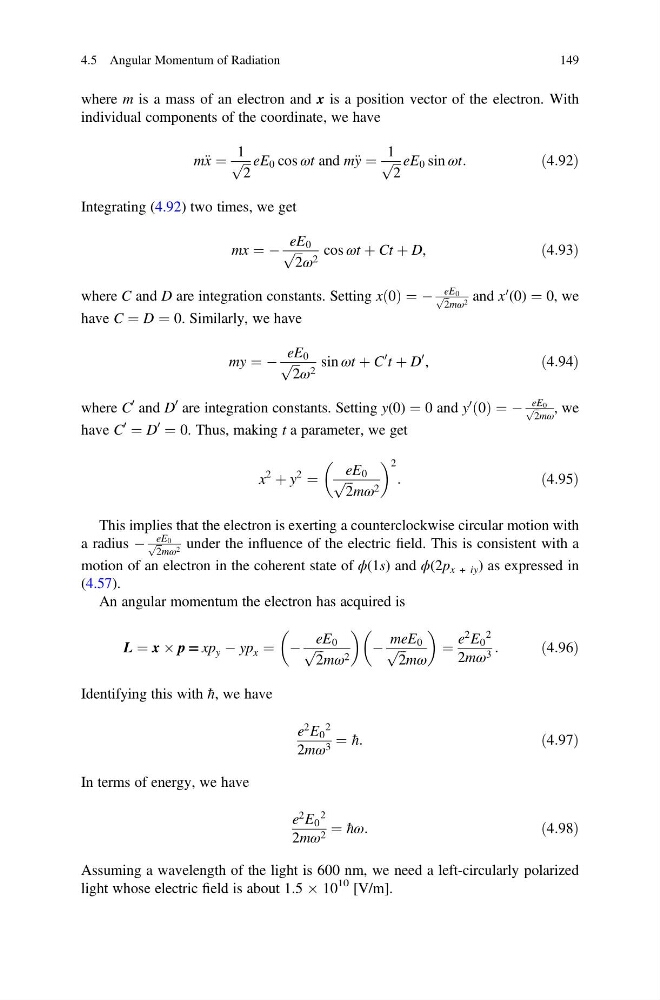
where m is a mass of an electron and x is a position vector of the electron. With
individual components of the coordinate, we have
m€ x ¼
1
ffiffi ffi
2
p eE 0 cos ωt and m€ y ¼
1
ffiffi ffi
2
p eE 0 sin ωt:
ð4:92Þ
Integrating (4.92) two times, we get
mx ¼ À
eE 0
ffiffi ffi
2
p ω 2
cos ωt þ Ct þ D,
ð4:93Þ
where C and D are integration constants. Setting x 0
ð Þ ¼ À
eE 0
ffiffi
2
p
mω 2 and x
0 (0) ¼ 0, we
have C ¼ D ¼ 0. Similarly, we have
my ¼ À
eE 0
ffiffi ffi
2
p ω 2
sin ωt þ C
0 t þ D
0 ,
ð4:94Þ
where C
0 and D
0 are integration constants. Setting y(0) ¼ 0 and y
0 0
ð Þ ¼ À
eE 0
ffiffi
2
p
mω
, we
have C
0
¼ D
0
¼ 0. Thus, making t a parameter, we get
x
2
þ y
2
¼
eE 0
ffiffi ffi
2
p
mω 2
2
:
ð4:95Þ
This implies that the electron is exerting a counterclockwise circular motion with
a radius À
eE 0
ffiffi
2
p
mω 2 under the influence of the electric field. This is consistent with a
motion of an electron in the coherent state of ϕ(1s) and ϕ(2p x + iy ) as expressed in
(4.57).
An angular momentum the electron has acquired is
L ¼ x  p = xp y À yp x ¼ À
eE 0
ffiffi ffi
2
p
mω 2
À
meE 0
ffiffi ffi
2
p
mω
¼
e
2 E 0
2
2mω 3 :
ð4:96Þ
Identifying this with h, we have
e
2 E 0
2
2mω 3 ¼ h:
ð4:97Þ
In terms of energy, we have
e
2 E 0
2
2mω 2 ¼ hω:
ð4:98Þ
Assuming a wavelength of the light is 600 nm, we need a left-circularly polarized
light whose electric field is about 1.5 Â 10
10 [V/m].
4.5 Angular Momentum of Radiation
149
individual components of the coordinate, we have
m€ x ¼
1
ffiffi ffi
2
p eE 0 cos ωt and m€ y ¼
1
ffiffi ffi
2
p eE 0 sin ωt:
ð4:92Þ
Integrating (4.92) two times, we get
mx ¼ À
eE 0
ffiffi ffi
2
p ω 2
cos ωt þ Ct þ D,
ð4:93Þ
where C and D are integration constants. Setting x 0
ð Þ ¼ À
eE 0
ffiffi
2
p
mω 2 and x
0 (0) ¼ 0, we
have C ¼ D ¼ 0. Similarly, we have
my ¼ À
eE 0
ffiffi ffi
2
p ω 2
sin ωt þ C
0 t þ D
0 ,
ð4:94Þ
where C
0 and D
0 are integration constants. Setting y(0) ¼ 0 and y
0 0
ð Þ ¼ À
eE 0
ffiffi
2
p
mω
, we
have C
0
¼ D
0
¼ 0. Thus, making t a parameter, we get
x
2
þ y
2
¼
eE 0
ffiffi ffi
2
p
mω 2
2
:
ð4:95Þ
This implies that the electron is exerting a counterclockwise circular motion with
a radius À
eE 0
ffiffi
2
p
mω 2 under the influence of the electric field. This is consistent with a
motion of an electron in the coherent state of ϕ(1s) and ϕ(2p x + iy ) as expressed in
(4.57).
An angular momentum the electron has acquired is
L ¼ x  p = xp y À yp x ¼ À
eE 0
ffiffi ffi
2
p
mω 2
À
meE 0
ffiffi ffi
2
p
mω
¼
e
2 E 0
2
2mω 3 :
ð4:96Þ
Identifying this with h, we have
e
2 E 0
2
2mω 3 ¼ h:
ð4:97Þ
In terms of energy, we have
e
2 E 0
2
2mω 2 ¼ hω:
ð4:98Þ
Assuming a wavelength of the light is 600 nm, we need a left-circularly polarized
light whose electric field is about 1.5 Â 10
10 [V/m].
4.5 Angular Momentum of Radiation
149