

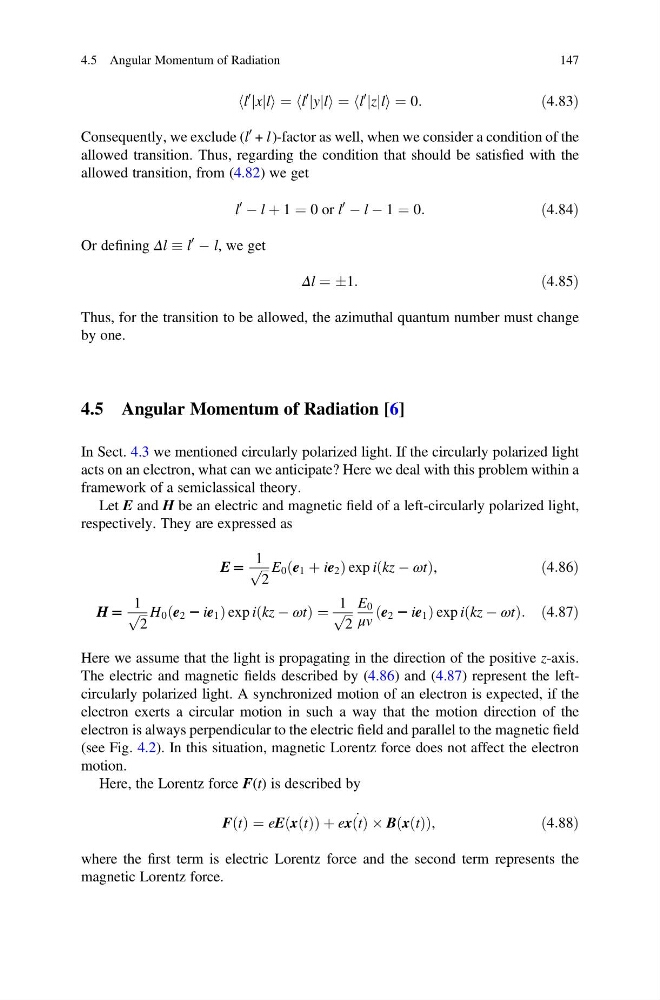
l
0
jxjl
h
i ¼ l
0
jyjl
h
i ¼ l
0
jzjl
h
i ¼ 0:
ð4:83Þ
Consequently, we exclude (l
0 + l)-factor as well, when we consider a condition of the
allowed transition. Thus, regarding the condition that should be satisfied with the
allowed transition, from (4.82) we get
l
0
À l þ 1 ¼ 0 or l
0
À l À 1 ¼ 0:
ð4:84Þ
Or defining Δl l
0
À l, we get
Δl ¼ Æ1:
ð4:85Þ
Thus, for the transition to be allowed, the azimuthal quantum number must change
by one.
4.5 Angular Momentum of Radiation [6]
In Sect. 4.3 we mentioned circularly polarized light. If the circularly polarized light
acts on an electron, what can we anticipate? Here we deal with this problem within a
framework of a semiclassical theory.
Let E and H be an electric and magnetic field of a left-circularly polarized light,
respectively. They are expressed as
E =
1
ffiffi ffi
2
p E 0 e 1 þ ie 2
ð
Þexp i kz À ωt
ð
Þ ,
ð4:86Þ
H =
1
ffiffi ffi
2
p H 0 e 2 2 ie 1
ð
Þexp i kz À ωt
ð
Þ¼
1
ffiffi ffi
2
p
E 0
μv
e 2 2 ie 1
ð
Þexp i kz À ωt
ð
Þ : ð4:87Þ
Here we assume that the light is propagating in the direction of the positive z-axis.
The electric and magnetic fields described by (4.86) and (4.87) represent the leftcircularly polarized light. A synchronized motion of an electron is expected, if the
electron exerts a circular motion in such a way that the motion direction of the
electron is always perpendicular to the electric field and parallel to the magnetic field
(see Fig. 4.2). In this situation, magnetic Lorentz force does not affect the electron
motion.
Here, the Lorentz force F(t) is described by
F t
ð Þ ¼ eE x t
ð Þ
ð
Þþe _
x t
ð Þ Â B x t
ð Þ
ð
Þ,
ð4:88Þ
where the first term is electric Lorentz force and the second term represents the
magnetic Lorentz force.
4.5 Angular Momentum of Radiation
147
0
jxjl
h
i ¼ l
0
jyjl
h
i ¼ l
0
jzjl
h
i ¼ 0:
ð4:83Þ
Consequently, we exclude (l
0 + l)-factor as well, when we consider a condition of the
allowed transition. Thus, regarding the condition that should be satisfied with the
allowed transition, from (4.82) we get
l
0
À l þ 1 ¼ 0 or l
0
À l À 1 ¼ 0:
ð4:84Þ
Or defining Δl l
0
À l, we get
Δl ¼ Æ1:
ð4:85Þ
Thus, for the transition to be allowed, the azimuthal quantum number must change
by one.
4.5 Angular Momentum of Radiation [6]
In Sect. 4.3 we mentioned circularly polarized light. If the circularly polarized light
acts on an electron, what can we anticipate? Here we deal with this problem within a
framework of a semiclassical theory.
Let E and H be an electric and magnetic field of a left-circularly polarized light,
respectively. They are expressed as
E =
1
ffiffi ffi
2
p E 0 e 1 þ ie 2
ð
Þexp i kz À ωt
ð
Þ ,
ð4:86Þ
H =
1
ffiffi ffi
2
p H 0 e 2 2 ie 1
ð
Þexp i kz À ωt
ð
Þ¼
1
ffiffi ffi
2
p
E 0
μv
e 2 2 ie 1
ð
Þexp i kz À ωt
ð
Þ : ð4:87Þ
Here we assume that the light is propagating in the direction of the positive z-axis.
The electric and magnetic fields described by (4.86) and (4.87) represent the leftcircularly polarized light. A synchronized motion of an electron is expected, if the
electron exerts a circular motion in such a way that the motion direction of the
electron is always perpendicular to the electric field and parallel to the magnetic field
(see Fig. 4.2). In this situation, magnetic Lorentz force does not affect the electron
motion.
Here, the Lorentz force F(t) is described by
F t
ð Þ ¼ eE x t
ð Þ
ð
Þþe _
x t
ð Þ Â B x t
ð Þ
ð
Þ,
ð4:88Þ
where the first term is electric Lorentz force and the second term represents the
magnetic Lorentz force.
4.5 Angular Momentum of Radiation
147