

U
{ U ¼ UU
{
¼ E:
ð4:44Þ
We will investigate details of the unitary transformation and matrix in Parts III
and IV.
We define e + and e À as follows [1]:
e þ
1
ffiffi ffi
2
p e 1 þ ie 2
ð
Þand e À
1
ffiffi ffi
2
p e 1 À ie 2
ð
Þ ,
ð4:45Þ
where complex vectors e + and e À represent the left-circularly polarized light and
right-circularly polarized light that carry an angular momentum h and Àh, respectively. We will revisit the characteristics and implication of these complex vectors in
Sect. 7.4.
We have
e 1 e 2 e 3
ð
Þ
x
y
z
0
B
@
1
C
A ¼ e À e þ e 3
ð
Þ
1
ffiffi ffi
2
p x þ iy
ð
Þ
1
ffiffi ffi
2
p x À iy
ð
Þ
z
0
B
B
B
B
@
1
C
C
C
C
A
:
ð4:46Þ
Note that e + , e À, and e 3 are orthonormal. That is,
e þ je þ
h
i¼1, e þ je À
h
i¼0, etc:
ð4:47Þ
In this situation, e + , e À, and e 3 are said to form an orthonormal basis in a threedimensional complex vector space (see Sect. 11.4).
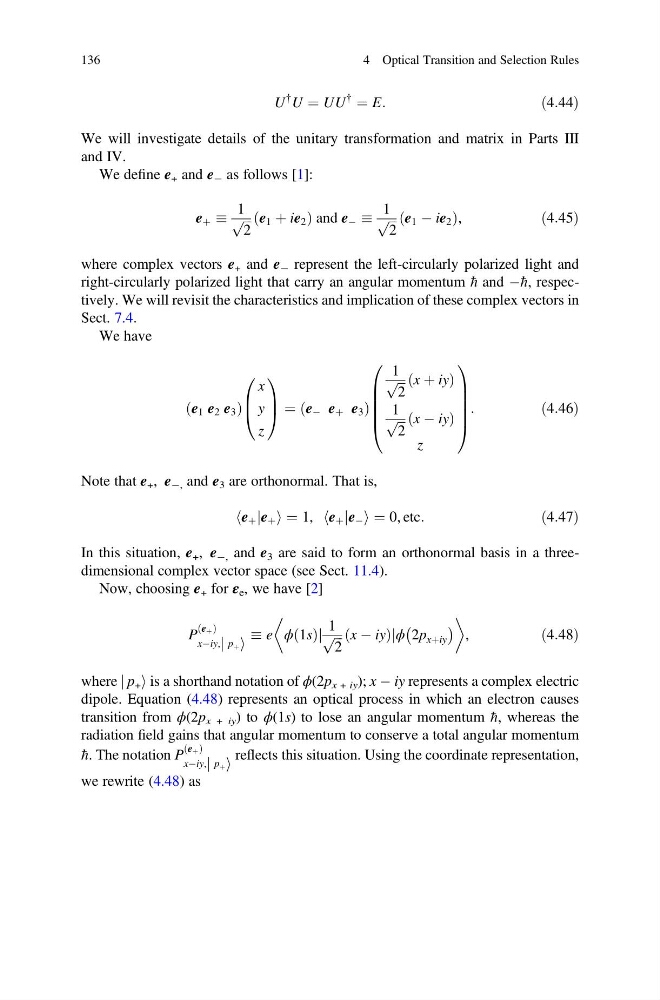
Now, choosing e + for ε e , we have [2]
P
e þ
ð Þ
xÀiy, p þ
j i
e ϕ 1s
ð Þj
1
ffiffi ffi
2
p x À iy
ð
Þjϕ 2p xþiy
À
Á
(
)
,
ð4:48Þ
where j p + i is a shorthand notation of ϕ(2p x + iy ); x À iy represents a complex electric
dipole. Equation (4.48) represents an optical process in which an electron causes
transition from ϕ(2p x + iy ) to ϕ(1s) to lose an angular momentum h, whereas the
radiation field gains that angular momentum to conserve a total angular momentum
h. The notation P
e þ
ð Þ
xÀiy, p þ
j i
reflects this situation. Using the coordinate representation,
we rewrite (4.48) as
136
4 Optical Transition and Selection Rules
{ U ¼ UU
{
¼ E:
ð4:44Þ
We will investigate details of the unitary transformation and matrix in Parts III
and IV.
We define e + and e À as follows [1]:
e þ
1
ffiffi ffi
2
p e 1 þ ie 2
ð
Þand e À
1
ffiffi ffi
2
p e 1 À ie 2
ð
Þ ,
ð4:45Þ
where complex vectors e + and e À represent the left-circularly polarized light and
right-circularly polarized light that carry an angular momentum h and Àh, respectively. We will revisit the characteristics and implication of these complex vectors in
Sect. 7.4.
We have
e 1 e 2 e 3
ð
Þ
x
y
z
0
B
@
1
C
A ¼ e À e þ e 3
ð
Þ
1
ffiffi ffi
2
p x þ iy
ð
Þ
1
ffiffi ffi
2
p x À iy
ð
Þ
z
0
B
B
B
B
@
1
C
C
C
C
A
:
ð4:46Þ
Note that e + , e À, and e 3 are orthonormal. That is,
e þ je þ
h
i¼1, e þ je À
h
i¼0, etc:
ð4:47Þ
In this situation, e + , e À, and e 3 are said to form an orthonormal basis in a threedimensional complex vector space (see Sect. 11.4).
Now, choosing e + for ε e , we have [2]
P
e þ
ð Þ
xÀiy, p þ
j i
e ϕ 1s
ð Þj
1
ffiffi ffi
2
p x À iy
ð
Þjϕ 2p xþiy
À
Á
(
)
,
ð4:48Þ
where j p + i is a shorthand notation of ϕ(2p x + iy ); x À iy represents a complex electric
dipole. Equation (4.48) represents an optical process in which an electron causes
transition from ϕ(2p x + iy ) to ϕ(1s) to lose an angular momentum h, whereas the
radiation field gains that angular momentum to conserve a total angular momentum
h. The notation P
e þ
ð Þ
xÀiy, p þ
j i
reflects this situation. Using the coordinate representation,
we rewrite (4.48) as
136
4 Optical Transition and Selection Rules