

ϕ 2p z
À Á ¼
1
4
ffiffiffiffiffiffiffiffiffi ffi
1
2πa 3
r
r
a
e
Àr=2a cos θ,
ð4:30Þ
ϕ 2p xþiy
À
Á ¼ À
1
8
ffiffiffiffiffiffiffi
1
πa 3
r
r
a
e
Àr=2a sin θe
iϕ ,
ð4:31Þ
ϕ 2p xÀiy
À
Á ¼
1
8
ffiffiffiffiffiffiffi
1
πa 3
r
r
a
e
Àr=2a sin θe
Àiϕ ,
ð4:32Þ
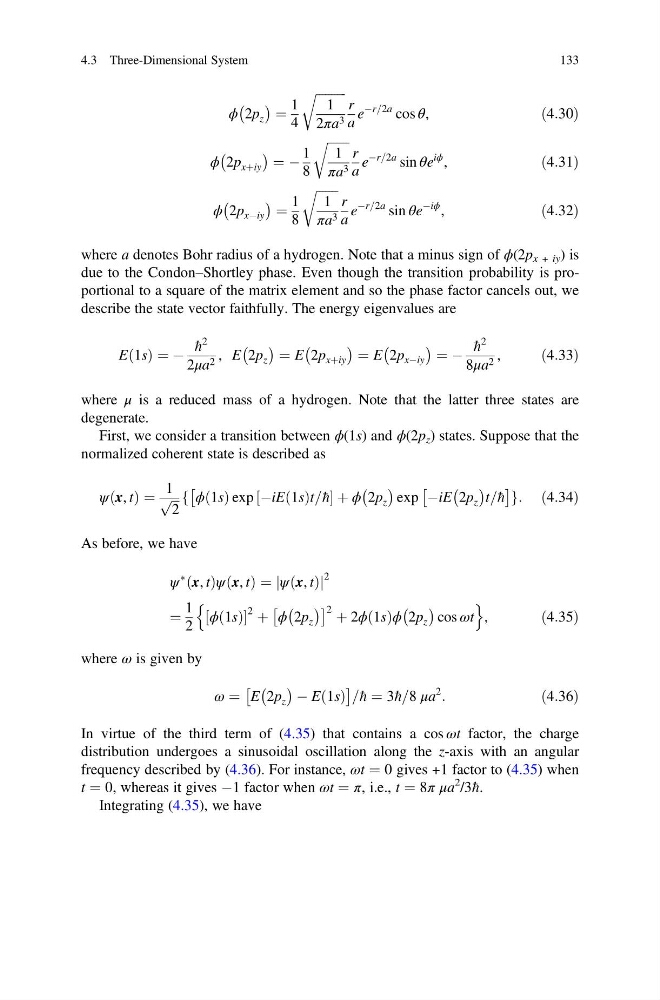
where a denotes Bohr radius of a hydrogen. Note that a minus sign of ϕ(2p x + iy ) is
due to the Condon–Shortley phase. Even though the transition probability is proportional to a square of the matrix element and so the phase factor cancels out, we
describe the state vector faithfully. The energy eigenvalues are
E 1s
ð Þ ¼ À
h
2
2μa 2 , E 2p z
À Á ¼ E 2p xþiy
À
Á ¼ E 2p xÀiy
À
Á ¼ À
h
2
8μa 2 ,
ð4:33Þ
where μ is a reduced mass of a hydrogen. Note that the latter three states are
degenerate.
First, we consider a transition between ϕ(1s) and ϕ(2p z ) states. Suppose that the
normalized coherent state is described as
ψ x, t
ð Þ ¼
1
ffiffi ffi
2
p f ϕ 1s
ð Þexp ÀiE 1s
ð Þt=h
½
þϕ 2p z
À Á
exp ÀiE 2p z
À Á
t=h
Â
Ã
g:
Â
ð4:34Þ
As before, we have
ψ
Ã
x, t
ð Þψ x, t
ð Þ ¼ ψ x, t
ð Þ
j
j
2
¼
1
2
ϕ 1s
ð Þ
½
2 þ ϕ 2p z
À Á
Â
à 2 þ 2ϕ 1s
ð Þϕ 2p z
À Á
cos ωt
n
o
,
ð4:35Þ
where ω is given by
ω ¼ E 2p z
À Á À E 1s
ð Þ
Â
à =h ¼ 3h=8 μa
2
:
ð4:36Þ
In virtue of the third term of (4.35) that contains a cos ωt factor, the charge
distribution undergoes a sinusoidal oscillation along the z-axis with an angular
frequency described by (4.36). For instance, ωt ¼ 0 gives +1 factor to (4.35) when
t ¼ 0, whereas it gives À1 factor when ωt ¼ π, i.e., t ¼ 8π μa
2 /3h.
Integrating (4.35), we have
4.3 Three-Dimensional System
133
À Á ¼
1
4
ffiffiffiffiffiffiffiffiffi ffi
1
2πa 3
r
r
a
e
Àr=2a cos θ,
ð4:30Þ
ϕ 2p xþiy
À
Á ¼ À
1
8
ffiffiffiffiffiffiffi
1
πa 3
r
r
a
e
Àr=2a sin θe
iϕ ,
ð4:31Þ
ϕ 2p xÀiy
À
Á ¼
1
8
ffiffiffiffiffiffiffi
1
πa 3
r
r
a
e
Àr=2a sin θe
Àiϕ ,
ð4:32Þ
where a denotes Bohr radius of a hydrogen. Note that a minus sign of ϕ(2p x + iy ) is
due to the Condon–Shortley phase. Even though the transition probability is proportional to a square of the matrix element and so the phase factor cancels out, we
describe the state vector faithfully. The energy eigenvalues are
E 1s
ð Þ ¼ À
h
2
2μa 2 , E 2p z
À Á ¼ E 2p xþiy
À
Á ¼ E 2p xÀiy
À
Á ¼ À
h
2
8μa 2 ,
ð4:33Þ
where μ is a reduced mass of a hydrogen. Note that the latter three states are
degenerate.
First, we consider a transition between ϕ(1s) and ϕ(2p z ) states. Suppose that the
normalized coherent state is described as
ψ x, t
ð Þ ¼
1
ffiffi ffi
2
p f ϕ 1s
ð Þexp ÀiE 1s
ð Þt=h
½
þϕ 2p z
À Á
exp ÀiE 2p z
À Á
t=h
Â
Ã
g:
Â
ð4:34Þ
As before, we have
ψ
Ã
x, t
ð Þψ x, t
ð Þ ¼ ψ x, t
ð Þ
j
j
2
¼
1
2
ϕ 1s
ð Þ
½
2 þ ϕ 2p z
À Á
Â
à 2 þ 2ϕ 1s
ð Þϕ 2p z
À Á
cos ωt
n
o
,
ð4:35Þ
where ω is given by
ω ¼ E 2p z
À Á À E 1s
ð Þ
Â
à =h ¼ 3h=8 μa
2
:
ð4:36Þ
In virtue of the third term of (4.35) that contains a cos ωt factor, the charge
distribution undergoes a sinusoidal oscillation along the z-axis with an angular
frequency described by (4.36). For instance, ωt ¼ 0 gives +1 factor to (4.35) when
t ¼ 0, whereas it gives À1 factor when ωt ¼ π, i.e., t ¼ 8π μa
2 /3h.
Integrating (4.35), we have
4.3 Three-Dimensional System
133