

the radial wave functions can be derived by successively operating the lowering
operators b l on e
ψ
n
ð Þ
nÀ1 that is parametrized with a principal quantum number n and an
orbital angular momentum quantum number l ¼ n À 1. This is clearly represented by
(3.278). The results agree with the conventional coordinate representation method
based upon the power series expansion that leads to associated Laguerre polynomials. Thus, the operator formalism is again found to be powerful in explicitly
representing the mathematical constitution of quantum-mechanical systems.
3.8 Total Wave Functions
Since we have obtained angular wave functions and radial wave functions, we
describe normalized total wave functions e
Λ
n
ð Þ
l,m of hydrogen-like atoms as a product
of the angular part and radial part such that
e
Λ
n
ð Þ
l,m ¼ Y
m
l θ, ϕ
ð
Þ e
R
n
ð Þ
l
r
ð Þ:
ð3:300Þ
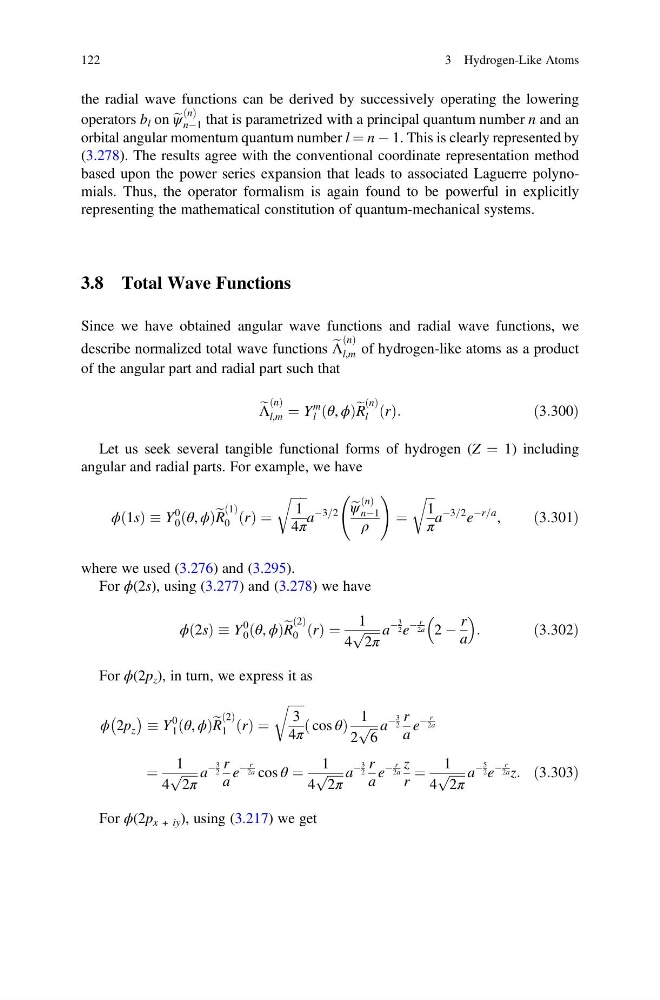
Let us seek several tangible functional forms of hydrogen (Z ¼ 1) including
angular and radial parts. For example, we have
ϕ 1s
ð Þ Y
0
0 θ, ϕ
ð
Þ e
R
1
ð Þ
0 r
ð Þ ¼
ffiffiffiffiffi
1
4π
r
a
À3=2 e
ψ
n
ð Þ
nÀ1
ρ
!
¼
ffiffiffi
1
π
r
a
À3=2 e
Àr=a ,
ð3:301Þ
where we used (3.276) and (3.295).
For ϕ(2s), using (3.277) and (3.278) we have
ϕ 2s
ð Þ Y
0
0 θ, ϕ
ð
Þ e
R
2
ð Þ
0 r
ð Þ ¼
1
4
ffiffiffiffiffi
2π
p a
À
3
2 e
À
r
2a 2 À
r
a
:
ð3:302Þ
For ϕ(2p z ), in turn, we express it as
ϕ 2p z
À Á Y
0
1 θ, ϕ
ð
Þ e
R
2
ð Þ
1 r
ð Þ ¼
ffiffiffiffiffi
3
4π
r
cos θ
ð
Þ
1
2
ffiffi ffi
6
p a
À
3
2
r
a
e
À
r
2a
¼
1
4
ffiffiffiffiffi
2π
p a
À
3
2
r
a
e
À
r
2a cos θ ¼
1
4
ffiffiffiffiffi
2π
p a
À
3
2
r
a
e
À
r
2a
z
r
¼
1
4
ffiffiffiffiffi
2π
p a
À
5
2 e
À
r
2a z: ð3:303Þ
For ϕ(2p x + iy ), using (3.217) we get
122
3 Hydrogen-Like Atoms
operators b l on e
ψ
n
ð Þ
nÀ1 that is parametrized with a principal quantum number n and an
orbital angular momentum quantum number l ¼ n À 1. This is clearly represented by
(3.278). The results agree with the conventional coordinate representation method
based upon the power series expansion that leads to associated Laguerre polynomials. Thus, the operator formalism is again found to be powerful in explicitly
representing the mathematical constitution of quantum-mechanical systems.
3.8 Total Wave Functions
Since we have obtained angular wave functions and radial wave functions, we
describe normalized total wave functions e
Λ
n
ð Þ
l,m of hydrogen-like atoms as a product
of the angular part and radial part such that
e
Λ
n
ð Þ
l,m ¼ Y
m
l θ, ϕ
ð
Þ e
R
n
ð Þ
l
r
ð Þ:
ð3:300Þ
Let us seek several tangible functional forms of hydrogen (Z ¼ 1) including
angular and radial parts. For example, we have
ϕ 1s
ð Þ Y
0
0 θ, ϕ
ð
Þ e
R
1
ð Þ
0 r
ð Þ ¼
ffiffiffiffiffi
1
4π
r
a
À3=2 e
ψ
n
ð Þ
nÀ1
ρ
!
¼
ffiffiffi
1
π
r
a
À3=2 e
Àr=a ,
ð3:301Þ
where we used (3.276) and (3.295).
For ϕ(2s), using (3.277) and (3.278) we have
ϕ 2s
ð Þ Y
0
0 θ, ϕ
ð
Þ e
R
2
ð Þ
0 r
ð Þ ¼
1
4
ffiffiffiffiffi
2π
p a
À
3
2 e
À
r
2a 2 À
r
a
:
ð3:302Þ
For ϕ(2p z ), in turn, we express it as
ϕ 2p z
À Á Y
0
1 θ, ϕ
ð
Þ e
R
2
ð Þ
1 r
ð Þ ¼
ffiffiffiffiffi
3
4π
r
cos θ
ð
Þ
1
2
ffiffi ffi
6
p a
À
3
2
r
a
e
À
r
2a
¼
1
4
ffiffiffiffiffi
2π
p a
À
3
2
r
a
e
À
r
2a cos θ ¼
1
4
ffiffiffiffiffi
2π
p a
À
3
2
r
a
e
À
r
2a
z
r
¼
1
4
ffiffiffiffiffi
2π
p a
À
5
2 e
À
r
2a z: ð3:303Þ
For ϕ(2p x + iy ), using (3.217) we get
122
3 Hydrogen-Like Atoms