

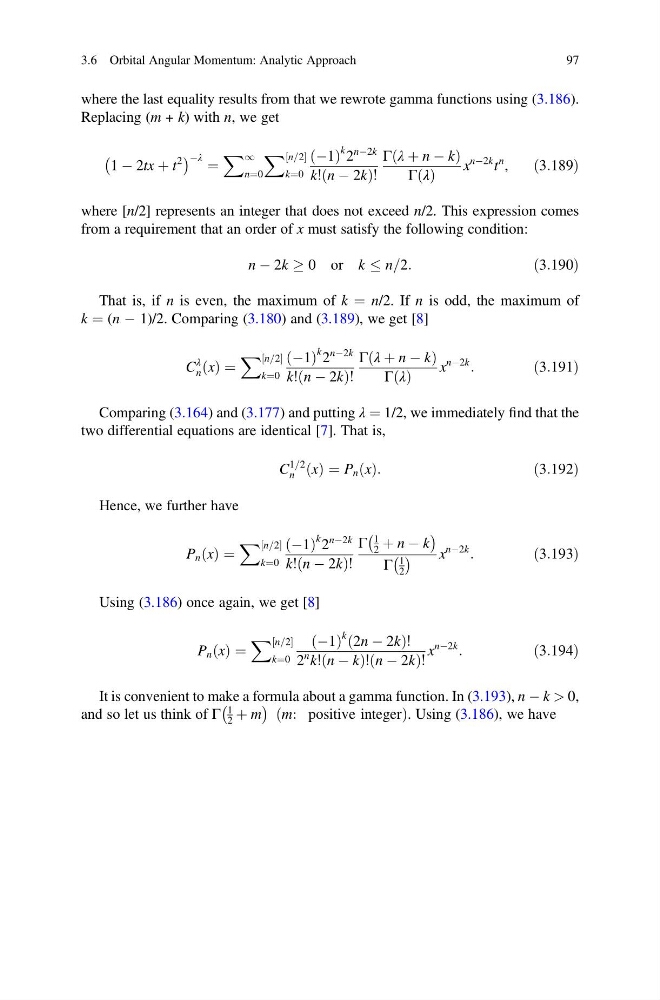
where the last equality results from that we rewrote gamma functions using (3.186).
Replacing (m + k) with n, we get
1 À 2tx þ t
2
À
Á Àλ ¼
X 1
n¼0
X n=2
½
k¼0
À1
ð Þ
k 2
nÀ2k
k! n À 2k
ð
Þ!
Γ λ þ n À k
ð
Þ
Γ λ
ð Þ
x
nÀ2k t
n ,
ð3:189Þ
where [n/2] represents an integer that does not exceed n/2. This expression comes
from a requirement that an order of x must satisfy the following condition:
n À 2k ! 0 or k n=2:
ð3:190Þ
That is, if n is even, the maximum of k ¼ n/2. If n is odd, the maximum of
k ¼ (n À 1)/2. Comparing (3.180) and (3.189), we get [8]
C
λ
n x
ð Þ ¼
X n=2
½
k¼0
À1
ð Þ
k 2
nÀ2k
k! n À 2k
ð
Þ!
Γ λ þ n À k
ð
Þ
Γ λ
ð Þ
x
nÀ2k
:
ð3:191Þ
Comparing (3.164) and (3.177) and putting λ ¼ 1/2, we immediately find that the
two differential equations are identical [7]. That is,
C
1=2
n
x
ð Þ ¼ P n x
ð Þ:
ð3:192Þ
Hence, we further have
P n x
ð Þ ¼
X n=2
½
k¼0
À1
ð Þ
k 2
nÀ2k
k! n À 2k
ð
Þ!
Γ
1
2 þ n À k
À
Á
Γ
1
2
À Á
x
nÀ2k
:
ð3:193Þ
Using (3.186) once again, we get [8]
P n x
ð Þ ¼
X n=2
½
k¼0
À1
ð Þ
k 2n À 2k
ð
Þ !
2
n k! n À k
ð
Þ! n À 2k
ð
Þ!
x
nÀ2k
:
ð3:194Þ
It is convenient to make a formula about a gamma function. In (3.193), n À k > 0,
and so let us think of Γ
1
2 þ m
À
Á
m: positive integer
ð
Þ . Using (3.186), we have
3.6 Orbital Angular Momentum: Analytic Approach
97
Replacing (m + k) with n, we get
1 À 2tx þ t
2
À
Á Àλ ¼
X 1
n¼0
X n=2
½
k¼0
À1
ð Þ
k 2
nÀ2k
k! n À 2k
ð
Þ!
Γ λ þ n À k
ð
Þ
Γ λ
ð Þ
x
nÀ2k t
n ,
ð3:189Þ
where [n/2] represents an integer that does not exceed n/2. This expression comes
from a requirement that an order of x must satisfy the following condition:
n À 2k ! 0 or k n=2:
ð3:190Þ
That is, if n is even, the maximum of k ¼ n/2. If n is odd, the maximum of
k ¼ (n À 1)/2. Comparing (3.180) and (3.189), we get [8]
C
λ
n x
ð Þ ¼
X n=2
½
k¼0
À1
ð Þ
k 2
nÀ2k
k! n À 2k
ð
Þ!
Γ λ þ n À k
ð
Þ
Γ λ
ð Þ
x
nÀ2k
:
ð3:191Þ
Comparing (3.164) and (3.177) and putting λ ¼ 1/2, we immediately find that the
two differential equations are identical [7]. That is,
C
1=2
n
x
ð Þ ¼ P n x
ð Þ:
ð3:192Þ
Hence, we further have
P n x
ð Þ ¼
X n=2
½
k¼0
À1
ð Þ
k 2
nÀ2k
k! n À 2k
ð
Þ!
Γ
1
2 þ n À k
À
Á
Γ
1
2
À Á
x
nÀ2k
:
ð3:193Þ
Using (3.186) once again, we get [8]
P n x
ð Þ ¼
X n=2
½
k¼0
À1
ð Þ
k 2n À 2k
ð
Þ !
2
n k! n À k
ð
Þ! n À 2k
ð
Þ!
x
nÀ2k
:
ð3:194Þ
It is convenient to make a formula about a gamma function. In (3.193), n À k > 0,
and so let us think of Γ
1
2 þ m
À
Á
m: positive integer
ð
Þ . Using (3.186), we have
3.6 Orbital Angular Momentum: Analytic Approach
97