

There have been mixed findings regarding returns on investment from alien plant
control projects. In a cost-benefit analysis of six sites in the Eastern Cape, Hosking
and Du Preez (2004) concluded that “catchment management on all the sites carried
out by the Working for Water Programme is inefficient”; benefit:cost ratios ranged
between 0.03 and 0.75, indicating negative returns on investment, although though
the benefits of associated employment creation were not included. By modelling the
spread of alien plants and their effects on water runoff, with and without attempts
at control, in the Western Cape’s Berg River catchment, van Wilgen et al. (1997)
concluded that such control would be “effective and efficient”. The estimated
delivery cost of water, with and without the management of alien plants, was
57 and 59 c kl
À1 respectively. The projected clearing costs used in arriving at this
estimate were around ZAR 180,000 per year for initial clearing over 10 years,
followed by about ZAR 25,000 per year for maintenance thereafter (1997 ZAR
values). The actual costs eventually amounted to almost ZAR 50 million by 2015
(2015 ZAR; 8.3 times greater than the net present value of costs estimated in 1997,
Fill et al. 2017). Despite considerable reductions in the cover of alien plants by 2015,
the invasions were still present over much of the area, albeit at reduced densities.
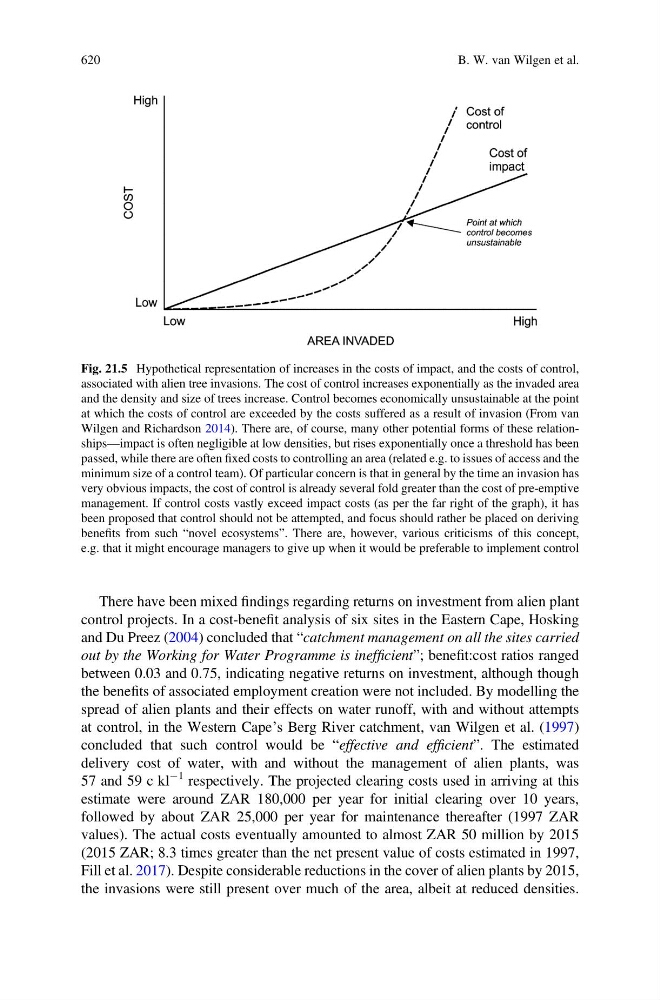
Fig. 21.5 Hypothetical representation of increases in the costs of impact, and the costs of control,
associated with alien tree invasions. The cost of control increases exponentially as the invaded area
and the density and size of trees increase. Control becomes economically unsustainable at the point
at which the costs of control are exceeded by the costs suffered as a result of invasion (From van
Wilgen and Richardson 2014). There are, of course, many other potential forms of these relationships—impact is often negligible at low densities, but rises exponentially once a threshold has been
passed, while there are often fixed costs to controlling an area (related e.g. to issues of access and the
minimum size of a control team). Of particular concern is that in general by the time an invasion has
very obvious impacts, the cost of control is already several fold greater than the cost of pre-emptive
management. If control costs vastly exceed impact costs (as per the far right of the graph), it has
been proposed that control should not be attempted, and focus should rather be placed on deriving
benefits from such “novel ecosystems”. There are, however, various criticisms of this concept,
e.g. that it might encourage managers to give up when it would be preferable to implement control
620
B. W. van Wilgen et al.