

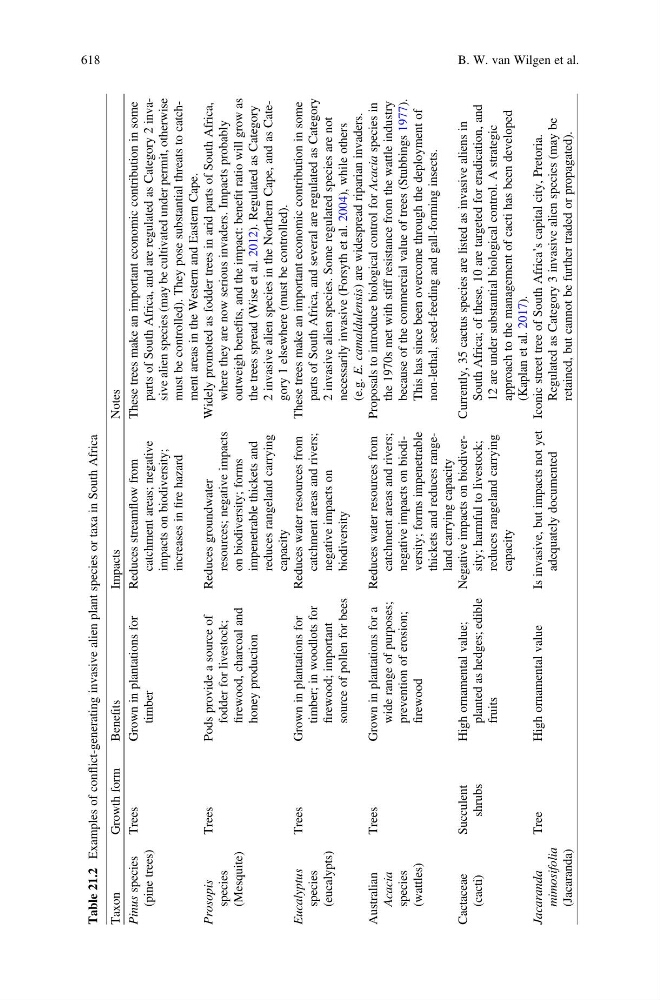
Table 21.2
Examples of conflict-generating invasive alien plant species or taxa in South Africa
Taxon
Growth form
Benefits
Impacts
Notes
Pinus
species
(pine trees)
Trees
Grown in plantations for
timber
Reduces streamflow from
catchment areas; negative
impacts on biodiversity;
increases in
fire hazard
These trees make an important economic contribution in some
parts of South Africa, and are regulated as Category 2 invasive alien species (may be cultivated under permit, otherwise
must be controlled). They pose substantial threats to catchment areas in the Western and Eastern Cape.
Prosopis
species
(Mesquite)
Trees
Pods provide a source of
fodder for livestock;
firewood, charcoal and
honey production
Reduces groundwater
resources; negative impacts
on biodiversity; forms
impenetrable thickets and
reduces rangeland carrying
capacity
Widely promoted as fodder trees in arid parts of South Africa,
where they are now serious invaders. Impacts probably
outweigh benefits, and the impact: benefit ratio will grow as
the trees spread (Wise et al. 2012). Regulated as Category
2 invasive alien species in the Northern Cape, and as Category 1 elsewhere (must be controlled).
Eucalyptus
species
(eucalypts)
Trees
Grown in plantations for
timber; in woodlots for
firewood; important
source of pollen for bees
Reduces water resources from
catchment areas and rivers;
negative impacts on
biodiversity
These trees make an important economic contribution in some
parts of South Africa, and several are regulated as Category
2 invasive alien species. Some regulated species are not
necessarily invasive (Forsyth et al. 2004), while others
(e.g. E. camaldulensis)
are widespread riparian invaders.
Australian
Acacia
species
(wattles)
Trees
Grown in plantations for a
wide range of purposes;
prevention of erosion;
firewood
Reduces water resources from
catchment areas and rivers;
negative impacts on biodiversity; forms impenetrable
thickets and reduces rangeland carrying capacity
Proposals to introduce biological control for Acacia
species in
the 1970s met with stiff resistance from the wattle industry
because of the commercial value of trees (Stubbings 1977).
This has since been overcome through the deployment of
non-lethal, seed-feeding and gall-forming insects.
Cactaceae
(cacti)
Succulent
shrubs
High ornamental value;
planted as hedges; edible
fruits
Negative impacts on biodiversity; harmful to livestock;
reduces rangeland carrying
capacity
Currently, 35 cactus species are listed as invasive aliens in
South Africa; of these, 10 are targeted for eradication, and
12 are under substantial biological control. A strategic
approach to the management of cacti has been developed
(Kaplan et al. 2017).
Jacaranda
mimosifolia
(Jacaranda)
Tree
High ornamental value
Is invasive, but impacts not yet
adequately documented
Iconic street tree of South Africa’s capital city, Pretoria.
Regulated as Category 3 invasive alien species (may be
retained, but cannot be further traded or propagated).
618
B. W. van Wilgen et al.