

or outputs (area treated), there was a lack of monitoring the ecological outcomes of
control operations.
21.7.5 Control of Chromolaena odorata in the HluhluweiMfolozi Park, KwaZulu-Natal
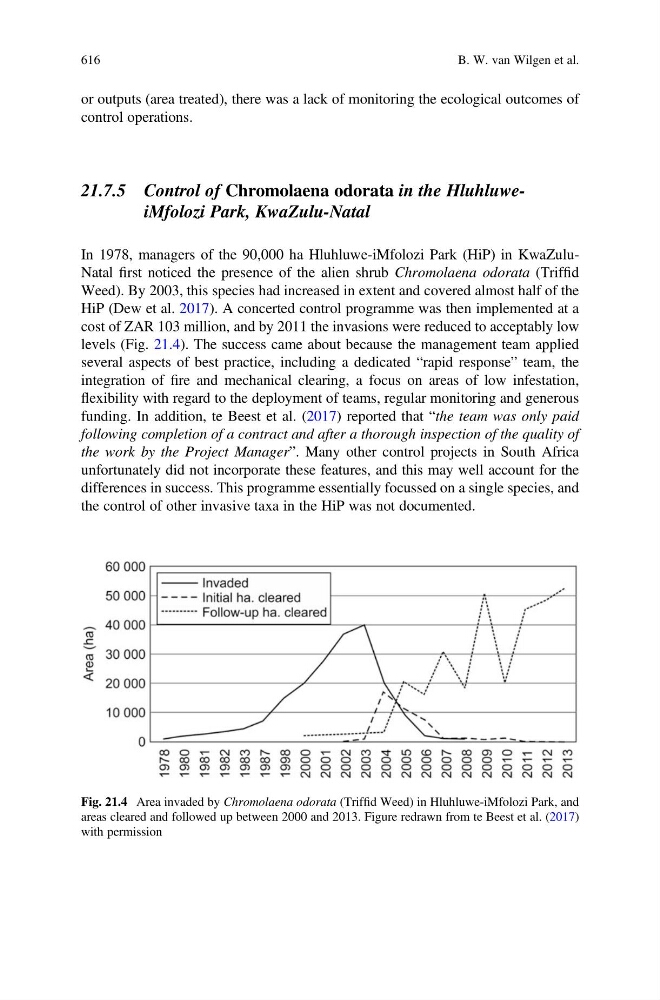
In 1978, managers of the 90,000 ha Hluhluwe-iMfolozi Park (HiP) in KwaZuluNatal first noticed the presence of the alien shrub Chromolaena odorata (Triffid
Weed). By 2003, this species had increased in extent and covered almost half of the
HiP (Dew et al. 2017). A concerted control programme was then implemented at a
cost of ZAR 103 million, and by 2011 the invasions were reduced to acceptably low
levels (Fig. 21.4). The success came about because the management team applied
several aspects of best practice, including a dedicated “rapid response” team, the
integration of fire and mechanical clearing, a focus on areas of low infestation,
flexibility with regard to the deployment of teams, regular monitoring and generous
funding. In addition, te Beest et al. (2017) reported that “the team was only paid
following completion of a contract and after a thorough inspection of the quality of
the work by the Project Manager”. Many other control projects in South Africa
unfortunately did not incorporate these features, and this may well account for the
differences in success. This programme essentially focussed on a single species, and
the control of other invasive taxa in the HiP was not documented.
Fig. 21.4 Area invaded by Chromolaena odorata (Triffid Weed) in Hluhluwe-iMfolozi Park, and
areas cleared and followed up between 2000 and 2013. Figure redrawn from te Beest et al. (2017)
with permission
616
B. W. van Wilgen et al.