

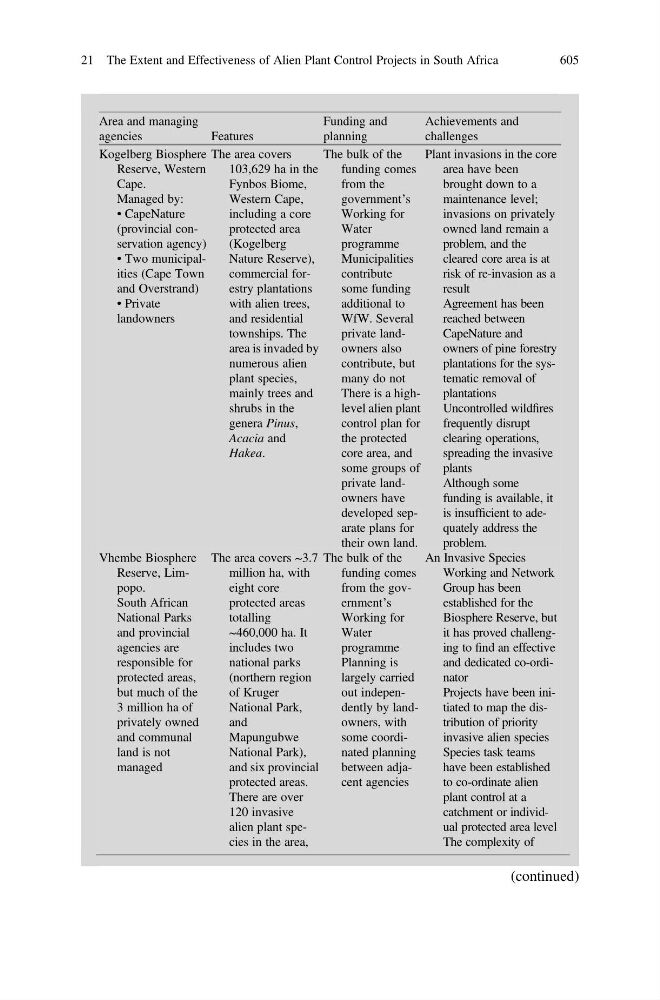
Area and managing
agencies
Features
Funding and
planning
Achievements and
challenges
Kogelberg Biosphere
Reserve, Western
Cape.
Managed by:
• CapeNature
(provincial conservation agency)
• Two municipalities (Cape Town
and Overstrand)
• Private
landowners
The area covers
103,629 ha in the
Fynbos Biome,
Western Cape,
including a core
protected area
(Kogelberg
Nature Reserve),
commercial forestry plantations
with alien trees,
and residential
townships. The
area is invaded by
numerous alien
plant species,
mainly trees and
shrubs in the
genera Pinus,
Acacia and
Hakea.
The bulk of the
funding comes
from the
government’s
Working for
Water
programme
Municipalities
contribute
some funding
additional to
WfW. Several
private landowners also
contribute, but
many do not
There is a highlevel alien plant
control plan for
the protected
core area, and
some groups of
private landowners have
developed separate plans for
their own land.
Plant invasions in the core
area have been
brought down to a
maintenance level;
invasions on privately
owned land remain a
problem, and the
cleared core area is at
risk of re-invasion as a
result
Agreement has been
reached between
CapeNature and
owners of pine forestry
plantations for the systematic removal of
plantations
Uncontrolled wildfires
frequently disrupt
clearing operations,
spreading the invasive
plants
Although some
funding is available, it
is insufficient to adequately address the
problem.
Vhembe Biosphere
Reserve, Limpopo.
South African
National Parks
and provincial
agencies are
responsible for
protected areas,
but much of the
3 million ha of
privately owned
and communal
land is not
managed
The area covers ~3.7
million ha, with
eight core
protected areas
totalling
~460,000 ha. It
includes two
national parks
(northern region
of Kruger
National Park,
and
Mapungubwe
National Park),
and six provincial
protected areas.
There are over
120 invasive
alien plant species in the area,
The bulk of the
funding comes
from the government’s
Working for
Water
programme
Planning is
largely carried
out independently by landowners, with
some coordinated planning
between adjacent agencies
An Invasive Species
Working and Network
Group has been
established for the
Biosphere Reserve, but
it has proved challenging to find an effective
and dedicated co-ordinator
Projects have been initiated to map the distribution of priority
invasive alien species
Species task teams
have been established
to co-ordinate alien
plant control at a
catchment or individual protected area level
The complexity of
(continued)
21 The Extent and Effectiveness of Alien Plant Control Projects in South Africa
605