

20.1 Risk Analysis for Biological Invasions
Frameworks for the management and regulation of alien species and associated
processes have been developed all over the world to deal with undesirable consequences and to mitigate future impacts of species introduced outside of their native
ranges. Risk analysis is a formal, evidence-based process to analyse the risk of a
particular hazard to a certain area or situation. A hazard can be an event or
phenomenon, like the increase of temperature globally or the pollution of a river
with chemicals. A hazard can also be more specific, like the introduction of an alien
species to a new area. This chapter reviews what has been done in South Africa in the
context of international best practice, and outlines a proposed way forward.
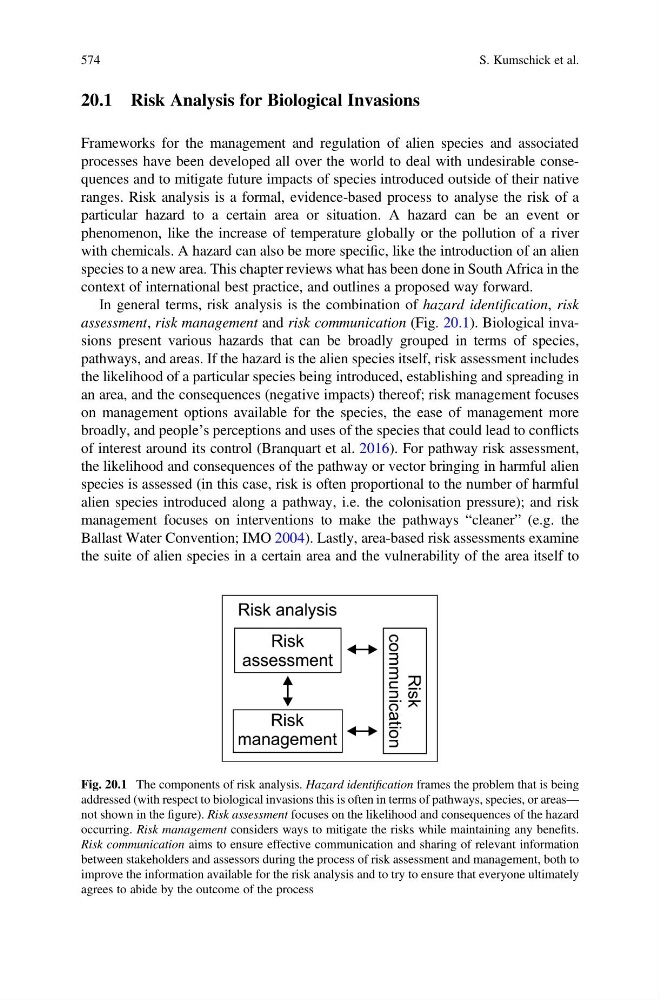
In general terms, risk analysis is the combination of hazard identification, risk
assessment, risk management and risk communication (Fig. 20.1). Biological invasions present various hazards that can be broadly grouped in terms of species,
pathways, and areas. If the hazard is the alien species itself, risk assessment includes
the likelihood of a particular species being introduced, establishing and spreading in
an area, and the consequences (negative impacts) thereof; risk management focuses
on management options available for the species, the ease of management more
broadly, and people’s perceptions and uses of the species that could lead to conflicts
of interest around its control (Branquart et al. 2016). For pathway risk assessment,
the likelihood and consequences of the pathway or vector bringing in harmful alien
species is assessed (in this case, risk is often proportional to the number of harmful
alien species introduced along a pathway, i.e. the colonisation pressure); and risk
management focuses on interventions to make the pathways “cleaner” (e.g. the
Ballast Water Convention; IMO 2004). Lastly, area-based risk assessments examine
the suite of alien species in a certain area and the vulnerability of the area itself to
Fig. 20.1 The components of risk analysis. Hazard identification frames the problem that is being
addressed (with respect to biological invasions this is often in terms of pathways, species, or areas—
not shown in the figure). Risk assessment focuses on the likelihood and consequences of the hazard
occurring. Risk management considers ways to mitigate the risks while maintaining any benefits.
Risk communication aims to ensure effective communication and sharing of relevant information
between stakeholders and assessors during the process of risk assessment and management, both to
improve the information available for the risk analysis and to try to ensure that everyone ultimately
agrees to abide by the outcome of the process
574
S. Kumschick et al.