

five terrestrial biomes (Savanna, Fynbos, Grasslands, Succulent Karoo and Nama
Karoo) in South Africa. With the exception of the fynbos, the current invasions had
no measurable impact on biodiversity intactness (an estimate of impact of land-use
changes on populations of various taxa such as plants, mammals, birds, reptiles and
amphibians in a particular area, see Scholes and Biggs 2005) at a landscape scale. While
the current impacts of alien plants were relatively low, the future impacts were predicted
to be very high. In addition, while the errors in these estimates are likely to be
substantial, the predicted impacts were sufficiently large to suggest that there is cause
for serious concern. De Lange and van Wilgen (2010) used the above estimates of
intactness to estimate the economic value of ecosystem services based on biodiversity.
It was estimated that the reduction in value of selected ecosystem services due to
invasive alien plants was the highest for fynbos, but still substantial for others like
savanna, thicket, grassland, succulent karoo and Nama karoo. Overall, terrestrial
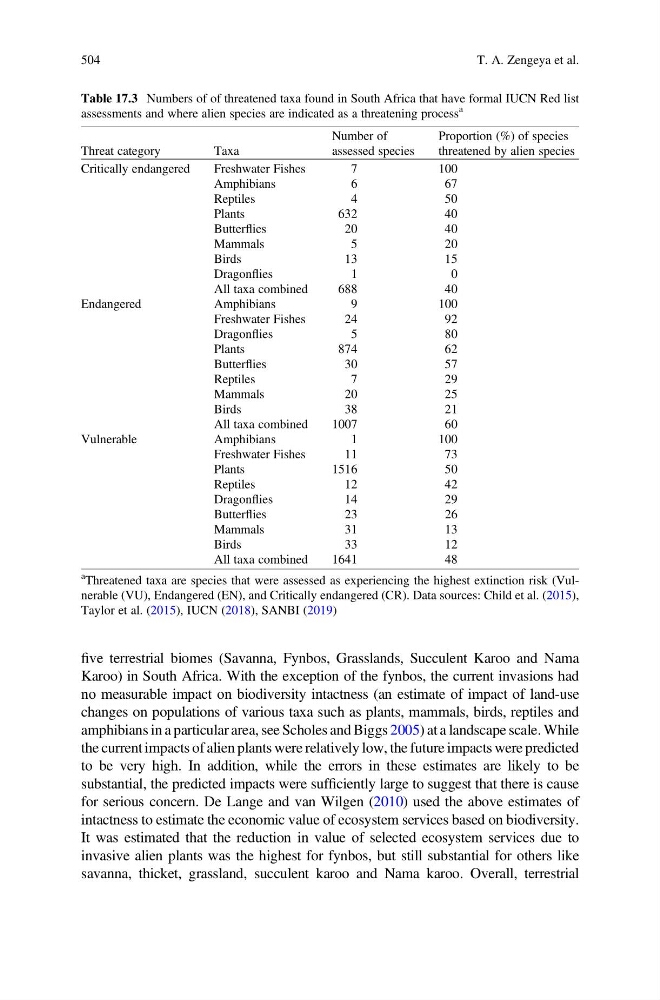
Table 17.3 Numbers of of threatened taxa found in South Africa that have formal IUCN Red list
assessments and where alien species are indicated as a threatening process
a
Threat category
Taxa
Number of
assessed species
Proportion (%) of species
threatened by alien species
Critically endangered
Freshwater Fishes
7
100
Amphibians
6
67
Reptiles
4
50
Plants
632
40
Butterflies
20
40
Mammals
5
20
Birds
13
15
Dragonflies
1
0
All taxa combined
688
40
Endangered
Amphibians
9
100
Freshwater Fishes
24
92
Dragonflies
5
80
Plants
874
62
Butterflies
30
57
Reptiles
7
29
Mammals
20
25
Birds
38
21
All taxa combined
1007
60
Vulnerable
Amphibians
1
100
Freshwater Fishes
11
73
Plants
1516
50
Reptiles
12
42
Dragonflies
14
29
Butterflies
23
26
Mammals
31
13
Birds
33
12
All taxa combined
1641
48
a Threatened taxa are species that were assessed as experiencing the highest extinction risk (Vulnerable (VU), Endangered (EN), and Critically endangered (CR). Data sources: Child et al. (2015),
Taylor et al. (2015), IUCN (2018), SANBI (2019)
504
T. A. Zengeya et al.