

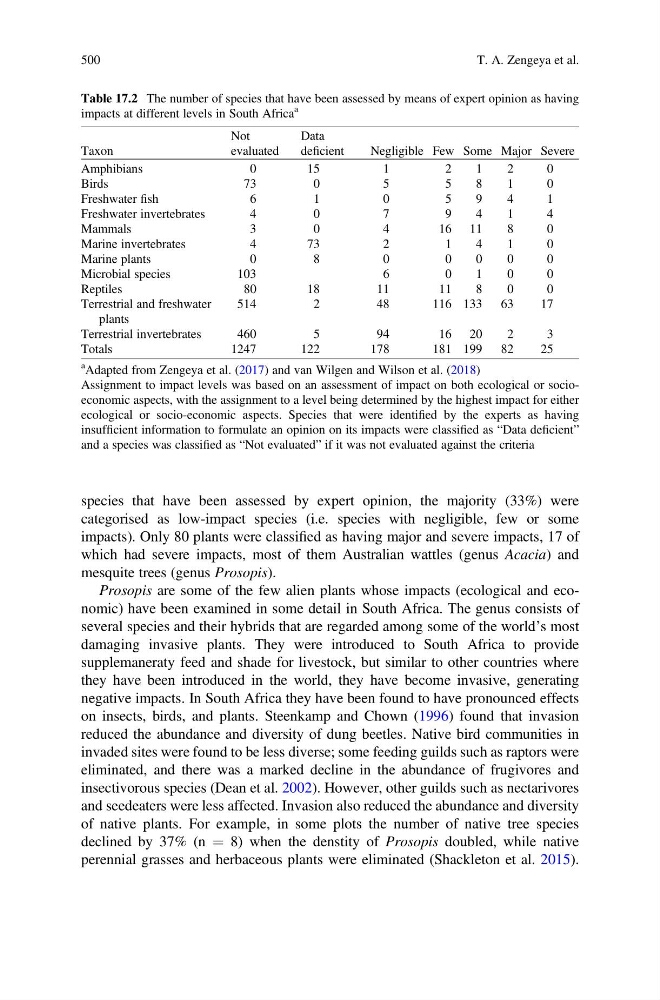
species that have been assessed by expert opinion, the majority (33%) were
categorised as low-impact species (i.e. species with negligible, few or some
impacts). Only 80 plants were classified as having major and severe impacts, 17 of
which had severe impacts, most of them Australian wattles (genus Acacia) and
mesquite trees (genus Prosopis).
Prosopis are some of the few alien plants whose impacts (ecological and economic) have been examined in some detail in South Africa. The genus consists of
several species and their hybrids that are regarded among some of the world’s most
damaging invasive plants. They were introduced to South Africa to provide
supplemaneraty feed and shade for livestock, but similar to other countries where
they have been introduced in the world, they have become invasive, generating
negative impacts. In South Africa they have been found to have pronounced effects
on insects, birds, and plants. Steenkamp and Chown (1996) found that invasion
reduced the abundance and diversity of dung beetles. Native bird communities in
invaded sites were found to be less diverse; some feeding guilds such as raptors were
eliminated, and there was a marked decline in the abundance of frugivores and
insectivorous species (Dean et al. 2002). However, other guilds such as nectarivores
and seedeaters were less affected. Invasion also reduced the abundance and diversity
of native plants. For example, in some plots the number of native tree species
declined by 37% (n ¼ 8) when the denstity of Prosopis doubled, while native
perennial grasses and herbaceous plants were eliminated (Shackleton et al. 2015).
Table 17.2 The number of species that have been assessed by means of expert opinion as having
impacts at different levels in South Africa
a
Taxon
Not
evaluated
Data
deficient
Negligible Few Some Major Severe
Amphibians
0
15
1
2
1
2
0
Birds
73
0
5
5
8
1
0
Freshwater fish
6
1
0
5
9
4
1
Freshwater invertebrates
4
0
7
9
4
1
4
Mammals
3
0
4
16 11
8
0
Marine invertebrates
4
73
2
1
4
1
0
Marine plants
0
8
0
0
0
0
0
Microbial species
103
6
0
1
0
0
Reptiles
80
18
11
11
8
0
0
Terrestrial and freshwater
plants
514
2
48
116 133 63
17
Terrestrial invertebrates
460
5
94
16 20
2
3
Totals
1247
122
178
181 199 82
25
a Adapted from Zengeya et al. (2017) and van Wilgen and Wilson et al. (2018)
Assignment to impact levels was based on an assessment of impact on both ecological or socioeconomic aspects, with the assignment to a level being determined by the highest impact for either
ecological or socio-economic aspects. Species that were identified by the experts as having
insufficient information to formulate an opinion on its impacts were classified as “Data deficient”
and a species was classified as “Not evaluated” if it was not evaluated against the criteria
500
T. A. Zengeya et al.